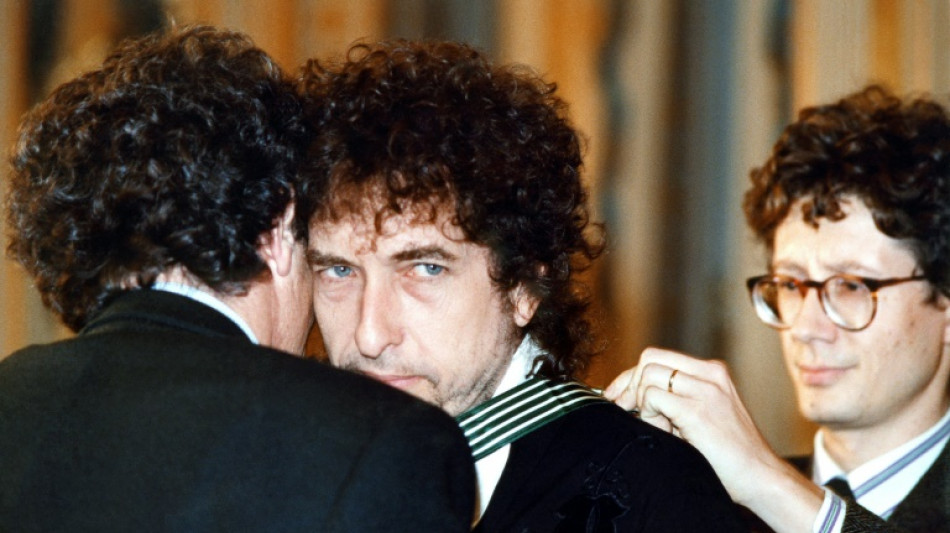
Song lyrics are getting simpler, more repetitive: study / Photo: - - AFP/File
 Fast-fashion giant Shein plunges 10% on Hong Kong debut

 South Korea hire former Spain boss Moreno as interim coach

 China-Taiwan friction clouds Pacific summit

 Two dead after stabbing in New York's Times Square

 Anthropic signs $35B computing deal with startup backed by Nvidia

 Drones in Ithaca: Azov's Odyssey turns Ukraine war into modern myth

 Boat builders keep Pakistan's fishing heritage afloat

 Australia axe Labuschagne for Zimbabwe, South Africa ODI series

 Heavy rain at Grand Canyon after flood kills 2, dozen missing

 Kushner blames soccer power struggle for World Cup plan collapse

 Buoyant Alcaraz shakes off nerves to advance at US Open

 US draws European pushback with Russia G20 finance invite

 Jury begins deliberations in Tupac Shakur murder trial

 US Supreme Court allows Trump ballroom project to proceed

 Trump says US reviewing position on Falkland Islands

 Saka strikes as flawless Arsenal punish troubled Villa

 Oil prices surge on renewed fighting in US-Iran war

 Cycling superstar Pogacar has surgery after Vuelta crash

 Man City agree deal for Everton's Ndiaye

 Apple CEO Tim Cook gives nod to founder Steve Jobs in final memo

 Russian finance minister makes unexpected appearance at G20

 Happy to be back in NY, Sabalenka advances

 Naomi Watts to receive lifetime award at top Spain film fest

 Jury hears closing arguments in Tupac Shakur murder trial

 Pakistan sack coach, send seven players home after England defeats

You're not just getting older. Song lyrics really are becoming simpler and more repetitive, according to a study published on Thursday.
Lyrics have also become angrier and more self-obsessed over the last 40 years, the study found, reinforcing the opinions of cranky ageing music fans everywhere.
A team of European researchers analysed the words in more than 12,000 English-language songs across the genres of rap, country, pop, R&B and rock from 1980 to 2020.
Before detailing how lyrics have become more basic, the study pointed out that US singer-songwriting legend Bob Dylan -- who rose to fame in the 1960s -- has won a Nobel Prize in literature.
Senior study author Eva Zangerle, an expert on recommendation systems at Austria's University of Innsbruck, declined to single out an individual newer artist for having simple lyrics.
But she emphasised that lyrics can be a "mirror of society" which reflect how a culture's values, emotions and preoccupations change over time.
"What we have also been witnessing in the last 40 years is a drastic change in the music landscape -- from how music is sold to how music is produced," Zangerle told AFP.
Over the 40 years studied, there was repeated upheaval in how people listened to music. The vinyl records and cassette tapes of the 1980s gave way to the CDs of the 90s, then the arrival of the internet led to the algorithm-driven streaming platforms of today.
For the study in the journal Scientific Reports, the researchers looked at the emotions expressed in lyrics, how many different and complicated words were used, and how often they were repeated.
"Across all genres, lyrics had a tendency to become more simple and more repetitive," Zangerle summarised.
The results also confirmed previous research which had shown a decrease in positive, joyful lyrics over time and a rise in those that express anger, disgust or sadness.
Lyrics have also become much more self-obsessed, with words such as "me" or "mine" becoming much more popular.
- 'Easier to memorise' -
The number of repeated lines rose most in rap over the decades, Zangerle said -- adding that it obviously had the most lines to begin with.
"Rap music has become more angry than the other genres," she added.
The researchers also investigated which songs the fans of different genres looked up on the lyric website Genius.
Unlike other genres, rock fans most often looked up lyrics from older songs, rather than new ones.
Rock has tumbled down the charts in recent decades, and this could suggest fans are increasingly looking back to the genre's heyday, rather than its present.
Another way that music has changed is that "the first 10-15 seconds are highly decisive for whether we skip the song or not," Zangerle said.
Previous research has also suggested that people tend to listen to music more in the background these days, she added.
Put simply, songs with more choruses that repeat basic lyrics appear to be more popular.
"Lyrics should stick easier nowadays, simply because they are easier to memorise," Zangerle said.
"This is also something that I experience when I listen to the radio."
T.Ward--AMWN