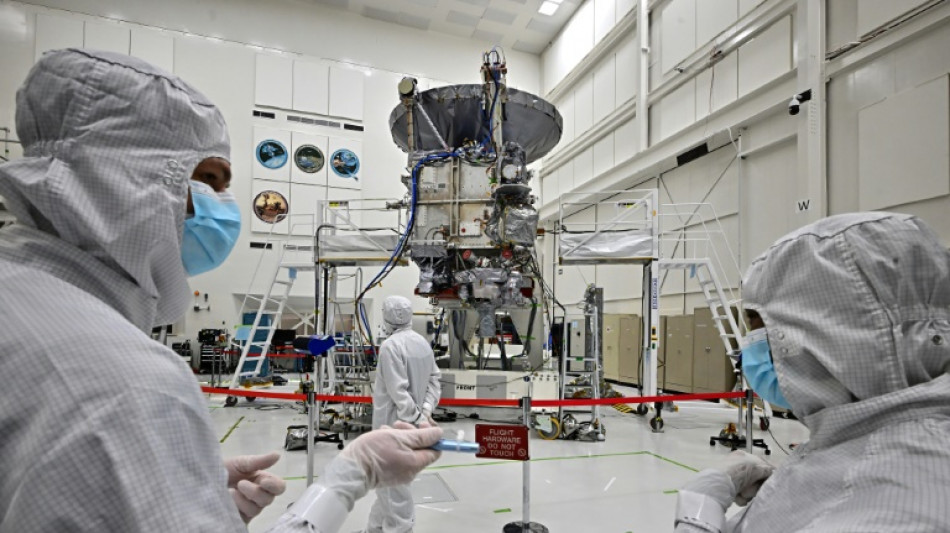
NASA unveils probe bound for Jupiter's possibly life-sustaining moon / Photo: Frederic J. Brown - AFP
 Fast-fashion giant Shein plunges 10% on Hong Kong debut

 South Korea hire former Spain boss Moreno as interim coach

 China-Taiwan friction clouds Pacific summit

 Two dead after stabbing in New York's Times Square

 Anthropic signs $35B computing deal with startup backed by Nvidia

 Drones in Ithaca: Azov's Odyssey turns Ukraine war into modern myth

 Boat builders keep Pakistan's fishing heritage afloat

 Australia axe Labuschagne for Zimbabwe, South Africa ODI series

 Heavy rain at Grand Canyon after flood kills 2, dozen missing

 Kushner blames soccer power struggle for World Cup plan collapse

 Buoyant Alcaraz shakes off nerves to advance at US Open

 US draws European pushback with Russia G20 finance invite

 Jury begins deliberations in Tupac Shakur murder trial

 US Supreme Court allows Trump ballroom project to proceed

 Trump says US reviewing position on Falkland Islands

 Saka strikes as flawless Arsenal punish troubled Villa

 Oil prices surge on renewed fighting in US-Iran war

 Cycling superstar Pogacar has surgery after Vuelta crash

 Man City agree deal for Everton's Ndiaye

 Apple CEO Tim Cook gives nod to founder Steve Jobs in final memo

 Russian finance minister makes unexpected appearance at G20

 Happy to be back in NY, Sabalenka advances

 Naomi Watts to receive lifetime award at top Spain film fest

 Jury hears closing arguments in Tupac Shakur murder trial

 Pakistan sack coach, send seven players home after England defeats

US space scientists on Thursday unveiled the interplanetary probe NASA plans to send to one of Jupiter's icy moons as part of humanity's hunt for extra-terrestrial life.
The Clipper spacecraft is due to blast off in October bound for Europa, one of dozens of moons orbiting the Solar System's biggest planet, and the nearest spot in our celestial neighborhood that could offer a perch for life.
"One of the fundamental questions that NASA wants to understand is, are we alone in the cosmos?" Bob Pappalardo, the mission's project scientist told AFP.
"If we were to find the conditions for life, and then someday actually find life in a place like Europa, then that would say in our own solar system there are two examples of life: Earth and Europa.
"That would be huge for understanding how common life might be throughout the universe."
The $5 billion probe is currently at NASA's Jet Propulsion Laboratory in California, sitting in a "clean room" -- a sealed area only accessible to people wearing head-to-toe covering.
The precautions are to ensure the probe remains free of contaminants to avoid transporting Earthly microbes to Europa.
After transport to Kennedy Space Center in Florida, Clipper is set to launch aboard a Space X Falcon Heavy rocket and begin an over-five-year journey that involves a pass by Mars to pick up speed.
In 2031, it should be in orbit around Jupiter and Europa, where it will begin a detailed study of the moon scientists believe is covered in frozen water.
"We have instruments like cameras, and spectrometers, a magnetometer and a radar that can... penetrate right through ice, bounce off liquid water and back to the surface to tell us how thick is the ice and where is liquid water located," Pappalardo said.
Mission managers do not expect to find little green men swimming in the water -- in fact, they're not even looking for life itself, only for the conditions that could support it.
Scientists know from extreme environments on Earth -- like light-starved geothermal vents located deep under the polar ice cap -- that tiny beings can find purchase almost anywhere.
And conditions on Europa, which is almost as large as Earth's moon, could provide a similar habitat, offering the tantalizing prospect we are not alone -- not even in our own Solar System.
"If moons around planets far away from stars could hold life, then the number of opportunities around the solar system, around the universe, where life could take hold, I think goes up dramatically," said Jordan Evans, project manager for the Europa Clipper mission.
- Challenges -
The science is not easy -- a powerful radiation field around Europa could degrade the instruments, which will be getting the equivalent of 100,000 chest x-rays every circuit around the moon.
The vast distances involved mean that when Clipper sends its data back, the signal will take 45 minutes to arrive at Mission Control.
And despite its massive solar array, which unfurls once in space, keeping Clipper powered will be a major challenge, Evans said.
"Right after launch, (the solar panels are) putting out 23,000 watts... but when we're out at Jupiter, so far away from the Sun, they're only putting out 700 watts," he said.
"Near Earth, they could power 20 houses continuously. And when we're at Jupiter, just a few light bulbs and some small appliances."
The mission, planning for which began in the late 1990s, is expected to conclude around 2034, when Clipper will likely have reached the end of its useful life.
The probe will then have one final port of call: Jupiter's largest moon, deputy project manager Tim Larson said.
"After we're done with the science mission, the way we end is by crashing into one of the other bodies in the Jovian system to dispose of the spacecraft," he said.
"Right now, the plan is to go into Ganymede."
J.Oliveira--AMWN