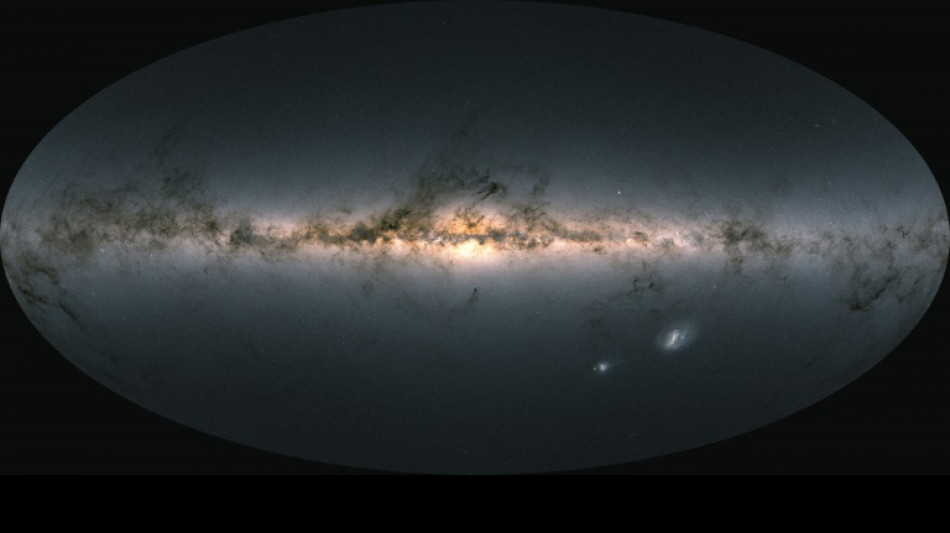
Astronomers discover largest black hole in Milky Way: study / Photo: Handout - EUROPEAN SPACE AGENCY/AFP
 Brussels Education Unions Schedule Major November Protest Over Funding and Reforms

 iPS Cell Research Accelerates Drug Discovery for ALS and Spinal Cord Injury

 Rene Eyre Revisits Autobiographical Performance 'Say A Little Prayer' in London

 UAE's HCT Holds Record Graduation and Announces Major Training Expansion

 NASA Awards $10B Lunar Contract Framework to SpaceX, Blue Origin

 Katy Perry Tells Fans Ex-Husband Russell Brand 'Should Be in Jail' During UK Concert

Astronomers identified the largest stellar black hole yet discovered in the Milky Way, with a mass 33 times that of the Sun, according to a study published on Tuesday.
The black hole, named Gaia BH3, was discovered "by chance" from data collected by the European Space Agency's Gaia mission, an astronomer from the National Centre for Scientific Research (CNRS) at the Observatoire de Paris, Pasquale Panuzzo, told AFP.
Gaia, which is dedicated to mapping the Milky Way galaxy, located BH3 2,000 light years away from Earth in the Aquila constellation.
As Gaia's telescope can give a precise position of stars in the sky, astronomers were able to characterise their orbits and measure the mass of the star's invisible companion -- 33 times that of the Sun.
Further observations from on-the-ground telescopes confirmed that it was a black hole with a mass far greater than the stellar black holes already in the Milky Way.
"No one was expecting to find a high-mass black hole lurking nearby, undetected so far. This is the kind of discovery you make once in your research life," Panuzzo said in a press release.
The stellar black hole was discovered when scientists spotted a "wobbling" motion on the companion star that was orbiting it.
"We could see a star a little smaller than the Sun (around 75 percent of its mass) and brighter, that revolved around an invisible companion," Panuzzo said.
Stellar black holes are created from the collapse of massive stars at the end of their lives and are smaller than supermassive black holes whose creation is still unknown.
Such giants have already been detected in distant galaxies via gravitational waves.
But "never in ours", said Panuzzo.
BH3 is a "dormant" black hole and is too far away from its companion star to strip it of its matter and therefore emits no X-rays -- making it difficult to detect.
Gaia's telescope identified the first two inactive black holes (Gaia BH1 and Gaia BH2) in the Milky Way.
Gaia has been operating 1.5 million kilometres from Earth for the past 10 years and in 2022 delivered a 3D map of the positions and motions of more than 1.8 billion stars.
D.Sawyer--AMWN

