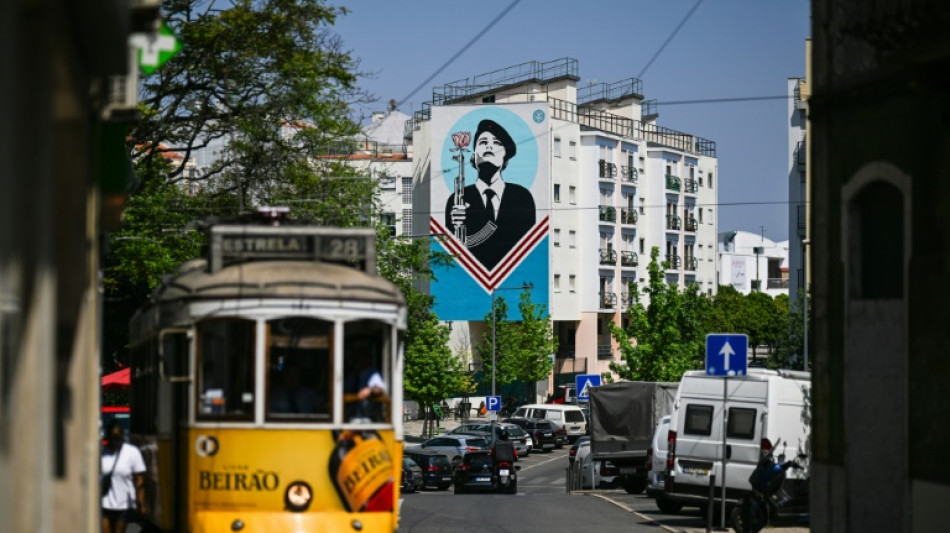
Portugal marks 50 years of democracy with far right on rise / Photo: PATRICIA DE MELO MOREIRA - AFP
 'Massive' Russian missile, drone attack on Kyiv kills 8
 Defence tech hub Munich booms as Europe rearms
 Nigeria rethinks criminalisation of suicide
 Osaka channels NBA icon Iverson to reach US Open second round

 Fast-fashion giant Shein plunges 10% on Hong Kong debut
 South Korea hire former Spain boss Moreno as interim coach
 China-Taiwan friction clouds Pacific summit

 Two dead after stabbing in New York's Times Square

 Anthropic signs $35B computing deal with startup backed by Nvidia
 Drones in Ithaca: Azov's Odyssey turns Ukraine war into modern myth
 Boat builders keep Pakistan's fishing heritage afloat

 Australia axe Labuschagne for Zimbabwe, South Africa ODI series

 Heavy rain at Grand Canyon after flood kills 2, dozen missing

 Kushner blames soccer power struggle for World Cup plan collapse

 Buoyant Alcaraz shakes off nerves to advance at US Open

 US draws European pushback with Russia G20 finance invite

 Jury begins deliberations in Tupac Shakur murder trial

 US Supreme Court allows Trump ballroom project to proceed

 Trump says US reviewing position on Falkland Islands

 Saka strikes as flawless Arsenal punish troubled Villa
 Oil prices surge on renewed fighting in US-Iran war

 Cycling superstar Pogacar has surgery after Vuelta crash
 Man City agree deal for Everton's Ndiaye

 Apple CEO Tim Cook gives nod to founder Steve Jobs in final memo

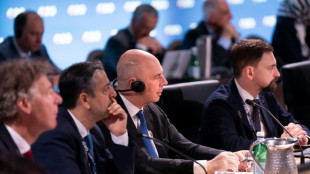 Russian finance minister makes unexpected appearance at G20

Portugal marks Thursday 50 years since a military coup ended a decades-long dictatorship and 13 years of colonial wars in Africa, an anniversary that comes as a far-right party gains prominence.
The anniversary of the Carnation Revolution -- named after the flowers protesters placed in soldiers' guns during the peaceful uprising -- comes a month after the far-right party Chega more than quadrupled its seats in parliament, cementing its position as Portugal's third-largest party.
The highlight of the celebrations will be a military parade through central Lisbon featuring some of the roughly 5,000 soldiers who were part of the putsch, as well as around 15 restored military vehicles used on the day.
On April 25, 1974, the oldest authoritarian regime in Western Europe at the time fell within a matter of hours, virtually without bloodshed, thanks to an uprising by non-commissioned officers that was immediately backed by the public.
The coup paved the way for the country's first free elections based on universal suffrage on April 25, 1975, as well as the independence of Portugal's remaining African colonies: Angola, Mozambique, Guinea-Bissau and Cape Verde.
"The main motivation was to resolve the problem of the colonial wars" that had been going on for 13 years in Angola, and almost as long in Mozambique and Guinea-Bissau, said retired colonel Vasco Lourenco.
Lourenco, one of the officers who took part in the coup, now heads the April 25 Association that represents putschist soldiers.
As a young officer, he said it took almost a year to put together the "conspiracy" to carry out "a coup d'etat aimed at opening the way to freedom, putting an end to the wars and building democracy in Portugal", he told AFP.
As it does every year, parliament will hold a special commemorative session and there will be a parade. And this year the heads of African states that were once Portuguese colonies will join the celebrations.
- 'Poor, backward, illiterate' -
Portugal's dictatorship years began in 1926, consolidated under prime minister Antonio de Oliveira Salazar and continued from 1968 by his successor Marcelo Caetano.
Many Portuguese believed the country's authoritarian past would offer it some protection from the rise of the far right, which has been seen elsewhere in Europe, but the breakthrough by Chega in a general election last month has dampened this view.
While its founder and leader Andre Ventura has criticised the dictatorship years, Chega ("Enough") has used the slogan "God, Homeland, Family, Work" -- an echo of the Salazar dictatorship's "God, Homeland, Family".
Set up in 2019, Chega promises greater law and order, tougher immigration measures and chemical castration for paedophiles.
It is the first hard-right party to gain ground on Portugal's political scene since the end of the dictatorship.
"I thought that 48 years of dictatorship would have made the country immune to this wave of populism and radical far-right movements, but the reality turned out to be different," said Maria Inacia Rezola, a historian who is overseeing the anniversary celebrations.
During the dictatorship Portugal remained "a poor, backward, illiterate country isolated from the rest of the world", Rezola said.
Despite the fact that the Carnation Revolution still appears widely appreciated, a sizable part of the population express a certain nostalgia for the previous regime.
A survey published last week found that half of respondents said the former regime had more negative aspects than positive -- but a fifth said the opposite.
F.Schneider--AMWN