Humanity in 'race against time' on AI: UN / Photo: Fabrice COFFRINI - AFP
 Man City chase Fernandez, Arsenal eye Alvarez on deadline day

 El Nino hammering Peru anchovy fishing: industry officials
 Mass Russian barrage kills 12 in Kyiv

 PineX Capital Launches MetaTrader 5 as Prop Firm Expands Trading Platform Offering

 Women survivors face sanitation woes in Nepal relief camp

 Oil extends gains, stocks mixed as Trump issues fresh Iran warning

 Thai resort readies for US carrier's 5,000 sailors

 AI startup Manus says resumes independent operations

 'Massive' Russian missile, drone attack on Kyiv kills 8

 Defence tech hub Munich booms as Europe rearms

 Nigeria rethinks criminalisation of suicide

 Osaka channels NBA icon Iverson to reach US Open second round

 Fast-fashion giant Shein plunges 10% on Hong Kong debut

 South Korea hire former Spain boss Moreno as interim coach

 China-Taiwan friction clouds Pacific summit
 Two dead after stabbing in New York's Times Square

 Anthropic signs $35B computing deal with startup backed by Nvidia

 Drones in Ithaca: Azov's Odyssey turns Ukraine war into modern myth
 Boat builders keep Pakistan's fishing heritage afloat

 Australia axe Labuschagne for Zimbabwe, South Africa ODI series

 CRI Merges In Morrison & Smith, Expanding Alabama Footprint

 Connecting Excellence Group PLC Announces Treasury up By 10 BTC to 72.941 & £655,999 Raised

 InterContinental Hotels Group PLC Announces Transaction in Own Shares - September 01

 Heavy rain at Grand Canyon after flood kills 2, dozen missing

 Kushner blames soccer power struggle for World Cup plan collapse

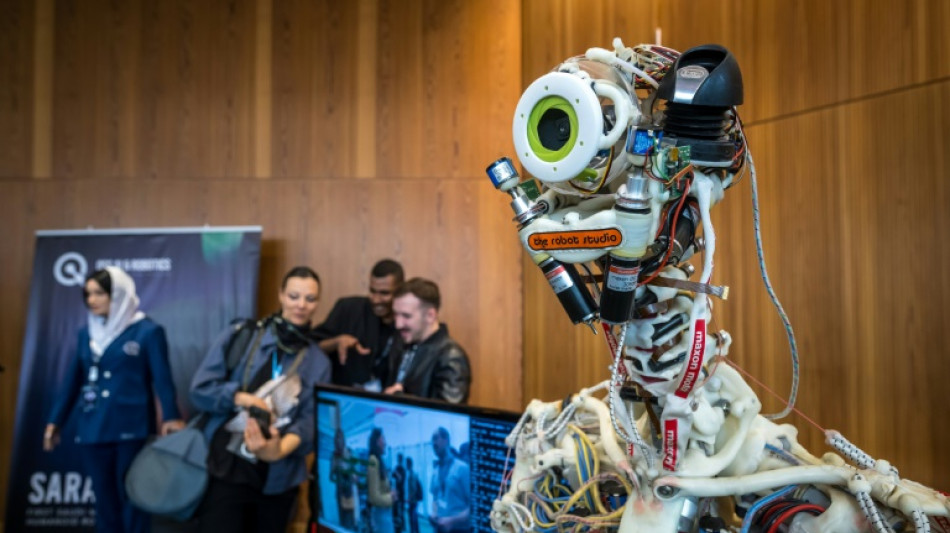
Humanity is in a race against time to harness the colossal emerging power of artificial intelligence for the good of all, while averting dire risks, a top UN official said Thursday.
"We've let the genie out of the bottle," said Doreen Bogdan-Martin, head of the United Nations' International Telecommunications Union (ITU).
"We are in a race against time," she told the opening of a two-day AI for Good Global Summit in Geneva.
"Recent developments in AI have been nothing short of extraordinary."
The thousands gathered at the conference heard how advances in generative AI are already speeding up efforts to solve some of the world's most pressing problems, such as climate change, hunger and social care.
"I believe we have a once-in-a-generation opportunity to guide AI to benefit all the world's people," Bogdan-Martin told AFP ahead of the summit.
But she lamented Thursday that one-third of humanity still remains completely offline, and is "excluded from the AI revolution without a voice".
"This digital and technological divide is no longer acceptable."
Bogdan-Martin highlighted that AI holds "immense potential for both good and bad", stressing that it was vital to "make AI systems safe".
- Concentrated power -
She said that was especially important given that "2024 is the biggest election year in history", with votes in dozens of countries, including in the United States.
She flagged the "rise of sophisticated deep fakes disinformation campaigns" and warned that the "misuse of AI threaten democracy (and) also endangers young people's mental health and compromises cyber-security."
Other experts at Thursday's conference agreed.
"We have to understand what we're steering towards," said Tristan Harris, a technology ethicist who co-founded the Center for Humane Technology.
He pointed to lessons from social media -- initially touted as a way to connect people and give everyone a voice, but which also brought addiction, viral misinformation, online harassment and ballooning mental health issues.
Harris warned the incentive driving the companies rolling out the technology risked dramatically swelling such negative impacts.
"The number one thing that is driving Open AI or Google behaviour is the race to actually achieve market dominance," he said.
In such a world, he said, "governance that moves at the speed of technology" is vital.
- Changing the social contract -
OpenAI chief Sam Altman, who rose to global prominence after OpenAI released ChatGPT in 2022, acknowledged the dangers.
Speaking via video-link, he told the gathering that "cyber-security" was currently the biggest concern when it came to negative impacts of the technology.
Further down the road, he said there would likely "be some change required to the social contract, given how powerful we expect this technology to be".
"I'm not a believer that there won't be any jobs... but I do think the whole structure of society itself will be (open to) some degree of debate and reconfiguration."
Overall though, he insisted that from the perspective of how new technologies evolve historically, the AI systems were "generally considered safe and robust".
While welcoming discussions around regulations to stem short-term negative impacts of AI, he warned that it was "difficult" to suggest regulations aimed at reining in future impacts.
"We don't know how society and this technology are going to co-evolve," he said.
Bogdan-Martin meanwhile hailed that governments and others had recently "raced to establish protections" and regulation around the use of AI.
On Wednesday the European Union announced the creation of an AI Office to regulate artificial intelligence under a sweeping new law.
"It's our responsibility to write the next chapter in the great story of humanity, and technology, and to make it safe, to make it inclusive and to make it sustainable," Bogdan-Martin said.
M.Fischer--AMWN