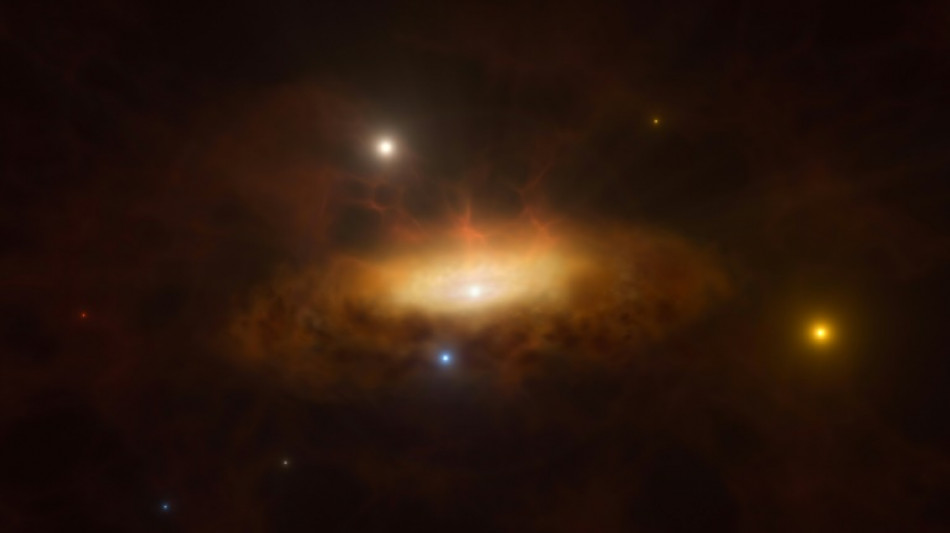
Black hole observed 'awakening' for the first time / Photo: ESO/M. Kornmesser - European Southern Observatory/AFP
 Brussels Education Unions Schedule Major November Protest Over Funding and Reforms

 iPS Cell Research Accelerates Drug Discovery for ALS and Spinal Cord Injury

 Rene Eyre Revisits Autobiographical Performance 'Say A Little Prayer' in London

 UAE's HCT Holds Record Graduation and Announces Major Training Expansion

 NASA Awards $10B Lunar Contract Framework to SpaceX, Blue Origin

 Katy Perry Tells Fans Ex-Husband Russell Brand 'Should Be in Jail' During UK Concert

Astronomers have been able to observe a supermassive black hole waking up and setting the heart of its host galaxy alight for the first time, the European Southern Observatory said on Tuesday.
The galaxy 300 million light years from Earth in the Virgo constellation had been quiet for decades until late 2019, when it suddenly began to shine brighter than ever before.
The centre of the galaxy -- where a supermassive black hole is believed to be squatting -- since then has been radiating a variety of rays.
"This behaviour is unprecedented," Paula Sanchez Saez, an European Southern Observatory astronomer and first author of a new study in the journal Astronomy & Astrophysics, said in a statement.
The "most tangible option" to explain this brightening is that the astronomers were watching "the activation of a massive black hole in real time", study co-author Lorena Hernandez Garcia said.
Most galaxies -- including our own Milky Way -- are believed to have a supermassive black hole at their centre.
These cosmic behemoths are by definition invisible -- not even light can escape the pull of their awesome power.
The only way to observe black holes is when they destroy something huge that lets off light in its death throes: such as a star that wandered too close being torn apart.
"These giant monsters usually are sleeping," study co-author Claudio Ricci explained.
But for the galaxy SDSS1335+0728, "we were able to observe the awakening of the massive black hole, (which) suddenly started to feast on gas available in its surroundings, becoming very bright," the astrophysicist added.
Initial observations indicate the black hole has 1.5 million times more mass than the Sun, enough for it to be classified as a supermassive black hole.
But it is still on the lighter side, as the true heavyweights easily exceed a billion times the Sun's mass.
The international team of astronomers is analysing data from a number of telescopes hoping to determine whether the black hole's activity is temporary -- perhaps caused by a star being ripped apart -- or whether it will continue to be active for a long time.
"This is something that could happen also to our own Sgr A*," the Milky Way's supermassive black hole, Hernandez Garcia said.
But fortunately for us, our own black hole remains fast asleep.
P.Mathewson--AMWN

