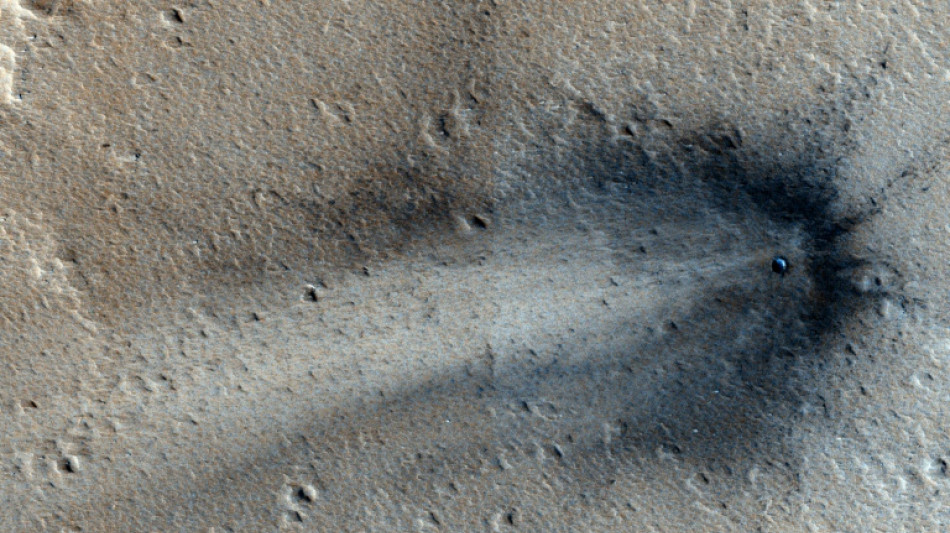
Meteorites strike Mars far more often than thought, probe finds / Photo: Handout - NASA/JPL-Caltech/Univ. of Arizona/AFP/File
 India's top court drops criminal cases against protesters

 Philippine couple married in hip-deep floodwaters

 Villa sign Senegal winger Mbaye from PSG

 Former Peru minister last-minute contender for UN labour agency helm

 Messi legacy will 'live forever', says Beckham

 'Literally tasting the smoke': Malaysians suffer as haze worsens

 Kyiv's defences, 'hybrid' threat from Moscow headline EU talks

 Oil extends gains, stocks mostly down as Trump issues fresh Iran warning
 ThinkMarkets Expands Weekend Trading Offering, Launches Weekend League Competition

 Tibet activists accuse China of downplaying floods

 Afghanistan war victims left 'without justice', UN says

 Iran president offers US olive branch before Putin meeting

 China-Nepal flood toll tops 1,000 as tunnel rescue offers last hope

 Japan to relax overtime regulation under workaholic PM
 Thwarted Niger mutiny exposes junta's Russia dependence
 Illegal mining ravages S.Africa's economic hub

 Nepal's wall of missing offers last hope after Himalayan flood

 US to press G20 on light-touch AI regulation

 2 die in Grand Canyon flash flood, only 1 person unaccounted for

 US Army Secretary Driscoll submits resignation: White House

 Oil extends gains, stocks drop as Trump issues fresh Iran warning

 Tsitsipas says Kyrgios's positive cocaine test 'kind of expected'

 In Japan's mountains, a different way to manage bears

 Middle East war a boon for UAE defence giant with global ambitions
 Former gang member found guilty of murdering Tupac Shakur

Mars is bombarded with basketball-sized meteorites on a nearly daily basis, fives times more often than previously estimated, seismic recordings from a NASA spacecraft have revealed.
Before the new study was published on Friday, the best guess for how many meteorites strike Mars was made by looking at images taken by orbiting spacecrafts or models based on craters on the Moon.
But NASA's InSight probe, which landed on a Martian plain called Elysium Planitia in 2018, has allowed scientists to listen to the internal rumblings of the red planet for the first time.
Mars is roughly twice as big as the Moon and is much closer to our solar system's main asteroid belt, making it a prime target for large rocks hurtling through space.
Most meteorites taking a shot at Earth break apart in our atmosphere. But the Martian atmosphere is 100 times thinner than Earth's, giving it little protection.
Rather than scouring through images taken from far away, the international team of researchers behind the new study in Nature Astronomy were able to listen in on meteorites smashing into Mars.
"Listening for impacts seems to be more effective than looking for them if we want to understand how often they occur," study co-author Gareth Collins of Imperial College London said in a statement.
The researchers used the data from InSight's seismometer to estimate that every year Mars is hit by between 280 to 360 meteorites, which all blast craters bigger than eight metres (26 feet) wide.
"This rate was about five times higher than the number estimated from orbital imagery alone," study co-author Geraldine Zenhaeusern of the ETH Zurich university said.
- Mars missions, take note -
Frequent, intense dust storms make it particularly difficult for spacecrafts orbiting Mars to see small meteorite craters down below.
New craters are easiest to spot in flat and dusty areas, but "this type of terrain covers less than half of the surface of Mars," Zenhaeusern said.
"The sensitive InSight seismometer, however, could hear every single impact within the landers' range," she added.
The scientists tracked a particular acoustic signal which is produced when meteorites strike Mars to estimate the diameter of craters and their distance from InSight.
They then calculated the number of craters made in one year near the lander, before extrapolating that number across the entire planet.
"This is the first paper of its kind to determine how often meteorites impact the surface of Mars from seismological data," said Domenico Giardini, who works on the InSight mission.
This data should be taken into account in "planning for future missions to Mars," he added.
The researchers estimated that a big meteorite strike makes a 30-metre crater on Mars about once a month -- something that may linger in the minds of astronauts hoping to walk on the red surface one day.
O.Norris--AMWN