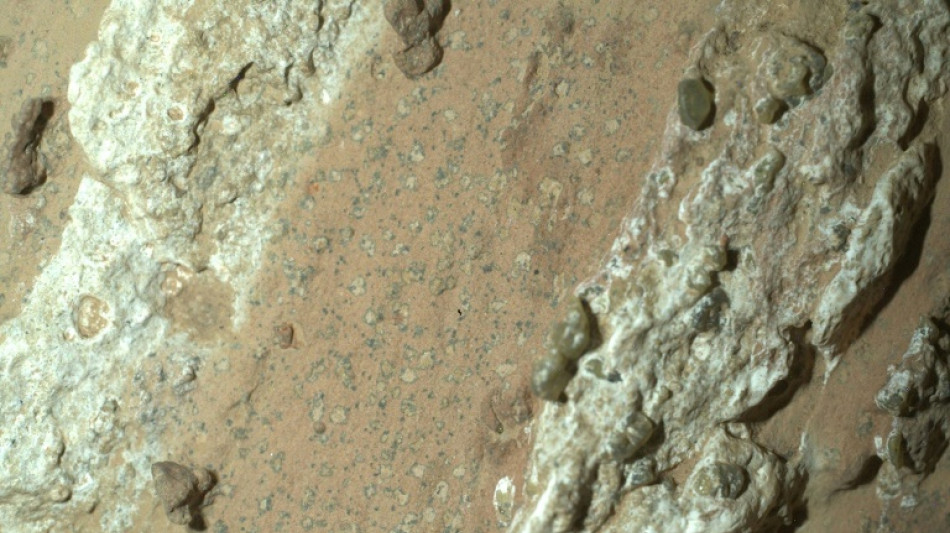
NASA Mars rover captures rock that could hold fossilized microbes / Photo: HANDOUT - NASA/JPL-Caltech/MSSS/AFP
 Nepal disaster a climate 'warning signal': foreign minister

 France winger Diaby returns to Leverkusen until 2031

 Barcelona confirm Jesus arrival from Arsenal

 EU official says it's not time to 'normalize' Russia at G20 finance talks

 RedHill Announces Transformational Acquisition of Commercialization Rights to Ferring’s Rebyota® and Clenpiq®
 TrendEadvisor Launches Global Multi-Asset Platform Combining Online Investing with Social Trading

 India's top court drops criminal cases against protesters

 Philippine couple married in hip-deep floodwaters

 Villa sign Senegal winger Mbaye from PSG

 Former Peru minister last-minute contender for UN labour agency helm

 Messi legacy will 'live forever', says Beckham

 'Literally tasting the smoke': Malaysians suffer as haze worsens

 Kyiv's defences, 'hybrid' threat from Moscow headline EU talks

 Oil extends gains, stocks mostly down as Trump issues fresh Iran warning

 ThinkMarkets Expands Weekend Trading Offering, Launches Weekend League Competition

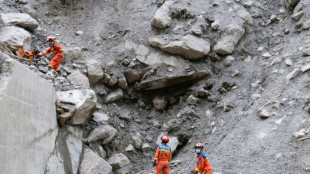 Tibet activists accuse China of downplaying floods
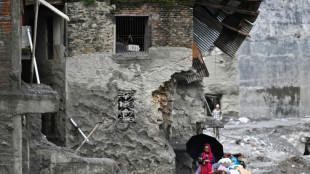
 Afghanistan war victims left 'without justice', UN says

 Iran president offers US olive branch before Putin meeting

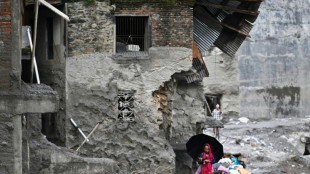 China-Nepal flood toll tops 1,000 as tunnel rescue offers last hope

 Japan to relax overtime regulation under workaholic PM

 Thwarted Niger mutiny exposes junta's Russia dependence

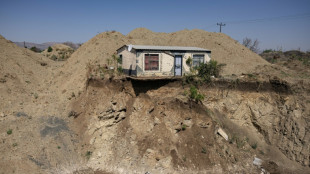 Illegal mining ravages S.Africa's economic hub

 Nepal's wall of missing offers last hope after Himalayan flood

 US to press G20 on light-touch AI regulation

 2 die in Grand Canyon flash flood, only 1 person unaccounted for

NASA's Perseverance Mars rover has made what could be its most astonishing discovery to date: possible signs of ancient life on the Red Planet.
The six-wheeled robotic explorer came across an intriguing, arrow-shaped rock dubbed "Cheyava Falls" that may harbor fossilized microbes from billions of years ago, when Mars was a watery world.
Perseverance drilled into the enigmatic rock to collect a core sample on July 21, as it traversed Neretva Vallis, an ancient river valley.
The samples carefully stowed beneath the rover's belly are destined to eventually return to Earth, where they will undergo more comprehensive analysis.
"Cheyava Falls is the most puzzling, complex, and potentially important rock yet investigated by Perseverance," project scientist Ken Farley of Caltech said Thursday.
Three compelling clues have scientists buzzing.
White calcium sulfate veins run the length of the rock, a telltale sign that water once flowed through it.
Between these veins is a reddish middle area, teeming with organic compounds, as detected by the rover's SHERLOC (Scanning Habitable Environments with Raman and Luminescence for Organics and Chemicals) instrument.
Finally, tiny off-white splotches ringed with black, reminiscent of leopard spots, contain chemicals that suggest energy sources for ancient microbes, according to scans by the PIXL (Planetary Instrument for X-ray Lithochemistry) instrument.
"On Earth, these types of features in rocks are often associated with the fossilized record of microbes living in the subsurface," said David Flannery, an astrobiologist and member of the Perseverance science team from the Queensland University of Technology in Australia.
The quest to confirm ancient Martian life is far from over, however.
The real test will come when Perseverance's precious rock samples are returned to Earth as part of the Mars Sample Return Program, a collaboration between NASA and the European Space Agency slated for the 2030s.
While there are alternative explanations for these findings that do not involve microbes, there is a tantalizing chance that Perseverance's core sample might contain actual fossilized microbes -- potentially making history as the first proof of life beyond Earth.
"We have zapped that rock with lasers and X-rays and imaged it literally day and night from just about every angle imaginable," said Farley.
"Scientifically, Perseverance has nothing more to give. To fully understand what really happened in that Martian river valley at Jezero Crater billions of years ago, we'd want to bring the Cheyava Falls sample back to Earth, so it can be studied with the powerful instruments available in laboratories."
S.F.Warren--AMWN