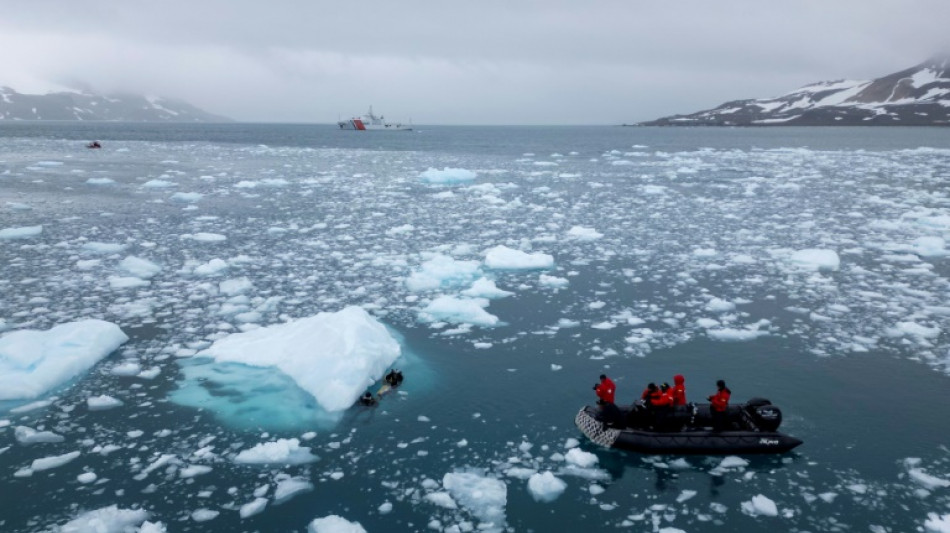
Melting sea ice in Antarctica causes ocean storms, scientists say / Photo: Juan BARRETO - AFP
 England omit Carse from squad for third Test against Pakistan

 Venice festival gets underway with Clooney taking swipe at US government

 DNA tests and funerals in Nepal, a week after deadly floods

 Iran threatens tougher strategy after US strikes kill 4 at wedding

 Chevron unveils deal to double Venezuela venture output in 5 years

 Uganda names its oil 'Pearl Sweet' as it prepares for first exports

 Tiger Woods driver's license suspended for five years after crash

 Germany probes latest sabotage attacks on power grid

 Wall Street stocks mixed as energy prices, bond yields turn lower

 Tiger Woods pleads guilty to reckless driving, license suspended

 Missing passengers likely went down with sunken ferry: N.Cyprus official

 Premier League clubs splash cash to smash transfer record

 Melting glaciers an 'immediate' climate risk: author of UN report

 Folarin Balogun's move to Everton collapses

 Pacific islands to face food shortages over global warming: scientists

 Venice jury head Maggie Gyllenhaal questions lack of women directors

 Stocks drop, bond yields rally on Mideast flare-up

 China expands Egypt investments in first Xi visit in a decade

 Messi departure leaves Argentina facing rebuild after golden era

 Ourbit SuperCEX Launches "Cosmic Wheel Season 3. Oracle Realm" on September 2 with 3M USDT Prize Pool

 Ebola death toll passes 3,000 in DR Congo: official data

 Hong Kong democracy activist Wong pleads guilty to foreign collusion

 World record prize winner Romantic Warrior retires from horse racing

 5,000 US sailors arrive in Thailand after months at sea

 Joshua Wong, Hong Kong's pro-democracy poster child

The record-breaking retreat of Antarctic sea ice in 2023 has led to more frequent storms over newly exposed parts of the Southern Ocean, according to a study published Wednesday.
Scientists know that the loss of Antarctic sea ice can diminish penguin numbers, cause ice shelves to melt in warmer waters, and impede the Southern Ocean from absorbing carbon dioxide.
But this new research, published in the peer-reviewed journal Nature, explores another consequence: increased heat loss from the ocean to the atmosphere, and an associated rise in storms.
Since 2016 there has been a large-scale reduction in Antarctic sea ice, but nothing like 2023 when a record amount failed to reform over the winter.
For this study, Simon Josey of the UK's National Oceanography Centre and colleagues focussed on three regions that experienced unusually high levels of sea-ice retreat that year.
Using satellite imagery, ocean and atmospheric data, and wind and temperature measurements, they found some newly ice-free areas experienced double the heat loss compared to a stabler period before 2015.
This was accompanied by "increases in atmospheric-storm frequency" over previously ice-covered regions, the authors found.
"In the sea-ice-decline regions, the June–July storm frequency has increased by up to 7 days per month in 2023 relative to 1990–2015."
The loss of heat caused by reduced sea ice could have implications for how the ocean circulates and the wider climate system, the study added.
Oceans are a crucial climate regulator and carbon sink, storing more than 90 percent of the excess heat trapped near Earth's surface by greenhouse gas emissions.
In particular, sea-ice retreat could mean changes in how a deeper layer of cold, dense Antarctic bottom water absorbs and stores heat.
The authors said further in-depth analysis of possible climate impacts were needed, including if sea-ice retreat could have even further-reaching consequences.
"Repeated low ice-cover conditions in subsequent winters will strengthen these impacts and are also likely to lead to profound changes further afield, including the tropics and the Northern Hemisphere," it said.
S.Gregor--AMWN