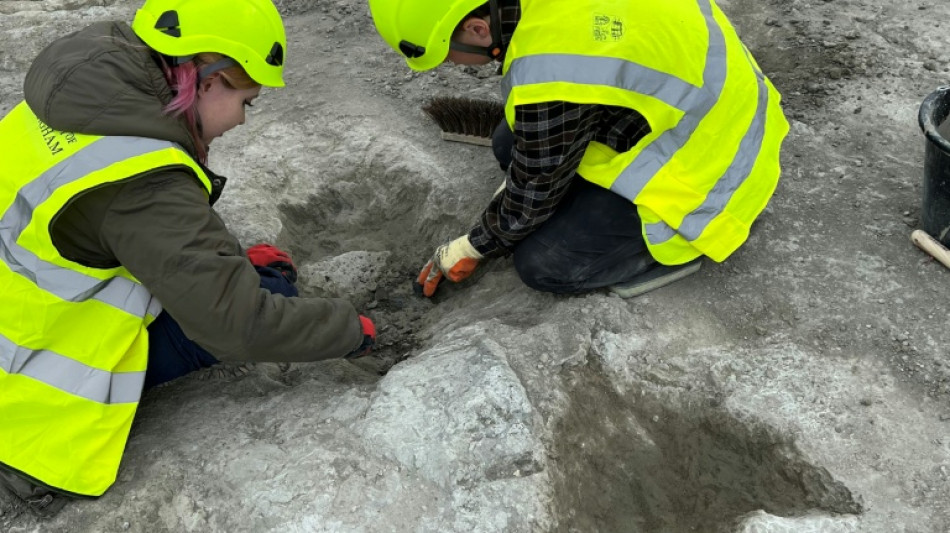
UK's biggest dinosaur footprint site uncovered / Photo: Emma NICHOLLS - Oxford University Museum of Natural History/AFP
 Rene Eyre Revisits Autobiographical Performance 'Say A Little Prayer' in London

 UAE's HCT Holds Record Graduation and Announces Major Training Expansion

 NASA Awards $10B Lunar Contract Framework to SpaceX, Blue Origin

 Katy Perry Tells Fans Ex-Husband Russell Brand 'Should Be in Jail' During UK Concert

 South African election results renew debate over identity-based voting

 South African voters report smoother local election but declining IEC trust

 Dolly Parton museum and Nashville hotel open after singer’s death

 George and Amal Clooney attend New York political-comedy reading

 British buyers pay substantial premiums for period-home appearance

 Thomas Markle released to house arrest after child-abuse-image charge

 Dawn of War 4 developers chose Adeptus Mechanicus for tactical variety

 Italy face unbeaten South Africa in Turin Nations Championship match

 ChatGPT interactive interface feature tested across six custom tools

 Freshways milk-price cut deepens pressure on UK dairy farms

 Labour and National remain virtually tied as New Zealand vote count advances
British researchers have unearthed some 200 dinosaur footprints dating back 166 million years in a find believed to be biggest in the UK.
Teams from Oxford and Birmingham Universities made the "exhilarating" discovery at a quarry in Oxfordshire in central England after a worker came across "unusual bumps" as he was stripping clay back with a mechanical digger, according to a new BBC documentary.
The site features five extensive trackways, with the longest continuous track stretching more than 150 metres (490 feet) in length.
Four of the five trackways uncovered are believed to have been made by a long-necked herbivorous dinosaur, most likely a cetiosaurus.
The fifth set of tracks likely belongs to a nine-metre long carnivorous megalosaurus known for its distinctive three-toed feet with claws, according to the University of Birmingham.
"It's rare to find them so numerous in one place and it's rare to find such extensive trackways as well," Emma Nicholls of Oxford University's Museum of Natural History told AFP.
The area could turn out to be one of the world's biggest dinosaur track sites, she added.
The discovery will feature in the BBC television documentary "Digging for Britain", due to be broadcast on January 8.
- 'So surreal' -
A 100-strong team led by academics from Oxford and Birmingham excavated the tracks during a week-long dig in June.
The new footprints follow a smaller discovery in the area in 1997, when 40 sets were uncovered during limestone quarrying, with some trackways reaching up to 180 metres in length.
The researchers took 20,000 photographs of the latest footprints and created detailed 3D models of the site using aerial drone photography.
It is hoped the discovery will provide clues about how dinosaurs interacted, as well as their size and the speeds at which they moved.
"Knowing that this one individual dinosaur walked across this surface and left exactly that print is so exhilarating," the Oxford museum's Duncan Murdock told the BBC.
"You can sort of imagine it making its way through, pulling its legs out of the mud as it was going," he added.
Richard Butler, a palaeobiologist from the University of Birmingham, said some chance weather may be the reason the tracks had been so well preserved.
"We don't know exactly... but it might be that there was a storm event that came in, deposited a load of sediments on top of the footprints, and meant that they were preserved rather than just being washed away," he said.
Quarry worker Gary Johnson, whose watchfulness triggered the excavation, said the experience had been spellbinding.
"I thought I'm the first person to see them. And it was so surreal -- a bit of a tingling moment, really," he said.
P.Martin--AMWN