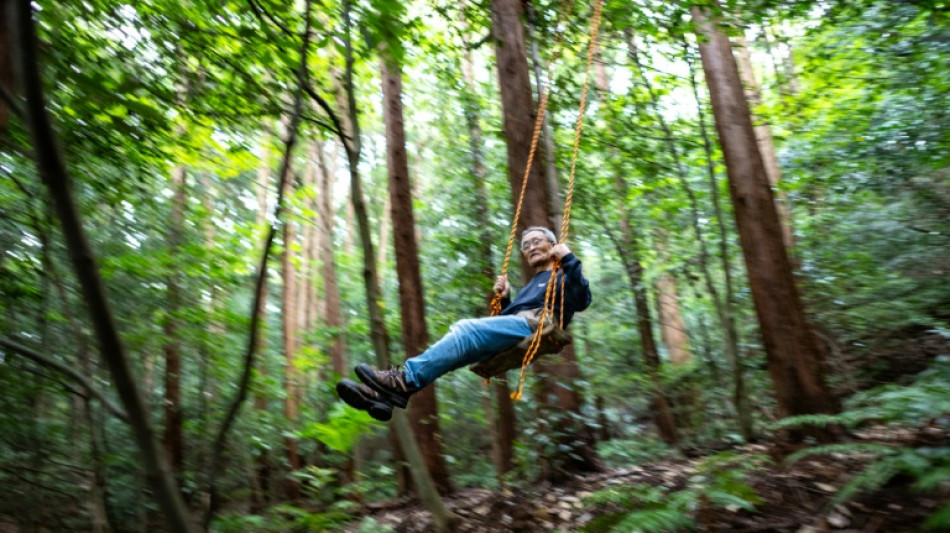
Japan 'poop master' gives back to nature / Photo: Philip FONG - AFP
 Palantir chief says France's digital sovereignty push 'backfiring'

 US energy firms dominate Venezuela deals worth billions

 Iran, US trade threats after escalation in fighting

 US jury deadlocks again in Lindsay Clancy's child murder trial

 Lake America? No way, Canadians say
 Spain report flags Moroccan police failings in Ceuta migrant rush

 Tech bosses press G20 to build data centers, but split on risk
 Dolly Parton to get new Hollywood star after vandalism

 Trump 'happy' Prince Harry and Meghan have left US

 Michelson shocks Nakashima in US Open clash of rising Americans

 Another body recovered after ferry capsizes off northern Cyprus: official

 Cupertino Chamber President Claudio Bono Invited to White House with GiveaRoof 3-Year Plan to End Homelessness

 Trump floats renaming Strait of Hormuz as 'Trump Strait'

 Man City, Chelsea fuel record-breaking Premier League transfer window

 Balogun rejected Everton move over transfer 'treatment'

 Northampton seek 'happy medium' in bid to keep England star Pollock

 US energy secretary in Venezuela to sign Trump's 'biggest' oil deal

 Branagh takes on action role in Apple's Cold War comedy 'Mayday'

 Lawson fills in again for injured Hadjar at Monza

 England omit Carse from squad for third Test against Pakistan
 Venice festival gets underway with Clooney taking swipe at US government

 DNA tests and funerals in Nepal, a week after deadly floods

 Iran threatens tougher strategy after US strikes kill 4 at wedding

 Chevron unveils deal to double Venezuela venture output in 5 years

 Uganda names its oil 'Pearl Sweet' as it prepares for first exports

When nature calls, Masana Izawa has followed the same routine for more than 50 years: heading out to the woods in Japan, dropping his pants and doing as bears do.
"We survive by eating other living things. But you can give faeces back to nature so that organisms in the soil can decompose them," the 74-year-old told AFP.
"This means you are giving life back. What could be a more sublime act?"
"Fundo-shi" ("poop-soil master") Izawa is something of a celebrity in Japan, publishing books, delivering lectures and appearing in a documentary.
People flock to his "Poopland" and centuries-old wooden "Fundo-an" ("poop-soil house") in Sakuragawa north of Tokyo, sometimes dozens of them a month.
There, in his 7,000-square-metre (1.7-acre) woodland -- about the size of a football pitch -- visitors get tips for open-air best practice.
"Noguso", as it is known in Japanese, requires digging a hole, a leaf or two for wiping, a bottle of water to wash up, and twigs to mark the spot.
The sticks ensure he doesn't use the same place twice and can later return to keep precise records of the decomposition process.
"Feel the back of these. Can you tell how soft they are?" he said, showing palm-sized silver poplar leaves picked from a branch.
"(It's) more comfortable than paper."
- 'Egocentric' -
Izawa is a former nature photographer who specialised in mushrooms before retiring in 2006.
His excrement epiphany came at age 20 when he saw a protest against the construction of a sewage plant.
"We all produce faeces, but (the demonstrators) wanted the treatment plant somewhere far away and out of sight," he says.
"People who believed they were absolutely right made such an egocentric argument."
He concluded that to alleviate his own conscience at least, outdoor defecating was the answer.
- Falling foul -
Toilets, toilet paper and wastewater facilities require huge amounts of water, energy and chemicals.
Letting soil do the work is much better for the environment, says Izawa, who believes more people should follow his lead.
Human waste -- more than other animals' -- can contain bacteria that are potentially harmful to the environment, and defecating outside is banned in Japan.
But since Izawa owns the forest around his centuries-old house, he has not fallen foul of the authorities.
He digs up old spots that he says show human stools are entirely and quickly broken down, unless they contain antibiotic medicines.
"Fungal activities degrade and transform things like dead animals, excrement and fallen leaves into nutritious earth, on which a forest grows," he says.
- Risky Business -
Izawa's iron beliefs have cost him dearly, not least his second marriage after an incident involving Machu Picchu, the popular tourist site in Peru.
He cancelled a leg of their honeymoon trip to the site after learning he would have to use the facilities.
"I jeopardised my wife and a trip to Machu Picchu just for a single 'noguso'," he says, laughing.
He believes that climate change and the growing interest in more sustainable ways of living may be winning him more attention, especially from young people.
Kazumichi Fujii, 43, a soil scientist at the Forestry and Forest Products Research Institute (FFPRI) in Japan, agreed.
"(It is) due to the Fukushima (nuclear) disaster, the Greta Thunberg movement... (and) distrust for the preceding generations and the desire for alternatives," Fujii said.
But Fujii warns Izawa that his methods may not be as safe as he thinks, particularly his habit of tasting the soil from Poopland to demonstrate how safe it is.
The city of Edo, as pre-modern Tokyo was known, used human excrement to fertilise farmland, but "some 70 percent of residents suffered from parasite infection," Fujii said.
"I must be seen as a hell of a freak," laughs Izawa. "But it is due to the human-centric society.
"In the whole ecological system, no other animal but humans use toilets...the human world is rather absurd to me."
He now strongly hopes that his body will also be decomposed in the forest instead of being cremated as is customary in Japan.
"I find the purpose of living in doing 'noguso'," he said.
M.A.Colin--AMWN