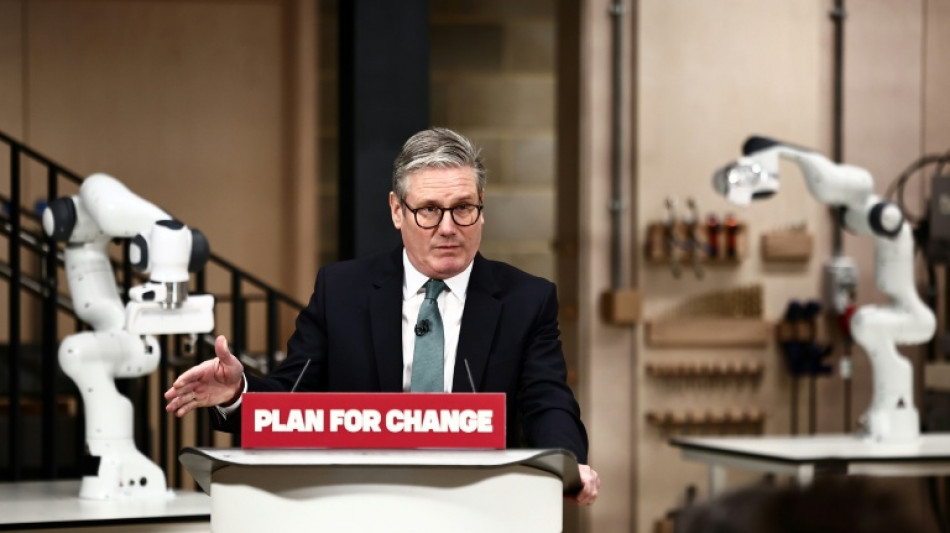
PM vows 'pro-growth' rules to make Britain an 'AI superpower' / Photo: HENRY NICHOLLS - POOL/AFP
 Chinese lucky loser stuns Jodar at US Open

 US Open under the influence: content creators spark debate

 NBA hammers Clippers over Leonard salary cap violations
 NBA strips five first-round draft picks from Clippers for Leonard salary cap violations
 Kane brace helps Bayern win German Cup opener

 Migrant plight, local anger divide Ceuta one month after influx

 Outrage as Maltese tycoon acquitted of reporter's murder

 Rare train of Pacific cyclones fueled by historic El Nino

 Macron, King Charles hail UK-France ties after viewing Bayeux Tapestry
 Fury hits out at 'coward' Joshua as 'Battle of Britain' talks go on

 Maltese tycoon acquitted of masterminding reporter's murder
 George Clooney: a Hollywood icon and campaigner

 Europe, US closer than they look on tech rules, says EU tech chief

 Clooney honoured as Hollywood-light Venice Film Festival kicks off

 Third-ranked Pegula, Medvedev power into US Open third round
 Davis-Woodhall a doubt for Ultimate Championship after car crash

 Third-ranked Pegula powers into US Open third round

 Uber says laying off 'about 10%' of workforce worldwide

 US judge rejects bid to break up Google's ad business

 Rupert Murdoch 'very happy' to be played by Guy Pearce in new film

 Wall Street stocks rise despite bond yields, oil rising

 Brennan claims third Vuelta victory in stage 11 sprint

 Nepal flood survivors cling to zipline to cross treacherous river

 US Treasury issues $1 coin with Trump's face on it

 Fernandez 'didn't hesitate' over record Man City move

Prime Minister Keir Starmer on Monday laid out his vision to harness the power of artificial intelligence to boost Britain's flagging economy, promising "pro-growth" regulations amid concerns about the technology's unchecked use.
Speaking following the launch of a government "action plan", Starmer pledged to ease red tape to attract billions of pounds of AI investment to Britain.
The "AI Opportunities Action Plan" includes 50 recommendations that the government will implement to boost AI-driven efficiency in the public sector, from education and healthcare to detecting potholes.
"Mark my words, Britain will be one of the great AI superpowers," Starmer said at an event at the UCL campus in east London, hailing the technology which is raising complex questions for governments around the world.
The UK -- which has the third-largest AI industry after the United States and China -- will be "pro-growth and pro-innovation on regulation", Starmer said.
"I think it is important to recognise that we've got freedom now in relation to regulation, to do it in the way that we think is best for the UK," said Starmer, calling for AI to be "tested" before it is "regulated".
"We don't need to walk down a US or an EU path on AI regulation", the prime minister wrote in the Financial Times ahead of the speech, calling for a "distinctively British approach".
Starmer's position marks a shift from the EU's heavy-handed regulation of the sector, especially regarding data protection laws, which has faced criticism from tech giants.
In the US, incoming President Donald Trump's desire to deregulate the economy and his team of Silicon Valley-linked advisors could influence policies on AI regulation.
- Data library -
The UK's latest plans include the creation of a national data library which would make public data sets, including anonymised National Health Service records, "available to AI researchers and innovators".
The data library would be bolstered by a "clear and trusted copyright regime", Starmer added. "It is important that we keep control of that data."
"But I don't think that we should have a defensive stance here that will inhibit the sort of breakthroughs that we need."
The latest plans come amid concerns surrounding AI's role in spreading online misinformation and deepfake pornography, as well as fears robots could one day outsmart humans if left unchecked.
The government outlined plans for the creation of "dedicated AI growth zones" designed to speed up planning proposals for data centres and other AI infrastructure.
It also hopes to increase server capacity twentyfold by 2030, including by building "a brand new supercomputer with enough AI power to play itself at chess half a million times a second".
The new supercomputer pledge comes months after Starmer axed a previous supercomputer project in Edinburgh planned by the previous government, citing a lack of funds.
- 'Economic mismanagement' -
Starmer's administration estimated that AI could be worth £47 billion ($57 billion) to the UK each year over a decade.
It announced that three tech companies -- Vantage Data Centres, Nscale and Kyndryl -- had committed to spending £14 billion on AI in the UK, leading to the creation of more than 13,000 jobs.
Starmer has put firing up Britain's economy at the heart of his agenda since taking office last July. In his speech, Starmer staked economic growth on advancements in AI, saying the technology "would turbocharge every single element of our plan for change".
But weaker-than-expected growth, rising borrowing costs and a falling pound is complicating his task, meaning he could be forced to make spending cuts or hike taxes this year.
Shadow Science Secretary Alan Mak accused Labour of insufficiently funding its AI ambitions.
"AI does have the potential to transform public services, but Labour's economic mismanagement and uninspiring plan will mean Britain is left behind," Mak said.
There are also concerns that the sector-wide implementation of AI could result in job losses.
"It's a disruptive technology, like many other previous technological waves," senior cabinet minister Pat McFadden told Times Radio.
"But I think it's too pessimistic to simply talk about job losses," he added.
The government is expected to wrap up next month a consultation to clarify the application of copyright law to AI, which it says aims to protect the creative industry.
B.Finley--AMWN