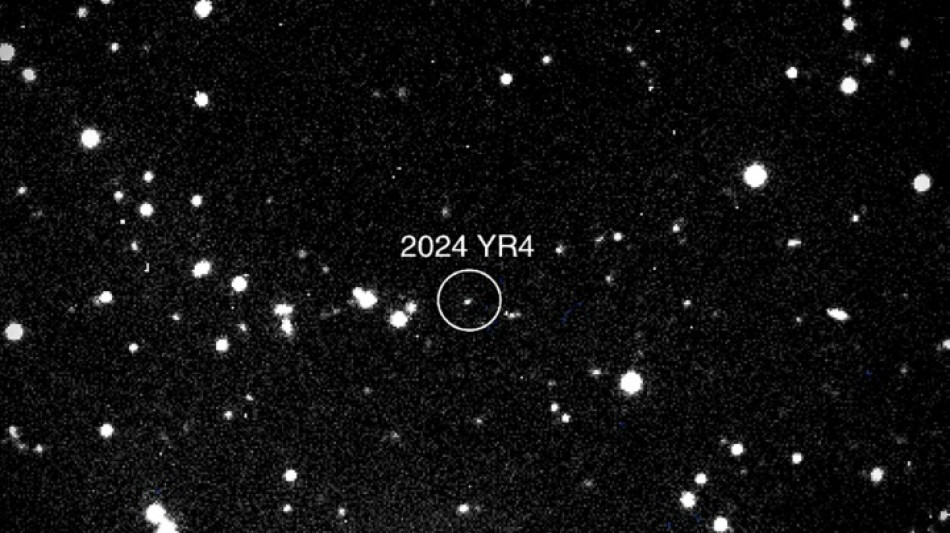
Chance huge asteroid will hit Earth down to 0.001 percent / Photo: Handout - NASA/Magdalena Ridge 2.4m telescope/New Mexico Institute of Technology/Ryan/AFP/File
 37 people die from fumes during oil pipeline theft in Nigeria: NGO

 Ahead of elections, Israel tests West's patience on West Bank violence
 Antonelli will obey Mercedes orders to help 'tow' teammate Russell

 UK fintech Revolut gains conditional US banking licence

 Mara sisters channel childhood energy for twins performance at Venice

 UN's Sudan probe says foreign fighters fuelling conflict

 Violence erupts at S.Africa anti-migrant protest
 Nothing left: Nepal flood survivors face loss and uncertainty

 Tesla to launch self-driving 'Cybercab' in Texas
 Europe struggles to respond as Russia escalates shadow warfare
 Malta PM urges 'caution' after acquittal in journalist's murder

 Spanish PM says no 'solid proof' Morocco planned Ceuta migrant rush

 Venezuela's Maduro seek immunity from US drug charges

 Tazapay Now Live on the Borderless.xyz Network For Seamless Money Movement to Asia Pacific and Latin America

 DWF Labs Expands Global Regulatory Footprint with BVI Virtual Asset Service Provider Approval

 Just the beginning of the journey, Broeders-Bol says of 800m adventure

 US trade gap in July hits biggest in over a year on AI buildout

 Study shows plug-in hybrids polluting far more than expected
 Lost tool disrupted Airbus jet deliveries for months
 MEXC Concludes 0808 Stock Season with Over 86,000 Participants and More Than $1M Saved Through 0 Fee Trading

 US feminist icon Gloria Steinem dies at 92: foundation
 All Blacks drop veteran hooker Taylor for third Springboks Test

 British, French leaders hold talks on migrants, EU relations

 Oil prices jump as Iran strikes US targets

 Putin denies plan for new Russia military call up
The chance that a football field-sized asteroid capable of destroying a city will strike Earth in 2032 has fallen to 0.001 percent, the European Space Agency said on Tuesday.
A week ago, the asteroid set a new record for having the highest probability of hitting Earth -- 3.1 percent according to NASA and 2.8 percent according to the ESA. The planetary defence community has been scanning the skies.
However, as had been widely expected, fresh observations from telescopes around the world narrowed the area of uncertainty where the asteroid could strike, increasingly ruling out the odds of a direct hit.
The ESA said the chance was now down to 0.001 percent, adding that the threat level on the Torino Impact Hazard Scale was now at zero -- after hitting level three out of a possible 10 last week.
The asteroid, called 2024 YR4, was discovered in December. It is estimated to be 40-90 metres (130 to 300 feet) wide, which means it has the potential to devastate a city.
The impact date would have been December 22, 2032 -- but it is now extremely likely the asteroid will simply zoom past Earth.
Despite the plummeting risk, the James Webb Space Telescope will still observe the asteroid in the coming months, the ESA said.
Scientists had emphasised that even if the asteroid had been heading our way, Earth is now capable of fighting back. In the first test of our planetary defences, NASA's DART mission successfully altered a harmless asteroid's trajectory in 2022 by smashing a spacecraft into it.
Richard Moissl, head of the ESA's planetary defence office, told AFP that observing the asteroid -- then ruling out a direct hit -- was "a very exciting and educational exercise".
Praising the early detection of the asteroid, he emphasised that "there is still ample room for improvement".
Several new telescopes, such as the Vera Rubin and Flyeye, which are near becoming operational will enable astronomers to spot asteroids more quickly, Moissl said. So will Europe's planned early warning mission NEOMIR, he added.
The last time an asteroid bigger than 30 metres wide posed such a significant risk was Apophis in 2004, when it briefly had a 2.7 percent chance of striking Earth in 2029 -- a possibility also ruled out through additional observations.
P.Costa--AMWN