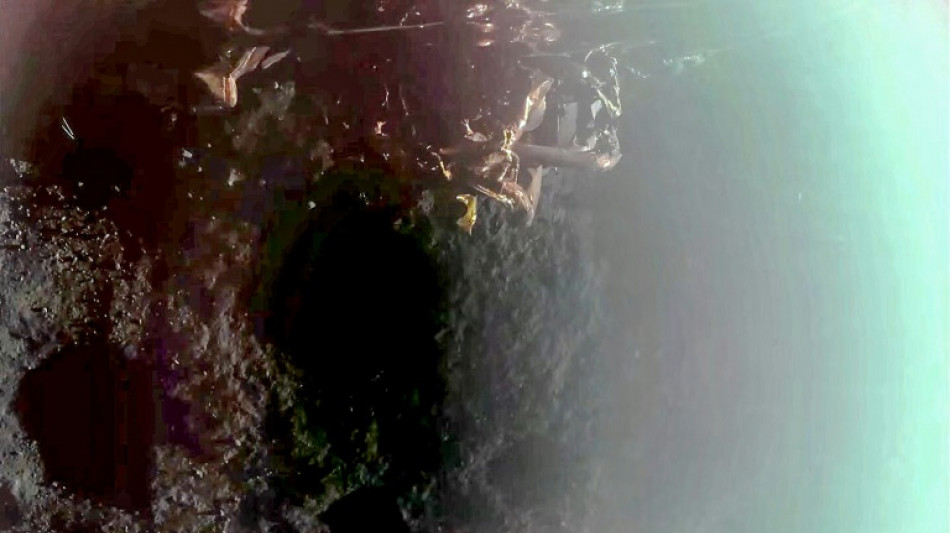
In first, private US spaceship lands upright on Moon / Photo: Handout - Firefly Aerospace/AFP
 Dana White Confirms Flight to Washington for Trump Meeting on Press Secretary Role

 Dengue Fever Expands Into High Himalayas as Climate Change Warms Nepal

 IoT Refrigerator Hacks Disrupt Blood Labs and Supermarkets Across Europe and US

 Post-election pressures complicate US and Israeli decisions on Iran

 UN members approve talks on treaty protocol against environmental crime

 Family-run West Sussex beach café prepares for first winter season

 CT scans reveal health and burial clues from Egypt’s Braided Lady mummy

 Oxford faces complaints over lecturer’s classroom attire

 Kyren Wilson and John Higgins reach International Championship snooker final

 New Zealand and Tonga meet for place in Rugby League World Cup final

 Reports of unsafe AI-toy responses renew calls for child-safety rules

 Juneau food network combines difficult supply routes with deep sharing traditions

 India climbs green-transition ranking after first emissions decline in 25 years

 Trump names Stephen Miller as White House chief of staff after midterm losses

 Restored Albanian tower houses anchor new rural tourism trail

 Sonia Gandhi reflects on family tragedy and reluctant political career

 Pope Leo begins three-country South American tour in Uruguay

 Khawaja says entire Australia camp knew of 2018 ball-tampering plan
A US company successfully landed its spacecraft on the Moon on Sunday, marking only the second private mission to achieve the milestone -- and the first to do so upright.
Firefly Aerospace's Blue Ghost Mission 1 touched down shortly after 3:34 am US Eastern Time (0834 GMT) near Mons Latreille, a volcanic formation in Mare Crisium on the Moon's northeastern near side.
"Y'all stuck the landing, we're on the Moon," an engineer at mission control in Austin, Texas, called out as the team erupted in cheers.
CEO Jason Kim confirmed that the spacecraft was "stable and upright" -- in contrast to the first private landing last February, which came down sideways.
"We're on the Moon!" Nicky Fox, associate administrator for NASA's Science Mission Directorate, rejoiced.
The first image from the lander revealed the rocky, pockmarked terrain it had to autonomously navigate in order to select its touchdown spot, having slowed down from thousands of miles per hour to just two mph.
Nicknamed "Ghost Riders in the Sky," the mission is part of a NASA-industry partnership aimed at reducing costs and supporting Artemis, the program designed to return astronauts to the Moon.
The golden lander, about the size of a hippopotamus, launched on January 15 on a SpaceX Falcon 9 rocket, capturing stunning footage of Earth and the Moon along its 2.8 million mile journey.
It shared a ride with a Japanese company's lander set to attempt a landing in May.
Blue Ghost carries 10 instruments, including a lunar soil analyzer, a radiation-tolerant computer and an experiment testing the feasibility of using the existing global satellite navigation system to navigate the Moon.
Designed to operate for a full lunar day (14 Earth days), Blue Ghost is expected to capture high-definition imagery of a total eclipse on March 14, when Earth blocks the Sun from the Moon's horizon.
On March 16, it will record a lunar sunset, offering insights into how dust levitates above the surface under solar influence -- creating the mysterious lunar horizon glow first documented by Apollo astronaut Eugene Cernan.
- Hopping drone -
Blue Ghost's arrival will be followed on March 6 by fellow Texas company Intuitive Machines' IM-2 mission, featuring its lander Athena.
In February 2024, Intuitive Machines became the first private company to achieve a soft lunar landing -- also the first US landing since the crewed Apollo 17 mission of 1972.
However, the success was tempered by a mishap: the lander came down too fast and tipped over on impact, leaving it unable to generate enough solar power and cutting the mission short.
This time, the company says it has made key improvements to the hexagonal-shaped lander, which has a taller, slimmer profile than Blue Ghost, and is around the height of an adult giraffe.
Athena launched on Wednesday aboard a SpaceX rocket, taking a more direct route toward Mons Mouton -- the southernmost lunar landing site ever attempted.
Its payloads include three rovers, a drill to search for ice and the star of the show: a first-of-its-kind hopping drone designed to explore the Moon's rugged terrain.
- NASA's private Moon fleet -
Landing on the Moon presents unique challenges due to the absence of an atmosphere, making parachutes ineffective.
Instead, spacecraft must rely on precisely controlled thruster burns to slow their descent.
Until Intuitive Machines' first successful mission, only five national space agencies had accomplished this feat: the Soviet Union, the United States, China, India and Japan, in that order.
Now, the United States is working to make private lunar missions routine through NASA's $2.6 billion Commercial Lunar Payload Services (CLPS) program.
The missions come at a delicate moment for NASA, amid speculation that it may scale back or even cancel its Artemis lunar program in favor of prioritizing Mars exploration -- a key goal of both President Donald Trump and his close advisor, SpaceX founder Elon Musk.
O.M.Souza--AMWN