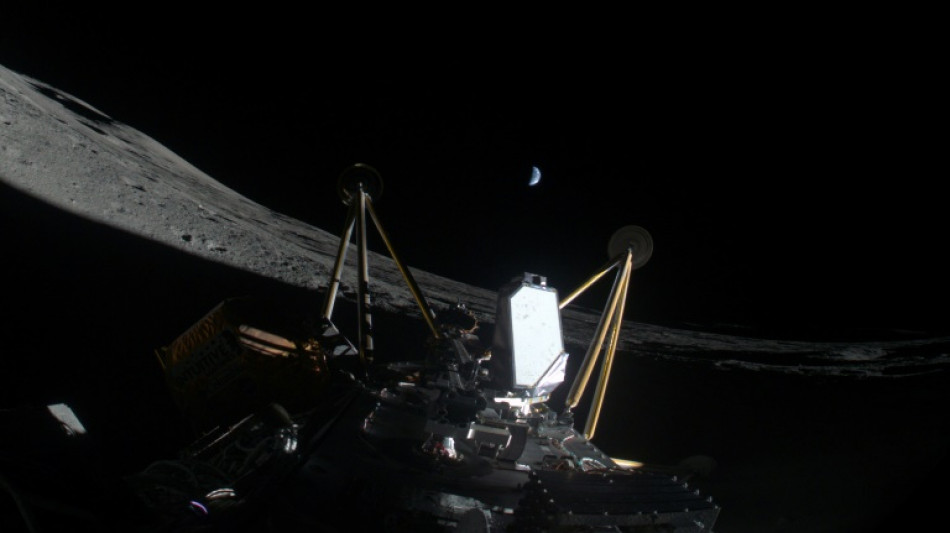
Oops, we tipped it again: Mission over for sideways US lander / Photo: Handout - Intuitive Machines, LLC/AFP
 Dana White Confirms Flight to Washington for Trump Meeting on Press Secretary Role

 Dengue Fever Expands Into High Himalayas as Climate Change Warms Nepal

 IoT Refrigerator Hacks Disrupt Blood Labs and Supermarkets Across Europe and US

 Post-election pressures complicate US and Israeli decisions on Iran

 UN members approve talks on treaty protocol against environmental crime

 Family-run West Sussex beach café prepares for first winter season

 CT scans reveal health and burial clues from Egypt’s Braided Lady mummy

 Oxford faces complaints over lecturer’s classroom attire

 Kyren Wilson and John Higgins reach International Championship snooker final

 New Zealand and Tonga meet for place in Rugby League World Cup final

 Reports of unsafe AI-toy responses renew calls for child-safety rules

 Juneau food network combines difficult supply routes with deep sharing traditions

 India climbs green-transition ranking after first emissions decline in 25 years

 Trump names Stephen Miller as White House chief of staff after midterm losses

 Restored Albanian tower houses anchor new rural tourism trail

 Sonia Gandhi reflects on family tragedy and reluctant political career

 Pope Leo begins three-country South American tour in Uruguay

 Khawaja says entire Australia camp knew of 2018 ball-tampering plan
Intuitive Machines' second Moon mission ended in disappointment on Friday after the US company confirmed that its spacecraft had tipped over and was unable to recharge its solar-powered batteries -- mirroring its first attempt last year.
It marked a premature conclusion to a mission that had sparked excitement in the space community, thanks to its cutting-edge payloads, including a futuristic hopping drone, multiple rovers, an ice drill, and a 4G network test.
Houston-based Intuitive Machines (IM) had hoped to make history with Athena, a hexagonal lander roughly the height of a giraffe, designed to touch down on a spot called the Mons Mouton plateau, closer to the lunar south pole than any mission before.
But after blasting off last week aboard a SpaceX Falcon 9 rocket and traveling more than a million kilometers through space, the spacecraft stumbled at the final hurdle on Thursday, coming down at an awkward angle.
IM confirmed Friday that it had fallen face-first into a crater, at least 250 meters (820 feet) from its intended landing site.
A photo released by the company showed Athena resting on an incline, with Earth visible between two of its splayed landing legs -- a fate similar to IM's prior landing with its Odysseus spacecraft in February 2024.
- Faulty instruments -
"With the direction of the Sun, the orientation of the solar panels, and extreme cold temperatures in the crater, Intuitive Machines does not expect Athena to recharge," the company said in a statement, adding "the mission has concluded."
NASA's Nicky Fox, associate administrator for science, struck a positive note.
"Each success and setback are opportunities to learn and grow, and we will use this lesson to propel our efforts to advance science, exploration, and commercial development as we get ready for human exploration of Mars."
NASA was able to power on the ice drill and move it around, but not use it for its intended purpose.
The science investigations and technology demonstrations were originally expected to last approximately 10 days, with the company hoping to capture a lunar eclipse from the Moon's perspective on March 14.
IM executives on Thursday suggested that issues with Athena's laser altimeters contributed to the bad landing, similar to the previous mission, when Odysseus came in too fast, caught a foot on the surface, and toppled over.
Specifically, the Terrain Relative Navigation laser, designed to provide altitude and velocity readings, was returning "noisy" data that could not be fully trusted, while the Hazard Relative Navigation sensors only sent intermittent signals.
Athena, like Odysseus, has a tall, slender build, standing 15.6 feet (4.8 meters) in height, raising stability concerns.
But CEO Steve Altemus isisted that the lander's weight distribution kept the center of gravity low, and the company remains confident in its design.
- Texas rival succeeds -
Adding to the disappointment, the latest mishap came just days after Texas rival Firefly Aerospace successfully landed its Blue Ghost lander on its first attempt.
These missions are part of NASA's $2.6 billion Commercial Lunar Payload Services (CLPS) program, which seeks to leverage private industry to lower costs and support Artemis -- NASA's effort to return astronauts to the Moon and eventually reach Mars.
Meanwhile, two probes that had hitched a ride on the same SpaceX rocket as the IM equipment have also been lost, adding to the sense of an ill-fated voyage.
NASA's Lunar Trailblazer probe was designed to map the Moon's water distribution, while Odin, a small private probe, aimed to capture close-up photos of an asteroid.
IM has been awarded two more lunar missions but will be reviewing data from IM-2 to better understand its implications for IM-3.
Of the four CLPS missions attempted so far, only one lander managed an upright touchdown, two landed sideways, and one failed to reach the Moon altogether.
F.Dubois--AMWN