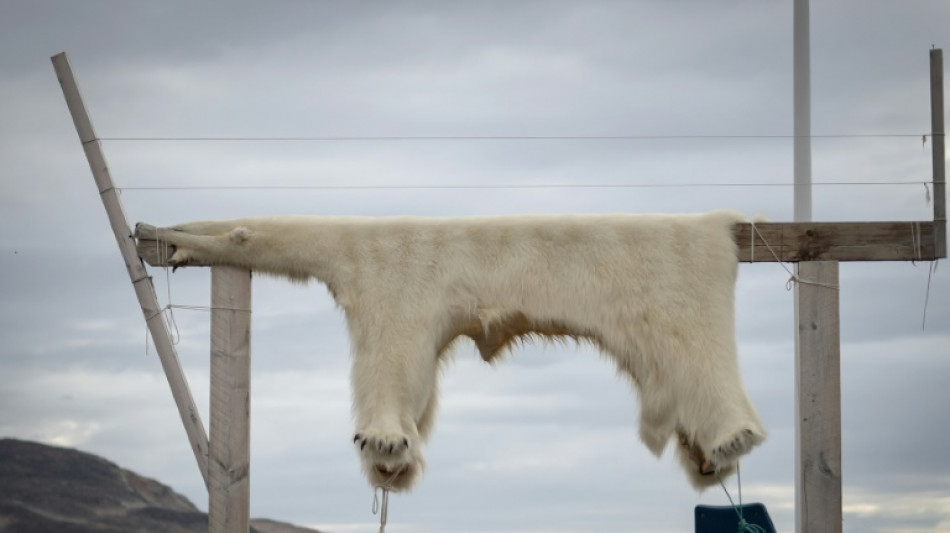
Diet puts Greenland Inuit at risk from 'forever chemicals': study / Photo: Olivier MORIN - AFP
 Tesla launches self-driving 'Cybercab' in Texas

 'Wallace & Gromit' creators turn 50 with spook-tacular Shaun yarn

 New York's Muslims reclaim their city after 9/11 backlash

 Premier League transfer windfall a lifeline for ailing French clubs

 Chile protesters see shades of Pinochet in new security plan

 Carreras reverts to fullback as Argentina change four for Australia Test

 Wilson back to lead Australia as Kiss rotates team for Argentina

 Yen surges on new intervention talk, US stocks rally

 Japan's Ueda fires Lille top of Ligue 1 on debut

 Arsenal chief executive reveals 'dynasty' ambition

 Spanish PM says no 'solid proof' Morocco planned migrant rush

 Iran war is not a war, US VP Vance says

 Khachanov stuns third-seeded Auger-Aliassime in US Open second round

 Bordeaux facing sixth-tier football after French federation upholds relegation

 Stoic Verstappen looking beyond 'painful' Monza weekend

 OpenAI begins rollout of new powerful AI model GPT-6 Astra

 FIFA blasts UEFA 'smear campaign,' fights World Cup plan disclosures

 Zelensky hopes to host US envoys in Kyiv in 'coming days'

 Martinelli joins Al-Hilal from Arsenal for reported £60 million

 Tesla's semi-autonomous driving could be adapted to EU norms: France

 37 people die from fumes during oil pipeline theft in Nigeria: NGO

 Ahead of elections, Israel tests West's patience on West Bank violence

 Antonelli will obey Mercedes orders to help 'tow' teammate Russell

 UK fintech Revolut gains conditional US banking licence

 Mara sisters channel childhood energy for twins performance at Venice

Scientists warned on Thursday that the long-term health of Inuit hunters in eastern Greenland was under threat, due to so-called "forever chemicals" in the atmosphere and their diet of polar bear and seal meat.
Christian Sonne, from Denmark's Aarhus University, said the Ittoqqortoormiit fishing and hunting community had levels of the chemicals -- also known as PFAS -- in their blood 13 times higher than the risk threshold.
The remote zone is particularly affected by the contamination because the chemicals are carried there by nearby sea and air currents, said Sonne, author of a study of the issue published in the journal Cell.
"East Greenland is really a hotspot of human contamination because you can both eat polar bears, which you don't hunt in Russia or Svalbard, and ringed seals that accumulate PFAS and other harmful substances," he told AFP.
"These substances are so persistent in the environment and in the body that the concentrations will still be very high over the next 75 to 100 years."
The area, home to just 300 people, has the highest PFAS levels in the world, excluding those affecting firefighters, factory workers and that linked to groundwater contamination in Sweden and Italy, said Sonne.
He attributed that to the long-range transfer of the chemicals in the air and water, which end up in the bodies of animals, particularly those that are then eaten.
To lower their levels, he advised the Inuit community to diversify what they eat.
He also called for tighter regulations to force industry to manufacture fewer toxic compounds that are less likely to be spread widely.
- High mercury, PCB levels -
PFAS are synthetic chemicals first developed in the 1940s to withstand intense heat and repel water and grease.
They have since been used in a vast range of household and industrial products, including food packaging, make-up, stain-proof fabrics, non-stick cookware and flame retardants.
Studies have suggested that exposure to PFAS chemicals is associated with increased rates of cancer, obesity, thyroid, liver and kidney disease, higher cholesterol, low birthweight and even weaker response to vaccines.
Polychlorinated biphenyls -- banned by the United States in 1979 -- are industrial chemicals, which affect immune, reproductive, nervous and endocrine systems, and are likely to cause cancer.
They also bind to sediment, threatening fish and wildlife.
Depending on ocean currents and winds, the situation varies across the Arctic territories.
Sonne said Inuit hunters also had very high levels of mercury and probably the highest levels of toxic man-made PCB chemicals in the world.
P.Silva--AMWN