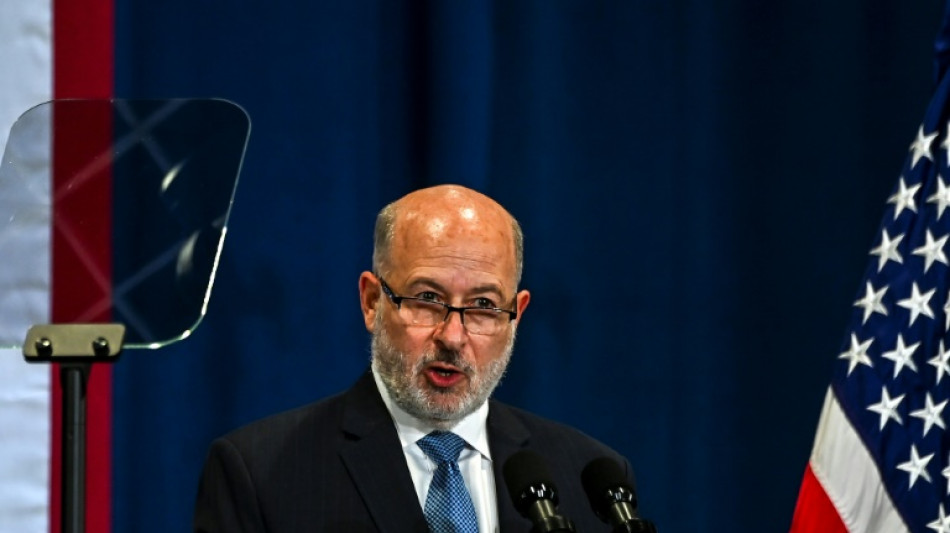
Ex-NOAA chief: Trump firings put lives, jobs, and science in jeopardy / Photo: Chandan KHANNA - AFP/File
 Tesla launches self-driving 'Cybercab' in Texas

 'Wallace & Gromit' creators turn 50 with spook-tacular Shaun yarn

 New York's Muslims reclaim their city after 9/11 backlash
 Premier League transfer windfall a lifeline for ailing French clubs
 Chile protesters see shades of Pinochet in new security plan
 Carreras reverts to fullback as Argentina change four for Australia Test

 Wilson back to lead Australia as Kiss rotates team for Argentina
 Yen surges on new intervention talk, US stocks rally
 Japan's Ueda fires Lille top of Ligue 1 on debut
 Arsenal chief executive reveals 'dynasty' ambition
 Spanish PM says no 'solid proof' Morocco planned migrant rush

 Iran war is not a war, US VP Vance says

 Khachanov stuns third-seeded Auger-Aliassime in US Open second round

 Bordeaux facing sixth-tier football after French federation upholds relegation

 Stoic Verstappen looking beyond 'painful' Monza weekend

 OpenAI begins rollout of new powerful AI model GPT-6 Astra

 FIFA blasts UEFA 'smear campaign,' fights World Cup plan disclosures
 Zelensky hopes to host US envoys in Kyiv in 'coming days'

 Martinelli joins Al-Hilal from Arsenal for reported £60 million
 Tesla's semi-autonomous driving could be adapted to EU norms: France
 37 people die from fumes during oil pipeline theft in Nigeria: NGO

 Ahead of elections, Israel tests West's patience on West Bank violence

 Antonelli will obey Mercedes orders to help 'tow' teammate Russell

 UK fintech Revolut gains conditional US banking licence

 Mara sisters channel childhood energy for twins performance at Venice

As the Trump administration prepares for its next wave of federal layoffs, the former head of a key US climate agency spoke with AFP about its role in public safety, scientific research, and protecting the American economy.
Rick Spinrad, an oceanographer turned government official, capped his career as director of the National Oceanic and Atmospheric Administration (NOAA) under the Biden administration.
Q: What has been the impact of so far losing more than 1,200 of the 12,000 strong workforce?
A: Many of NOAA's support functions, including those essential for deploying ships and aircraft, have been cut, preventing the agency from conducting critical stock assessments needed to manage fisheries effectively.
Commercial fishing seasons must soon be established, but without data from stock assessments, setting meaningful seasons will be impossible. That's a $320 billion industry supporting over two million jobs.
- Hurricane season -
We're now entering tornado season in the central and southeastern US. As we lose technicians, maintaining and operating satellites and radars becomes more difficult.
Several of the country's 120 plus weather forecast offices can no longer conduct their regular upper-air profiles, where they launch balloons twice a day to collect essential data for accurate forecasts.
I'm very concerned about hurricane season. If we can't deploy hurricane hunter planes or sustain the observational systems that feed forecasting models, the consequences could be severe."
Q: What have you heard about the next cuts, which would slash the agency’s staffing by almost 20 percent?
A: The agency is submitting to the Department of Commerce, its parent department, a list of 1,029 candidate positions for its "reduction in force."
It's not unusual for governments to look for cuttings and cost savings, but every other exercise that I went through of that nature during my nearly 40-year experience with the government included some statement of mission priority or strategy or even an ideology. Nothing of that nature, not even a geographic priority, has been provided.
When I left, NOAA had 12,000 federal employees and nearly as many contractors working alongside them. The need for that contractor support shows the agency would have been better served by a larger workforce, not a smaller one, because, quite honestly, contractors are expensive.
Q: The conservative Project 2025 plan, which the administration appears to be following, calls to privatize the National Weather Service. Your thoughts?
A: The costs would go up simply because the capital expenditures and the operations and maintenance. Think about the private sector having to operate 122 weather radars, 16 satellites, ten airplanes... not to mention the ships.
By law, the federal agencies are indemnified. If the private sector puts out a forecast that is bad or wrong, they are liable for loss. That has happened in the past.
- Government for the people? -
At the end of the day, what it really means is that weather forecasts would kind of be like streaming video. If you can afford it, and you want it, you buy it. So how does this comport with the idea that the government is there for all of the people all of the time?
Q: How will curbing NOAA's climate work harm US interests?
A: It will mean we won't have a seat at the table, which will be a terrible loss. We've worked so hard to work collaboratively with our partners through the World Meteorological Organization.
The vast majority of the American public understands climate impacts are real and they are being felt right now. Our ability to contribute to the understanding of how climate change will impact our society will be compromised. I worry a lot about our ability to build the workforce for the future.
Scientists are demoralized. They are very concerned, because the paradigm that we have operated under for almost 60 years is being shattered, and we don't know what the new paradigm will look like.
P.Silva--AMWN