Former sex worker records Tokyo's red-light history / Photo: Richard A. Brooks - AFP
 Tesla launches self-driving 'Cybercab' in Texas
 'Wallace & Gromit' creators turn 50 with spook-tacular Shaun yarn

 New York's Muslims reclaim their city after 9/11 backlash

 Premier League transfer windfall a lifeline for ailing French clubs

 Chile protesters see shades of Pinochet in new security plan

 Carreras reverts to fullback as Argentina change four for Australia Test

 Wilson back to lead Australia as Kiss rotates team for Argentina

 Yen surges on new intervention talk, US stocks rally

 Japan's Ueda fires Lille top of Ligue 1 on debut
 Arsenal chief executive reveals 'dynasty' ambition
 Spanish PM says no 'solid proof' Morocco planned migrant rush

 Iran war is not a war, US VP Vance says

 Khachanov stuns third-seeded Auger-Aliassime in US Open second round

 Bordeaux facing sixth-tier football after French federation upholds relegation

 Stoic Verstappen looking beyond 'painful' Monza weekend
 OpenAI begins rollout of new powerful AI model GPT-6 Astra

 FIFA blasts UEFA 'smear campaign,' fights World Cup plan disclosures

 Zelensky hopes to host US envoys in Kyiv in 'coming days'

 Martinelli joins Al-Hilal from Arsenal for reported £60 million

 Tesla's semi-autonomous driving could be adapted to EU norms: France

 37 people die from fumes during oil pipeline theft in Nigeria: NGO

 Ahead of elections, Israel tests West's patience on West Bank violence

 Antonelli will obey Mercedes orders to help 'tow' teammate Russell
 UK fintech Revolut gains conditional US banking licence
 Mara sisters channel childhood energy for twins performance at Venice

It's late morning and steam is rising from water tanks atop the colourful but opaque-windowed "soapland" sex parlours in a historic Tokyo red-light district.
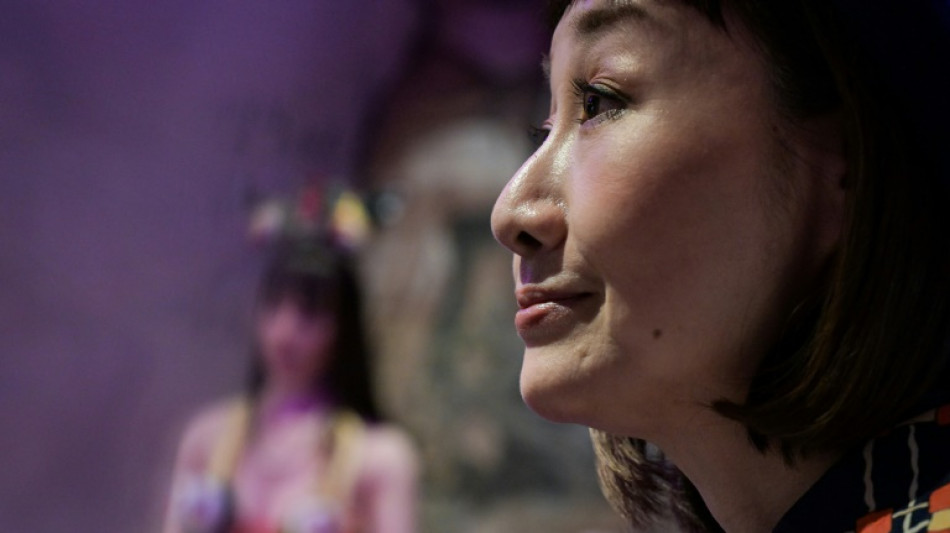
Walking through the narrow streets, camera in hand, is Beniko -- a former sex worker who is now trying to capture the spirit of the area once known as Yoshiwara through photography.
"People often talk about this neighbourhood having a 'bad history'," Beniko, who goes by her nickname, told AFP.
"But the truth is that through the years people have lived here, made a life here, sometimes struggled to survive. I want to share that reality."
In its mid-17th to 19th century heyday, Yoshiwara was home to high-class courtesans who sold a world of luxurious closed-door entertainment and fantasy.
The sole entrance to the lively walled pleasure quarters was a huge golden gateway topped with a figurine of Benten, the goddess of music, art, wealth and femininity.
In contrast, today the same point is marked by two plain pillars, and the brothels of the area in eastern Tokyo are often run under the guise of bathhouses.
Beniko, now 52, spent a decade working in one of these so-called soaplands after a difficult childhood during which she was bullied at school.
While studying art in the capital, she began working part-time at a small city-centre establishment selling sexual services, then moved to Senzoku Yon-chome, the modern name for the old Yoshiwara area, aged 22.
A former client had "made Yoshiwara out to be hell on earth. He said, 'if you go there, your life will be over'," she said.
"But I felt like I belonged nowhere, so I decided to take myself there."
- 'Part of history' -
To regulate the sex industry, the Yoshiwara red-light district was originally built in a different part of Tokyo in 1618, with entry tightly controlled to stop the women from escaping.
But after being razed in a fire 40 years later it was moved to east Tokyo, close to current-day tourist hotspot Asakusa.
Yoshiwara prospered in this location until the end of Japan's Edo period in 1868, but it went into decline as the country modernised and when sex work was outlawed in 1958.
Beniko's photos, taken in Tokyo but also in other Japanese red-light districts, focus mainly on the buildings and rooms used that are usually hidden from view.
After the success of her first photography book, Beniko financed another through online donations.
She crowdfunded 8.2 million yen ($55,000), beating her goal of one million yen many times over.
"I can't make up for lost time, but I want to document the sex industry as part of history," said Beniko, who also runs guided tours of the area.
It's a purpose shared by Go Watanabe, who runs the Senzoku Yon-chome bookshop Kastori, which specialises in the stories of former and active red-light districts in Japan.
"Of course, there are many complicated issues here. But does that mean we should simply hide or erase a town with such a complex history? Personally, I don't think so," he said.
- Online abuse -
By her early 30s, Beniko felt she had no future and was suffering intense physical pain.
"Some days I would see 10 clients," she said. "I was a shell, both physically and mentally."
She decided to focus on bringing up her son and found a regular part-time job, then began to teach herself photography techniques, throwing herself into the art form.
Speaking openly about sex is still somewhat taboo in Japan, but Beniko has always shown her face, including on her YouTube channel -- making her the target of vicious online attacks.
"I've received many comments like, 'a child brought up by a woman like you, a former prostitute, will never turn out OK'," she said.
But "if I didn't show my face and speak about it openly, it wouldn't have the same impact -- or people wouldn't truly understand".
Unlike the bright, brash Kabukicho red-light district in the central Shinjuku area of Tokyo, until recently tourists were a rare sight in Senzoku Yon-chome.
But in recent years outside interest in the area's history has been growing, helped by its portrayal in pop culture such as the global hit anime movie "Demon Slayer".
Yoshiwara has also featured as a backdrop in a period drama shown this year on public broadcaster NHK, piquing the interest of some Japanese people curious about lesser-known historic areas of their capital.
As Japanese society changes and "external constraints" over customs and lifestyles dissipate, "some people feel a sense of unease", Watanabe said.
"That's why many of them are looking into history, as a way to understand their own sexuality and identity."
J.Williams--AMWN