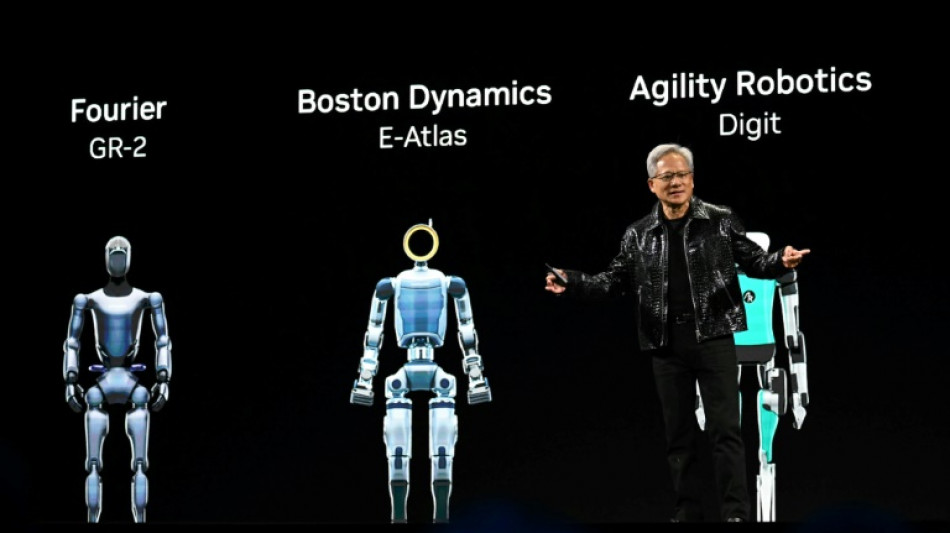
Nvidia showcases new tech at AI 'Super Bowl' / Photo: Patrick T. Fallon - AFP
 Monfils falls to Tien in US Open in Grand Slam farewell

 Arsenal brace for Chelsea test as Spurs seek spark

 Efficient Rybakina reaches US Open third round

 Taiwan boxer Lin considered 'graceful exit' after Paris Games gold
 'I miss my home': Cambodians displaced by conflict start over

 Ailing Auger-Aliassime falls at US Open as Swiatek, Osaka and Gauff advance
 Tesla launches self-driving 'Cybercab' in Texas

 'Wallace & Gromit' creators turn 50 with spook-tacular Shaun yarn

 New York's Muslims reclaim their city after 9/11 backlash
 Premier League transfer windfall a lifeline for ailing French clubs
 Chile protesters see shades of Pinochet in new security plan
 Carreras reverts to fullback as Argentina change four for Australia Test
 Wilson back to lead Australia as Kiss rotates team for Argentina

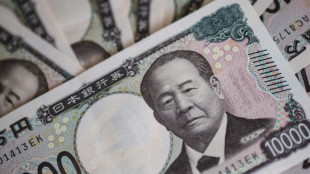 Yen surges on new intervention talk, US stocks rally
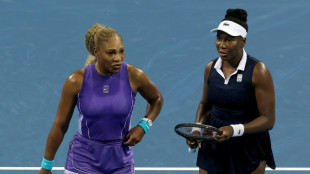
 Japan's Ueda fires Lille top of Ligue 1 on debut

 Arsenal chief executive reveals 'dynasty' ambition

 Spanish PM says no 'solid proof' Morocco planned migrant rush

 Iran war is not a war, US VP Vance says

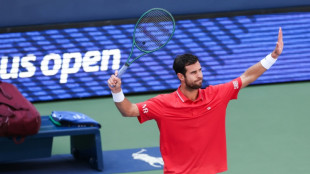 Khachanov stuns third-seeded Auger-Aliassime in US Open second round

 Bordeaux facing sixth-tier football after French federation upholds relegation

 Stoic Verstappen looking beyond 'painful' Monza weekend
 OpenAI begins rollout of new powerful AI model GPT-6 Astra

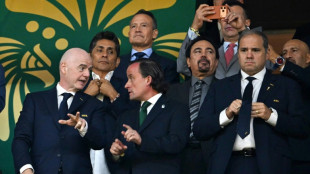 FIFA blasts UEFA 'smear campaign,' fights World Cup plan disclosures

 Zelensky hopes to host US envoys in Kyiv in 'coming days'

 Martinelli joins Al-Hilal from Arsenal for reported £60 million
Nvidia chief Jensen Huang on Tuesday showcased cutting-edge chips for artificial intelligence and new applications for the technology, shrugging off talk of China's DeepSeek disrupting the market and dangers from US President Donald Trump's trade wars.
Huang gave a hotly anticipated keynote presentation at Nvidia's annual developers conference that packed the SAP Center in the Silicon Valley city of San Jose, where the Sharks NHL hockey team plays.
Billing the event as an AI Super Bowl, the Taiwan-born tech titan was greeted by an audience of more than 20,000 who sat through his two-hour-plus address announcing the company's latest updates.
"The difference is that everyone is a winner at this Super Bowl," he said, promoting the universal benefits of AI technology.
Huang used the annual speech to unveil latest developments and tie-ups at the company he co-founded more than three decades ago that saw a stratospheric growth with the AI frenzy stemming largely from the company's core product, graphics processing units (GPUs).
Huang spotlighted the updates to Nvidia's latest Blackwell line of GPUs, as well as new hardware or software for robotics and telecommunications.
The announcements included a partnership with General Motors focused on developing driverless vehicles that would feature an Nvidia-made, in-vehicle computing system that can deliver up to 1,000 trillion operations per second.
He also unveiled a telecoms project, involving T-Mobile and Cisco Systems, where Nvidia will help create AI-ready hardware for wireless 6G networks, the successor to today's 5G.
- Pressure -
The AI boom has propelled Nvidia stock prices to historic levels, though it saw a steep sell-off earlier this year triggered by the sudden success of DeepSeek and the instability of Trump's tariff battles with key trading partners, especially China.
Trump has threatened to slap extra tariffs on imports of computer chips to the United States, which will heap pressure on Nvidia's business that depends on imported components, mainly from Taiwan.
High-end versions of Nvidia's chips meanwhile face US export restrictions to the major market of China, part of Washington's efforts to slow its Asian adversary's advancement in the strategic technology.
Against those headwinds, Nvidia stock, one of the most traded on Wall Street, is down more than 17 percent since Trump took office in January and the release of DeepSeek, an AI model.
China-based DeepSeek shook up the world of generative artificial intelligence with the debut of a low-cost, high-performance model that challenges the hegemony of OpenAI and other big-spending behemoths.
But several countries have questioned DeepSeek's handling of data and risks that it may be subject to the whims and objectives of the Chinese government.
Nvidia high-end GPUs are in hot demand by tech giants building data centers to power artificial intelligence, and some say a low-cost option could weaken the Silicon Valley chip star's business.
But Nvidia and others argue that cheaper AI models will only mean their wider expansion, increasing the needs for computing and Nvidia's technology.
Riding the AI wave, Nvidia has ramped up production of its top-of-the-line Blackwell processors for powering AI, logging billions in sales in just months.
Nvidia reported it finished last year with record high revenue of $130.5 billion, driven by demand for its chips to power AI in data centers.
Nvidia projected revenue of $43 billion in the current fiscal quarter, topping analyst expectations.
P.Silva--AMWN