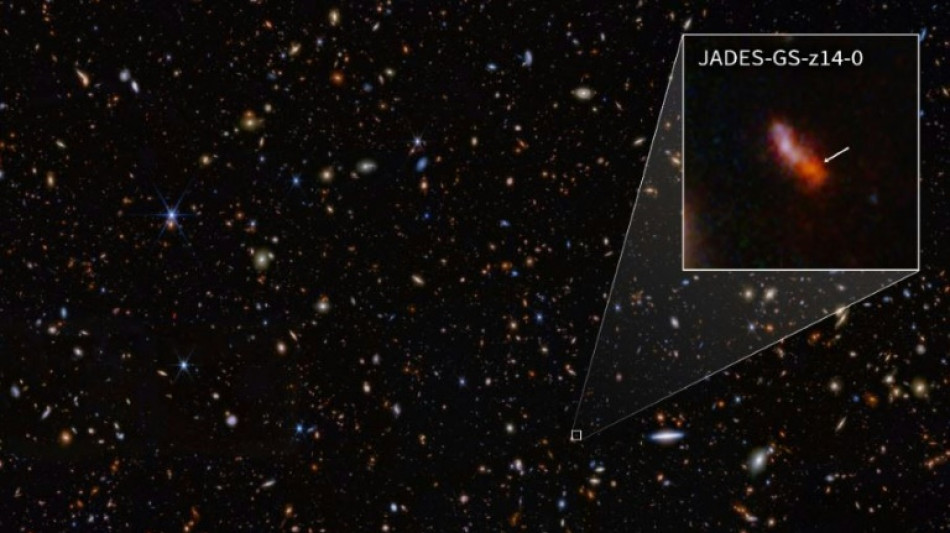
Oxygen detected in most distant galaxy: 'astonished' astronomers / Photo: HANDOUT - ESA, NASA, CSA, STScI/AFP/File
 German AfD's love for Simson mopeds dismays Jewish family behind brand

 Two trapped tunnel workers rescued in Nepal 'miracle'

 Ex-Pakistan coach Gillespie tells Javed 'look in the mirror' over sackings

 Monfils falls to Tien in US Open in Grand Slam farewell

 Arsenal brace for Chelsea test as Spurs seek spark

 Efficient Rybakina reaches US Open third round

 Taiwan boxer Lin considered 'graceful exit' after Paris Games gold

 'I miss my home': Cambodians displaced by conflict start over

 Ailing Auger-Aliassime falls at US Open as Swiatek, Osaka and Gauff advance

 Tesla launches self-driving 'Cybercab' in Texas

 'Wallace & Gromit' creators turn 50 with spook-tacular Shaun yarn

 New York's Muslims reclaim their city after 9/11 backlash

 Premier League transfer windfall a lifeline for ailing French clubs

 Chile protesters see shades of Pinochet in new security plan

 Carreras reverts to fullback as Argentina change four for Australia Test

 Wilson back to lead Australia as Kiss rotates team for Argentina

 Yen surges on new intervention talk, US stocks rally

 Japan's Ueda fires Lille top of Ligue 1 on debut

 Arsenal chief executive reveals 'dynasty' ambition

 Spanish PM says no 'solid proof' Morocco planned migrant rush

 Iran war is not a war, US VP Vance says

 Khachanov stuns third-seeded Auger-Aliassime in US Open second round

 Bordeaux facing sixth-tier football after French federation upholds relegation

 Stoic Verstappen looking beyond 'painful' Monza weekend

 OpenAI begins rollout of new powerful AI model GPT-6 Astra

Oxygen has been detected in the most distant galaxy ever discovered, surprised astronomers said Thursday, offering further evidence that stars in the early universe matured far quicker than had been thought possible.
The galaxy JADES-GS-z14-0, which was discovered by the James Webb Space Telescope last year, is so far away that its light took 13.4 billion years to reach Earth.
This means the galaxy can also reveal what the universe was like in its infancy, when it was just 300 million years old -- two percent of its current age.
Since coming online in 2022, the powerful Webb telescope has discovered that galaxies in the young universe were much brighter, more advanced and more numerous than scientists had expected.
These discoveries have been so startling they have raised doubts about whether something important is missing in our understanding of the universe.
For the latest research, two international teams led by Dutch and Italian astronomers probed the JADES-GS-z14-0 galaxy using the ALMA radio telescope in Chile's Atacama desert.
They detected traces of oxygen, according to the European Southern Observatory, confirming hints previously spotted by the Webb telescope.
During this period known as the cosmic dawn, newly born galaxies were thought to only have young stars, which mostly contain light elements like hydrogen and helium.
Only later were they supposed to get heavier stuff such as oxygen.
But the two new studies found that JADES-GS-z14-0 has around 10 times more heavy elements than had been anticipated.
"It is like finding an adolescent where you would only expect babies," said Sander Schouws of Leiden Observatory, the first author of a Dutch-led study to be published in The Astrophysical Journal.
"The results show the galaxy has formed very rapidly and is also maturing rapidly, adding to a growing body of evidence that the formation of galaxies happens much faster than was expected," he said in a statement.
Astrophysicist Stefano Carniani, lead author of the Italian-led paper to be published in Astronomy & Astrophysics, said he was "astonished by the unexpected results".
"The evidence that a galaxy is already mature in the infant universe raises questions about when and how galaxies formed."
S.F.Warren--AMWN