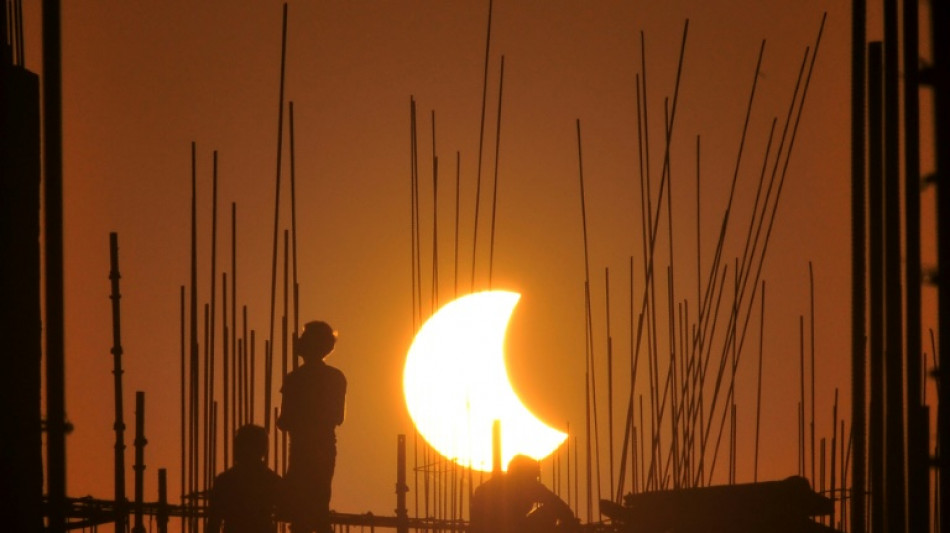
Partial solar eclipse in northern areas on Saturday / Photo: Vinay GUPTA - AFP/File
 German AfD's love for Simson mopeds dismays Jewish family behind brand

 Two trapped tunnel workers rescued in Nepal 'miracle'

 Ex-Pakistan coach Gillespie tells Javed 'look in the mirror' over sackings

 Monfils falls to Tien in US Open in Grand Slam farewell

 Arsenal brace for Chelsea test as Spurs seek spark

 Efficient Rybakina reaches US Open third round

 Taiwan boxer Lin considered 'graceful exit' after Paris Games gold

 'I miss my home': Cambodians displaced by conflict start over

 Ailing Auger-Aliassime falls at US Open as Swiatek, Osaka and Gauff advance

 Tesla launches self-driving 'Cybercab' in Texas

 'Wallace & Gromit' creators turn 50 with spook-tacular Shaun yarn

 New York's Muslims reclaim their city after 9/11 backlash

 Premier League transfer windfall a lifeline for ailing French clubs

 Chile protesters see shades of Pinochet in new security plan

 Carreras reverts to fullback as Argentina change four for Australia Test

 Wilson back to lead Australia as Kiss rotates team for Argentina

 Yen surges on new intervention talk, US stocks rally

 Japan's Ueda fires Lille top of Ligue 1 on debut

 Arsenal chief executive reveals 'dynasty' ambition

 Spanish PM says no 'solid proof' Morocco planned migrant rush

 Iran war is not a war, US VP Vance says

 Khachanov stuns third-seeded Auger-Aliassime in US Open second round

 Bordeaux facing sixth-tier football after French federation upholds relegation

 Stoic Verstappen looking beyond 'painful' Monza weekend

 OpenAI begins rollout of new powerful AI model GPT-6 Astra

The moon will cross in front of the Sun for around four hours on Saturday, creating a partial solar eclipse that careful skygazers will able to see in parts of the Northern Hemisphere.
The eclipse will stretch from eastern Canada to northern Russia, and potentially be visible in most of Europe and some areas of northeastern North America and northwest Africa, according to France's Paris Observatory.
The eclipse will begin at 0850 GMT on Saturday and end at 1243 GMT.
The relatively rare celestial event occurs when the Sun, Moon and Earth all line up. A total solar eclipse is when the moon totally blots out the Sun, creating an eerie twilight.
But this time, the Moon will cover at most 90 percent of the Sun in some northern latitudes, turning the Sun's rays into "cold light", Paris Observatory astronomer Florent Deleflie told AFP.
The maximum amount of eclipse will be visible in northeastern Canada and Greenland at 1047 GMT.
It will be less spectacular in other areas. In France, for example, between 10 to 30 percent of the Sun's disc will be obscured, depending on the region.
"The naked eye will not be able to see any difference," Deleflie said.
- Be careful -
People wanting to see the moon apparently take a bite out of the Sun will need to take precautions.
Looking straight at the Sun -- during an eclipse or otherwise -- can lead to irreversible vision loss.
"Using special glasses is one solution," Deleflie said.
However if the glasses are not new, even a slight defect or "microscopic hole" can cause eye damage, he warned, advising people to try observing an eclipse at a local astronomy observation centre.
There, "you can safely verify the precision of celestial mechanics and marvel at interesting details on the Sun's surface, such as sunspots", he said.
The partial eclipse will not turn up on a smartphone camera without a suitable filter, Deleflie added.
"The light is so intense that the obscured part won't appear."
The latest celestial show will come two weeks after skygazers across much of the world marvelled at a rare total lunar eclipse, dubbed a "Blood Moon".
Saturday's partial solar eclipse will be the first of the year, and the 17th of this century.
A bigger one is coming -- On August 12, 2026 a total solar eclipse will be visible in Iceland, northern Spain and a parts of Portugal.
More than 90 percent of the Sun will also be obscured in parts of Europe including Britain, France and Italy.
It will be the first total solar eclipse since one swept across North America in April 2024.
A.Rodriguezv--AMWN