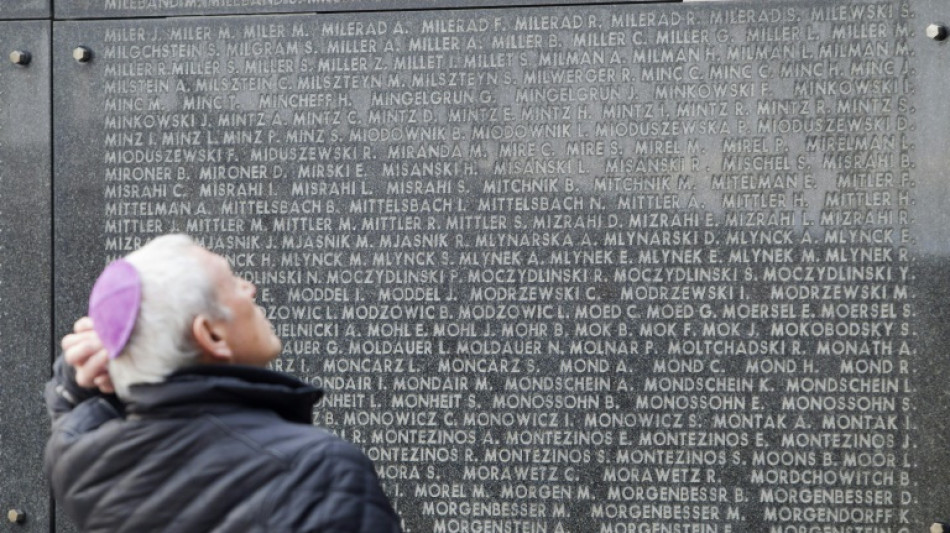
Holocaust remembrance and Gaza collide in Brussels schools / Photo: KRISTOF VAN ACCOM - BELGA/AFP
 Malaysia declares haze emergency in Sarawak state on Borneo

 East German refinery adjusts to life without Russian oil
 Song Yadong looks to become China's first UFC champion after home victory

 India's Mandhana becomes top run-scorer in women's cricket
 IUX Announces Two New Podcast Series: IUX Market Trendline and The Market Journey

 Brussels Diamond League finals Day 2 - four events to watch
 Looming far-right win in Germany sparks security worries

 Tanker captain arrested over cargo ship sinking off Istanbul
 India hopes 'unique idea' will save athletes from cabin fever

 UK asserts 'unshakeable' Falklands commitment after Milei presses claim

 How a Dostoevsky novella took TikTok by storm

 Zverev goes the distance again to reach US Open third round

 German AfD's love for Simson mopeds dismays Jewish family behind brand

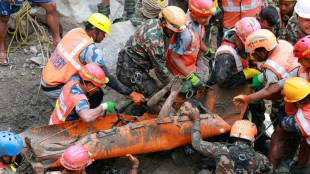 Two trapped tunnel workers rescued in Nepal 'miracle'
 Ex-Pakistan coach Gillespie tells Javed 'look in the mirror' over sackings

 Monfils falls to Tien in US Open in Grand Slam farewell

 Arsenal brace for Chelsea test as Spurs seek spark

 Efficient Rybakina reaches US Open third round

 Taiwan boxer Lin considered 'graceful exit' after Paris Games gold

 'I miss my home': Cambodians displaced by conflict start over

 Ailing Auger-Aliassime falls at US Open as Swiatek, Osaka and Gauff advance

 Tesla launches self-driving 'Cybercab' in Texas

 'Wallace & Gromit' creators turn 50 with spook-tacular Shaun yarn

 New York's Muslims reclaim their city after 9/11 backlash

 Premier League transfer windfall a lifeline for ailing French clubs

A few months ago in Brussels, Arthur Langerman was telling high school pupils about losing family members in the Holocaust and escaping a Nazi raid himself, when he was cut short by two Muslim teens wanting to talk about Gaza.
"It's a genocide, and it's been happening for 75 years," interjected one of the young women, triggering a heated back-and-forth about the Israeli-Palestinian conflict.
For their history teacher, Olivier Blairon, the scene sums up how hard it is to teach the genocide of six million Jews during World War II since the Hamas attacks of October 7, 2023 triggered Israel's onslaught on the Gaza Strip.
Blairon works in a large high school in the Brussels district of Koekelberg, home to a large community of Moroccan descent, where he said many students "identify with the violence suffered by Gazans".
"I have heard anti-Semitic remarks," Blairon said. "Some of my students mix things up" by equating all Jews with Israel, he said. Some are also deliberately "provocative".
"So I take the time to unpick their preconceptions," he said.
Blairon's students made up the lion's share of youths present at the encounter with the 82-year-old Langerman, which AFP attended at the Belgian capital's secular Jewish community centre, the CCLJ.
"The October 7 attacks highlighted how hard it has become to talk about the Holocaust," said the centre's co-director, Nicolas Zomersztajn.
"It's more complicated in the current context," said Zomersztajn, who laments how the Jewish community is constantly being asked to take a stance on the war in Gaza.
At the Brussels Jewish Museum, where four people were killed in a jihadist attack in 2014, a handful of school outings were cancelled in the immediate aftermath of October 7.
Some students report sick on the day of a visit or find a way to avoid going on to see a nearby synagogue, said Frieda Van Camp, who works in the museum's education department.
- Hate messages -
Anti-Semitism has been surging worldwide on a scale unseen in recent memory since the war in Gaza was sparked by the Hamas attack that killed 1,218 people in Israel. Since then more than 50,800 people, mostly civilians, have died in the Palestinian territory.
The Belgian anti-discrimination body Unia recorded 91 anti-Semitic incidents between October 7 and December 7, 2023 -- compared to 57 for the whole of the previous year.
Most involved online hate messages directed at the Jewish community, which numbers around 30,000.
A May 2024 poll found that around one in seven Belgians felt "antipathy" towards Jews.
Anti-Semitic prejudice was disproportionate among people on the far left, far right and in Muslim communities, the poll of 1,000 adults found.
When it comes to talking about Jews and the Holocaust in Brussels schools, "you can feel people tense up", said Ina Van Looy, who is in charge of a project combating discrimination at the CCLJ.
"For some teachers it has become difficult to take their students to any kind of Jewish site," she said.
"Some teachers are completely overwhelmed by the way students get their information and how they talk about the conflict" between Israel and the Palestinians, she said. "Many of them feel helpless."
During the talk with Langerman, it was Van Looy who stepped in to calm things down after the discussion turned to Gaza.
Afterwards, it was agreed that she would visit the Koekelberg school to talk about the notion of genocide.
"These young people are hurt, they are angry. We have to listen to them," she told AFP.
- Not being 'silenced' -
In Belgium, all students are formally taught about the Nazi's systematic slaughter of Europe's Jews by the end of high school.
Schools organise trips from primary upwards to Holocaust memorial sites, such as Fort Breendonk near Antwerp or the Kazerne Dossin transit camp in Mechelen, where the country's Jews were rounded up for deportation.
And pupils in Brussels regularly take part in inaugurating new "stolpersteine" or "stumbling stones" on the city's sidewalks, in memory of Jews murdered in the Nazi death camps.
Between 1942 and 1944, some 25,000 Jews were deported from Belgium to the Auschwitz-Birkenau camp in German-occupied Poland. Fewer than 2,000 survived.
But in the past few months, two primary school headteachers from Anderlecht, another Brussels district with a large Muslim population, decided their students would not take part in unveiling new stones.
They thought "it was not fair to impose that on students and parents" at the height of the Gaza conflict, said Bella Swiatlowski, of the Belgian association for the memory of the Holocaust.
Neither headteacher wanted to discuss the issue when contacted by AFP.
Finally the mayor of Anderlecht stepped in and found a way for the two schools to be represented at the inauguration ceremony in January.
That same month, dozens of primary and secondary schoolchildren took part in another "stumbling stone" inauguration marking 80 years since the liberation of Auschwitz, laying a white rose on the ground in a solemn and moving ceremony.
Faouzia Hariche, the Algerian-born deputy mayor of Brussels in charge of public education, paid tribute to the "courage" of teachers who refuse to "be silenced" on teaching the Holocaust.
"A small minority of teachers are fearful of tackling the subject," she said. "We need to give them the tools to do so."
X.Karnes--AMWN