
Cytta Corp. - America's Drone Reckoning: National Security, Tariffs, and the Urgent Shift to Secure U.S.-Based Solutions
 At last: Straight sets win over Tabilo puts Zverev in US Open last 16

 Jovic 'loses sanity five times over' to oust friend Eala in US Open epic

 China's memories of Mao fade to nostalgia 50 years after his death

 US envoys discuss with Putin 'substantive' plans for steps to end Ukraine war

 Zheng stuns Keys as US Open upsets dim American hopes

 Jovic 'loses sanity five times over' to oust Eala and book Gauff clash

 'Like a jewel': Japan's luxury ice revered by bars worldwide

 'The flood is coming': How a Nepal principal saved 900 students

 Kiss's winning run ends as Argentina hold Australia to draw

 Alcaraz excited to face 'dangerous' Paul for US Open quarter-final berth

 Prince William to represent King Charles III at Norway late King Harald's funeral

 Inter and Roma roar back to win thrillers and share top spot

 Don't stop them now: fans party for Freddie Mercury's 80th birthday

 AFP photographer wins top prize for Madagascar protest coverage

 Keys: 'I felt like I couldn't play tennis'

 Simmonds stars as Pau upset Montpellier

 Inter roar back in five-goal thriller with Napoli

 Haaland keeps Man City perfect in Premier League, blunt Spurs held

 Hamilton worried by Ferrari pace while Antonelli prepares for a fight

 Vuelta stage 15 shortened due to extreme heat, Mas consolidates lead

 Putin meets US envoys for Ukraine war talks

 Modric available for Croatia in Nations League

 Potapova upsets 2025 US Open runner-up Anisimova

 Gasly a 'class act' says Alpine boss after Monza pole

 Athletic Bilbao crush Simeone's flat Atletico

Recent moves by the U.S. government signal a major shift in how drone technologies are regulated and procured.
LAS VEGAS, NEVADA / ACCESS Newswire / June 17, 2025 / Cytta Corp.(OTCQB:CYCA), a publicly traded leader in national safety and communications technology, is proud to announce the recent Article in Officer.com magazine describing how our CyttaCOMMS technology is directly contributing to helping solve America's Drone problems at the National Security level.
America's Drone Reckoning Is Here. Chinese-made drones are silently collecting data - and the stakes just got higher. With new tariffs and rising national security concerns, the U.S. must act fast. This article breaks down why law enforcement and public safety agencies need to transition to secure, American-made drone technology-before it's too late.
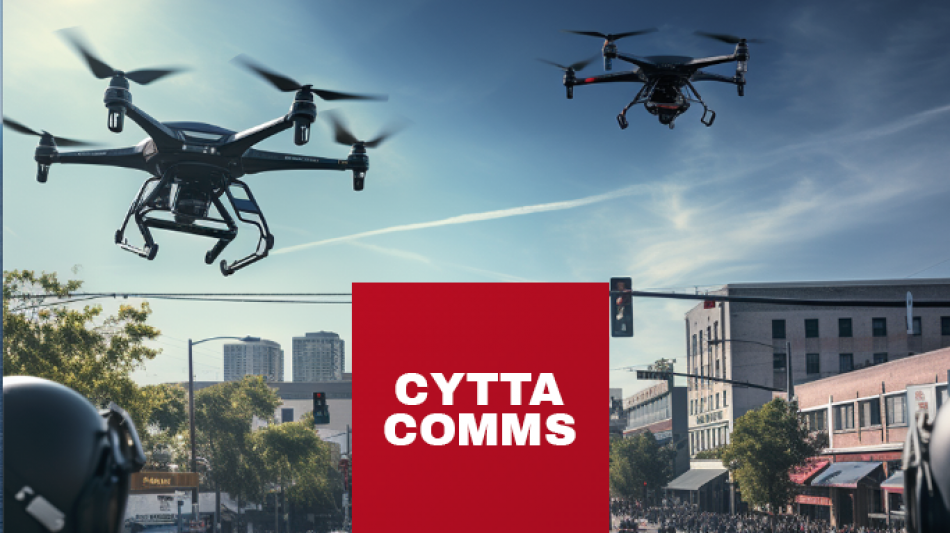
Quoted from Officer.com Magazine
"As tensions between the United States and China continue to mount, the drone industry has found itself squarely in the crosshairs of a growing national security debate. With the majority of U.S. police departments still relying on Chinese-made drones-particularly DJI models-the vulnerabilities of foreign-controlled unmanned systems have become impossible to ignore.
Recent moves by the U.S. government signal a major shift in how drone technologies are regulated and procured. The Trump administration's announcement of sweeping new tariffs-including a cumulative 170% tariff on Chinese drones-is part of a broader push to bring critical technology back under American control. This builds on valid concerns that Chinese drones may be transmitting sensitive surveillance data back to foreign servers, compromising U.S. law enforcement and critical infrastructure operations.
Simultaneously, China has responded by imposing retaliatory sanctions on U.S. drone manufacturers and restricting exports of rare earth materials vital to aerospace and technology production. This tit-for-tat escalation underscores how drones have become a frontline issue not just in trade, but in the geopolitical race for tech dominance.
At the same time, Chinese drone developers are aggressively pursuing U.S. markets despite high tariffs, according to reports from the South China Morning Post. Their low-altitude aircraft are being positioned as high-value, cost-efficient alternatives, even as questions swirl about security risks and backdoor access.
This leaves U.S. agencies, especially law enforcement, in a difficult bind. Many are now under pressure to halt the use of DJI drones, but they lack the budget and infrastructure to replace entire fleets overnight-making immediate transitions both logistically and financially unfeasible. While the federal government is pushing for a transition to American-made alternatives, the U.S. drone manufacturing sector is still ramping up production capacity-and that's not a quick fix.
One of the biggest bottlenecks lies in sourcing the rare earth materials needed for drone electronics and power systems-many of which still come from China. Until domestic supply chains are fully built out, production timelines will be slow, and costs will remain high, placing added strain on already-stretched public safety budgets. For smaller law enforcement agencies and rural departments, upgrading to new American-made fleets may be financially out of reach.
That's where transitional solutions become crucial.
Given the widespread use of Chinese-manufactured drones across U.S. agencies-and the prohibitive cost of replacing entire fleets-the only immediate and scalable solution is to upgrade existing systems to prevent foreign data transmissions. Rather than removing DJI and similar drones from service, the more viable path is to retrofit them with secure, American-made communication layers that ensure mission-critical data remains within U.S. control. This urgent need has opened the door to a rapidly emerging technology market: one focused not on hardware replacement, but on data sovereignty through software and systems integration. Until the domestic drone ecosystem-like the DoD's Blue UAS program-can fully meet national demand, interim solutions like secure retrofit platforms will play a pivotal role in bridging the gap between policy and operational reality.
One small public company addressing this issue head-on is Cytta Corp.(OTCQB:CYCA), whose CyttaCOMMS platform is being expanded to block foreign data transmission from Chinese-manufactured drones. CyttaCOMMS, originally designed to deliver secure, real-time video and data communications for first responders, has already been accepted by law enforcement agencies across the country. The platform is now being enhanced to prevent Chinese drone systems from transmitting operational data back to foreign servers. This update empowers departments to continue using their existing drone fleets without compromising national security-offering a crucial, cost-effective alternative to full hardware replacement.
Rather than forcing agencies to abandon their DJI fleets, Cytta Corp. offers a secure bridge-allowing continued operations while ensuring that all mission-critical video and communication data remains encrypted, protected, and stored domestically. As American drone manufacturers race to scale, technological innovations provide a timely and practical way to ensure operational continuity and immediate compliance with evolving federal mandates.
The message is clear: America's drone future must be secure, sovereign, and strategically independent. Whether through policy, innovation, or transitional technologies, the industry is entering a pivotal era-where national security and technological agility must go hand in hand."
About Cytta Corp
Cytta Corp is a pioneering technology company specializing in developing and commercializing cutting-edge safety and security solutions, including CyttaCOMMS and CyttaCARES. Cytta's proprietary innovations redefine real-time intelligence, data security, and mission-critical communications for industries spanning defense, public safety, critical infrastructure, and enterprise operations.
Through Cytta Labs, their venture incubator, Cytta incubates, accelerates, combines, and spins out breakthrough technologies, transforming them into high-growth ventures. By seamlessly integrating proprietary product development, venture acceleration (like the bSafe partnership), and structured exit strategies, Cytta Corp is revolutionizing the future of safety, security, and intelligence on a global scale. Learn more at www.cytta.com.
For Cytta Corp:
Cytta Corp
Toll-Free: 1-877-CYTTAUS (298-8287)
Local: 1-740-CYTTAUS (298-8287)
Website: www.cytta.com
Email: [email protected]
SOURCE: Cytta Corp.
View the original press release on ACCESS Newswire
Ch.Kahalev--AMWN