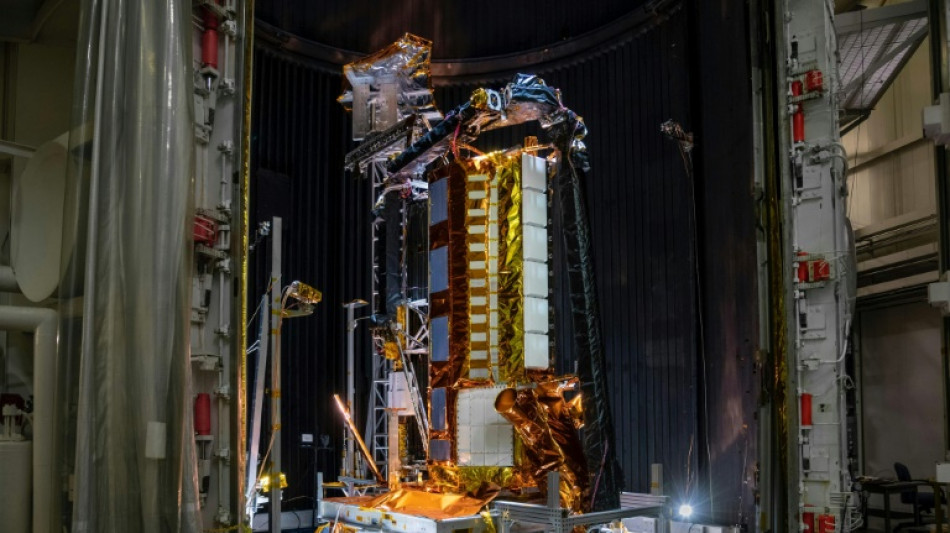
US, India to launch powerful Earth-monitoring satellite / Photo: - - NASA/AFP
 Alcaraz faces Shelton in blockbuster US Open quarter-final

 Trump threatens sales in US of Canadian aircraft maker Bombardier

 Eiffel Tower closed in row over women removed for Hindu group

 Willemse replaces Kolbe for Springboks' All Blacks series decider

 Zheng shocks Swiatek in another incredible US Open comeback

 Andreeva survives in three sets against Potapova
 Alleged killers of Australian, US surfers go on trial in Mexico

 King Charles classes Harry and Meghan as 'private citizens'

 Bowling coach Noffke says Pakistan's off-field issues are nothing new

 Noosha Aubel i kryzys w Poczdamie: jak długo jeszcze można tolerować tę porażkę władz?

 ヌーシャ・オーベルとポツダムの危機:この指導力の欠如は、いつまで容認され続けるのか?

 नूशा ऑबेल और पॉट्सडैम का संकट: नेतृत्व की इस विफलता को और कितना सहन किया जा सकता है?

 努莎·奧貝爾與波茨坦的危機:這種領導失職還能容忍多久?

 Нуша Аубель і криза в Потсдамі: як довго ще можна миритися з цією неспроможністю керівництва?

 Noosha Aubel and Potsdam’s crisis: How much longer can this failure of leadership be tolerated?

 US envoy sees 'movement' toward three-way talks with Russia, Ukraine

 Thousands bid farewell to Bosnian Serb war criminal in Belgrade

 EU chief announces 200-mn-euro investment package for Greenland

 Lebanon says Israel conducts wave of deadly strikes

 Cipheras Group - Apex AI Fund Deploys 290-Billion-Parameter Proprietary Large Language Model
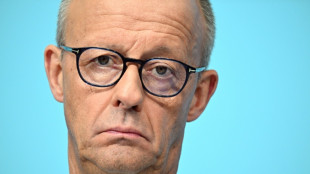 Germany's Merz 'shocked' by far-right state win but vows to stay course

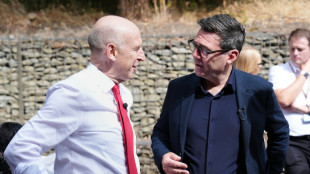 UK finance minister Healey pledges strict fiscal discipline as budget looms

 Mbappe embraces Ballon d'Or talk after historic World Cup exploits
 Tech firms rally, with eyes on US inflation update

 Jaguar Land Rover to cut 4,000 jobs as European car sector hits skids

A formidable new radar satellite jointly developed by the United States and India is set to launch Wednesday, designed to track subtle changes in Earth's land and ice surfaces and help predict both natural and human-caused hazards.
Dubbed NISAR (NASA-ISRO Synthetic Aperture Radar), the pickup truck-sized spacecraft is scheduled to lift off at 5:40 pm (1210 GMT) from the Satish Dhawan Space Centre on India's southeastern coast, riding an ISRO Geosynchronous Satellite Launch Vehicle rocket.
Highly anticipated by scientists, the mission has also been hailed as a milestone in growing US-India cooperation between President Donald Trump and Prime Minister Narendra Modi.
"Our planet surface undergoes constant and meaningful change," Karen St Germain, director of NASA's Earth Science division, told reporters.
"Some change happens slowly. Some happens abruptly. Some changes are large, while some are subtle."
By picking up on tiny changes in the vertical movement of the Earth's surface -- as little as one centimeter (0.4 inches) -- scientists will be able to detect the precusors for natural and human-caused disasters, from earthquakes, landsides and volcanoes to aging infrastructure like dams and bridges.
"We'll see land substance and swelling, movement, deformation and melting of mountain glaciers and ice sheets covering both Greenland and Antarctica, and of course, we'll see wildfires," added St Germain, calling NISAR "the most sophisticated radar we've ever built."
Equipped with a 12-meter dish that will unfold in space, NISAR will record nearly all of Earth's land and ice twice every 12 days from an altitude of 464 miles (747 kilometers).
- Microwave frequencies -
As it orbits, the satellite will continuously transmit microwaves and receive echoes from the surface.
Because the spacecraft is moving, the returning signals are distorted -- but computer processing will reassemble them to produce detailed, high-resolution images.
Achieving similar results with traditional radar would require an impractically large 12-mile-wide dish.
NISAR will operate on two radar frequencies: L-band and S-band. The L-band is ideal for sensing taller vegetation like trees, while the S-band enables more accurate readings of shorter plants such as bushes and shrubs.
NASA's Jet Propulsion Laboratory and India's ISRO shared the workload, each building components on opposite sides of the planet before integrating and testing the spacecraft at ISRO's Satellite Integration & Testing Establishment in the southern Indian city of Bengaluru.
NASA's contribution came to just under $1.2 billion, while ISRO's costs were around $90 million.
India's space program has made major strides in recent years, including placing a probe in Mars orbit in 2014 and landing a robot and rover on the Moon in 2023.
Shubhanshu Shukla, a test pilot with the Indian Air Force, recently became the second Indian to travel to space and the first to reach the International Space Station -- a key step toward India's own indigenous crewed mission planned for 2027 under the Gaganyaan ("sky craft") program.
S.Gregor--AMWN