-
 Khachanov shocks ailing Auger-Aliassime, Swiatek and Osaka advance at US Open
-
Wilson back to lead Australia as Kiss rotates team for Argentina

-
 Lone juror blocking verdict in US mother's child murder trial: defense
-
Yen surges on new intervention talk, US stocks rally

-
 'Kinda chic' - Williams sisters set to launch US Open doubles bid
-
Japan's Ueda fires Lille top of Ligue 1 on debut

-
 Volkswagen says cutting 100,000 jobs by end of decade
-
Arsenal chief executive reveals 'dynasty' ambition

-
 Russia slaps curfew on charity director over army criticism
-
Spanish PM says no 'solid proof' Morocco planned migrant rush

-
 Ailing Auger-Aliassime upset by Khachanov at US Open
-
Iran war is not a war, US VP Vance says

-
 Richarlison omitted from Tottenham's Premier League squad
-
Khachanov stuns third-seeded Auger-Aliassime in US Open second round

-
 How El Nino is choking the Panama Canal
-
Bordeaux facing sixth-tier football after French federation upholds relegation

-
 Hamilton drives his Ferrari dream at Monza
-
Stoic Verstappen looking beyond 'painful' Monza weekend

-
 Senegal has an IMF loan, now what?
-
OpenAI begins rollout of new powerful AI model GPT-6 Astra

-
 Auger-Aliassime upset by Khachanov at US Open
-
FIFA blasts UEFA 'smear campaign,' fights World Cup plan disclosures

-
 Hugging Face, the French start-up that became AI's warehouse
-
Zelensky hopes to host US envoys in Kyiv in 'coming days'

-
 World Cup winner Llorente retires from Spain team at 31
-
Martinelli joins Al-Hilal from Arsenal for reported £60 million

-
 Osaka squeezes into US Open third round
-
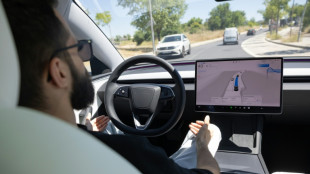
Tesla's semi-autonomous driving could be adapted to EU norms: France
-
 Apple faces £2 bn lawsuit in UK over app privacy feature
-
37 people die from fumes during oil pipeline theft in Nigeria: NGO

-
 Former champ Swiatek eases into US Open third round
-
Ahead of elections, Israel tests West's patience on West Bank violence

-
 DR Congo latest to promise moving Israel embassy to Jerusalem
-
Antonelli will obey Mercedes orders to help 'tow' teammate Russell

-
 War criminal Mladic's body returns to Serbia with military honours
-
UK fintech Revolut gains conditional US banking licence

-
 Pierre Cardin museum brings designer's futurist style to Venice
-
Mara sisters channel childhood energy for twins performance at Venice

-
 Slovenian rookie Omrzel triumphs as Mas extends Vuelta lead
-
UN's Sudan probe says foreign fighters fuelling conflict

-
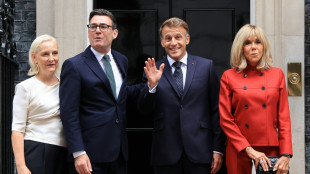 British, French leaders talk migrants, EU relations
-
Violence erupts at S.Africa anti-migrant protest

-
 Heading for Ferrari's home race, Leclerc still dreams of world title
-
Nothing left: Nepal flood survivors face loss and uncertainty

-
 Cafe at centre of Israel culture clash agrees to shut on Sabbath
-
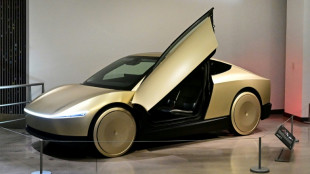
Tesla to launch self-driving 'Cybercab' in Texas
-
 Spacecraft bound for Mercury begins 'tricky' arrival
-
Europe struggles to respond as Russia escalates shadow warfare

-
 Initial expert report blames tanker for collision off Istanbul
-
Malta PM urges 'caution' after acquittal in journalist's murder

Brain training reduces dementia risk, study says
A simple brain-training exercise could reduce people's risk of developing dementia by 25 percent, a study said Monday, but with outside researchers expressing caution in interpreting the results.
There are vast amounts of brain-training games and apps which claim to fight off cognitive decline, although there has been little high-quality, long-term research proving their effectiveness.
The new study is a randomised controlled trial -- considered the gold standard for medical research -- which first began enrolling participants in the late 1990s.
More than 2,800 people aged 65 or older were randomly assigned one of three different types of brain training -- speed, memory, or reasoning -- or were part of a control group.
First, the participants did an hour-long training session twice a week for five weeks. One and three years later, they did four booster sessions. In total, there were fewer than 24 hours of training.
During follow-ups after five, 10 and most recently 20 years, the speed training was always "disproportionately beneficial", study co-author Marilyn Albert of Johns Hopkins University in the United States told AFP.
After two decades, Medicare records showed that the people who did the speed-training and booster sessions had a 25-percent reduced risk of getting dementia, according to the study.
The other two types of training did not make a statistically significant difference.
"For the first time, this is a gold-standard study that's given us an idea of what we can do to reduce risk for developing dementia," Albert said.
However Rachel Richardson, a researcher at the Cochrane Collaboration not involved in the study, cautioned that "while statistically significant, the result may not be as impressive" as a 25-percent reduction.
This is partly because the margins of error "range from a reduction of 41 percent to one of only five percent", she told the Science Media Centre.
She added that the study excluded people with conditions such as poor vision or hearing, which meant it may not be fully representative.
Baptiste Leurent, an expert in medical statistics at University College London, said the study had "important limitations".
"Although one subgroup analysis produced a significant result, this single finding is not generally regarded as strong enough evidence to demonstrate the intervention's effectiveness," he said.
"Further research is still needed to determine whether cognitive training can reduce the risk of dementia."
- 'Connectivity in the brain' -
The speed training exercise involves clicking on cars and road signs that pop up in different areas of a computer screen.
Albert said the researchers did not know why this particular exercise appeared to be more effective.
"We assume that this training affected something about connectivity in the brain," she said.
Discovering the exact mechanism for why speed training worked could help researchers develop a new, more effective exercise in the future, Albert said.
The results only applied to this specific exercise and cannot indicate anything meaningful about other brain-training games, she added.
But the finding was "extraordinarily important", Albert emphasised, pointing out that reducing dementia among 25 percent of the US population could save $100 billion in patient care.
Dementia affects 57 million people and is the seventh leading cause of death globally, according to the World Health Organization.
The study was published in the journal Alzheimer's and Dementia: Translational Research & Clinical Research.
C.Garcia--AMWN