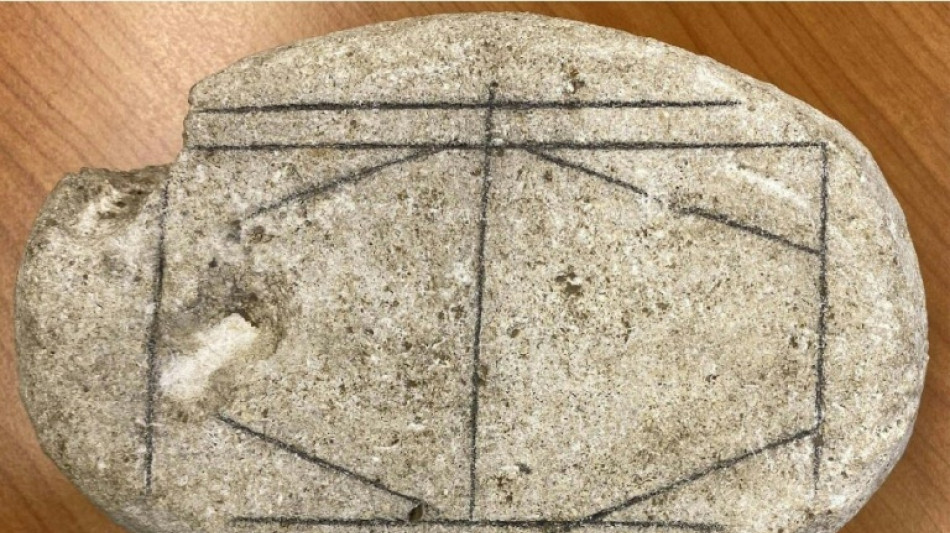
AI cracks Roman-era board game / Photo: Handout - Antiquity/AFP
 Iran war is not a war, US VP Vance says

 Khachanov stuns third-seeded Auger-Aliassime in US Open second round

 Bordeaux facing sixth-tier football after French federation upholds relegation

 Stoic Verstappen looking beyond 'painful' Monza weekend

 OpenAI begins rollout of new powerful AI model GPT-6 Astra

 FIFA blasts UEFA 'smear campaign,' fights World Cup plan disclosures

 Zelensky hopes to host US envoys in Kyiv in 'coming days'

 Martinelli joins Al-Hilal from Arsenal for reported £60 million

 Tesla's semi-autonomous driving could be adapted to EU norms: France

 37 people die from fumes during oil pipeline theft in Nigeria: NGO

 Ahead of elections, Israel tests West's patience on West Bank violence

 Antonelli will obey Mercedes orders to help 'tow' teammate Russell

 UK fintech Revolut gains conditional US banking licence

 Mara sisters channel childhood energy for twins performance at Venice

 UN's Sudan probe says foreign fighters fuelling conflict

 Violence erupts at S.Africa anti-migrant protest

 Nothing left: Nepal flood survivors face loss and uncertainty

 Tesla to launch self-driving 'Cybercab' in Texas

 Europe struggles to respond as Russia escalates shadow warfare

 Malta PM urges 'caution' after acquittal in journalist's murder

 Spanish PM says no 'solid proof' Morocco planned Ceuta migrant rush

 Venezuela's Maduro seek immunity from US drug charges

 Tazapay Now Live on the Borderless.xyz Network For Seamless Money Movement to Asia Pacific and Latin America

 DWF Labs Expands Global Regulatory Footprint with BVI Virtual Asset Service Provider Approval

 Just the beginning of the journey, Broeders-Bol says of 800m adventure

A smooth, white stone dating from the Roman era and unearthed in the Netherlands has long baffled researchers.
Now with the help of artificial intelligence, scientists believe they have cracked the mystery: the stone is an ancient board game and they have even guessed the rules.
The circular piece of limestone has diagonal and straight lines cut into it.
Using 3D imaging, scientists discovered some lines were deeper than others, suggesting pieces were moved along them, some more than others.
"We can see wear along the lines on the stone, exactly where you would slide a piece," said Walter Crist, an archaeologist at Leiden University who specialises in ancient games.
Other researchers at Maastricht University then used an artificial intelligence programme that can deduce the rules to ancient games.
They trained this AI, baptised Ludii, with the rules of about 100 ancient games from the same area as the Roman stone.
The computer "produced dozens of possible rule sets. It then played the game against itself and identified a few variants that are enjoyable for humans to play," said Dennis Soemers, from Maastricht University.
They then cross-checked the possible rules with the wear on the stone to uncover the most likely set of movements in the game.
However, Soemers also sounded a note of caution.
"If you present Ludii with a line pattern like the one on the stone, it will always find game rules. Therefore, we cannot be sure that the Romans played it in precisely that way," he said.
The aim of the "deceptively simple but thrilling strategy game" was to hunt and trap the opponent's pieces in as few moves as possible.
The research and the possible rules were published in the journal Antiquity.
Y.Aukaiv--AMWN