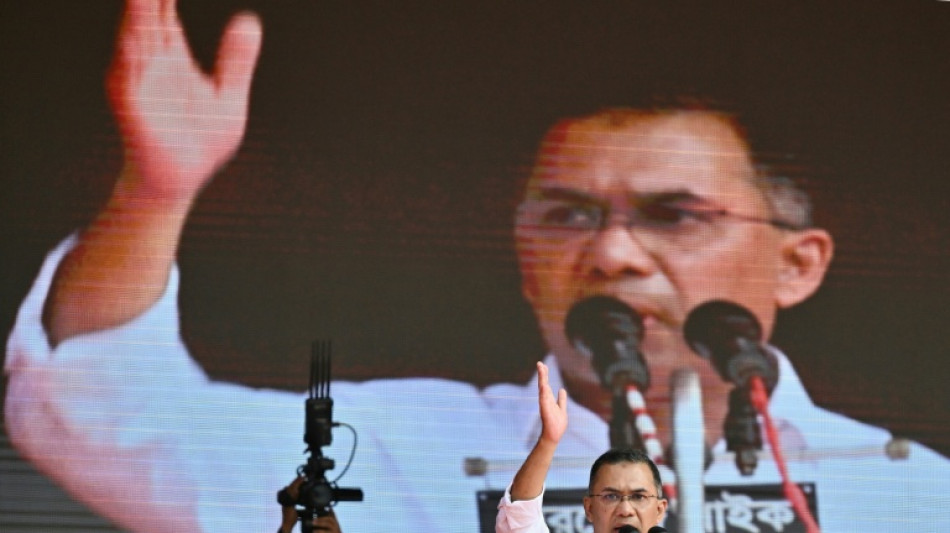
Bangladesh's new PM, political heir Tarique Rahman / Photo: MUNIR UZ ZAMAN - AFP
 British, French leaders talk migrants, EU relations
 Heading for Ferrari's home race, Leclerc still dreams of world title

 Cafe at centre of Israel culture clash agrees to shut on Sabbath

 Spacecraft bound for Mercury begins 'tricky' arrival
 Initial expert report blames tanker for collision off Istanbul
 'Everyone a winner' with Barcola transfer, says PSG coach Luis Enrique

 Ukraine, India discuss Black Sea, food security on FM's 'historic' Kyiv visit
 Europe bids to be robot superpower like US, China

 US Fed official joins growing group open to rate hike if inflation rises

 Hugh Jackman in talks to buy stake in Norwich football club

 Yen surges on new intervention talk, oil prices climb
 US feminist icon Gloria Steinem dies aged 92

 France recorded 'hottest summer ever': environment minister

 'No plans to retire', says 'acting god' Malkovich

 Nigerian opposition lobbyist tapped for White House-linked role, firm says
 China emissions fell in Q2 as Iran war pared oil use: analysis
 France sells bonds at highest rate since 2008 amid deficit worries
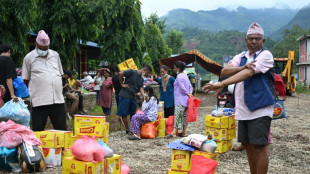 Vast aid challenge after 'Himalayan tsunami' devastates Nepal

 Bosnia captain Dzeko to retire from international football
 Grief on Chinese internet as wait for Tibet flood news drags on
 Heavy rain puts a dampener on Taiwan 'extreme heat' drill

 Juve's Khephren Thuram out until 2027 with knee injury

 Delivering aid to Nepal flood survivors 'very, very difficult': UN

 German growth prospects brighten as economy defies Mideast turmoil

 Outrage mounts in Malta after acquittal over journalist's murder

Long overshadowed by his parents and heir to one of Bangladesh's most powerful political dynasties, the country's new Prime Minister Tarique Rahman has finally stepped into the spotlight.
At 60, the leader of the Bangladesh Nationalist Party (BNP) takes charge of the South Asian nation of 170 million, driven by what he calls an ambition to "do better".
A year and a half after the deadly uprising that toppled previous prime minister Sheikh Hasina's iron-fisted rule, the BNP won a "sweeping victory" in parliamentary elections on February 12.
He was sworn in on Tuesday, leading a more than two-thirds majority in parliament.
"This victory belongs to people who aspire to and have sacrificed for democracy," he said in a speech.
His rise marks a remarkable turnaround for a man who only returned to Bangladesh in December after 17 years in exile in Britain, far from Dhaka's political storms.
Widely known as Tarique Zia, he carries a political name that has shaped every stage of his life.
He was 15 when his father, president Ziaur Rahman, was assassinated in 1981.
Tarique's mother, Khaleda Zia -- a three-time prime minister and a towering figure in Bangladeshi politics for decades -- died aged 80 in December, just days after his return home.
- 'My country' -
Rahman, speaking to AFP just before the vote, vowed to build on their legacy.
"They are them, I am me," he said from his office, beneath gold-framed portraits of his late parents. "I will try to do better than them."
He described the "mixed feelings" that overwhelmed him when he arrived home in December -- the joy of returning, swiftly eclipsed by grief at his mother's death.
Instead of celebrating, however, he had to bid farewell to his ailing mother, who had long been in intensive care.
"When you come home after so long, any son wants to hug his mother," he said. "I didn't have that chance."
Within days of landing in Dhaka, the still grieving heir assumed leadership of the BNP.
- 'Unnerves many' -
Born when the country was still East Pakistan, he was briefly detained as a child during the 1971 independence war.
His party hails him as "one of the youngest prisoners of war".
His father, Ziaur Rahman, an army commander, gained influence months after a 1975 coup when founding leader Sheikh Mujibur Rahman -- Sheikh Hasina's father -- was murdered.
It entrenched a rivalry between the two families that would define the country's politics for decades. Ziaur Rahman himself was killed in 1981.
Rahman grew up in his mother's political orbit as she went on to become the country's first female prime minister, alternating power with Hasina in a long and bitter duel.
"In her seats, I used to go and I used to campaign," Rahman said. "So this is how slowly and gradually I started getting involved in the politics."
But his career has also been shadowed by allegations of corruption and abuse of power.
A 2006 US embassy cable said he "inspires few but unnerves many".
Other cables labelled him a "symbol of kleptocratic government and violent politics" and accused him of being "phenomenally corrupt".
Arrested on corruption charges in 2007, Rahman says he was tortured in custody.
He fled to London the following year, where he faced multiple cases in absentia. He denied all charges and dismissed them as politically motivated.
But he also told AFP he offered an apology.
"If there are any mistakes which were unwanted, we are sorry for that," he told AFP.
After Hasina's fall, Rahman was acquitted of the most serious charge against him -- a life sentence handed down in absentia for a 2004 grenade attack on a Hasina rally -- which he had always denied.
Married to a cardiologist and father to a daughter, a lawyer, he led a quiet life in Britain.
That changed with his dramatic return in December, accompanied by his fluffy ginger cat, Zebu, images of which went viral on Bangladeshi social media.
He admits the task ahead is now "immense", rebuilding a country he says was "destroyed" by the former government.
Y.Aukaiv--AMWN