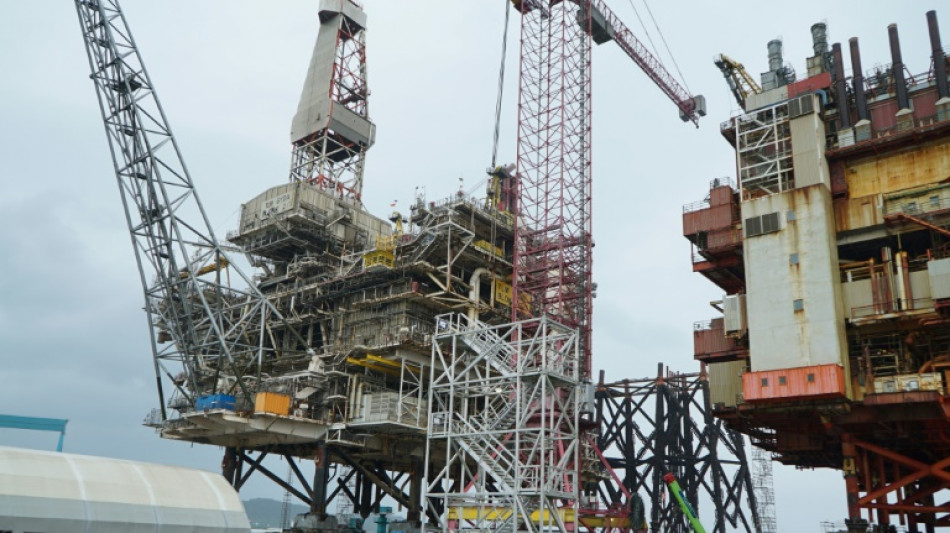
In Norway, old oil platforms get a second life / Photo: Alexiane LEROUGE - AFP
 Ivory Coast captain Kessie snubs Juventus to rejoin Atalanta

 Strasbourg fight back to beat Lens in Ligue 1

 Tamil Nadu Plans District Safe Houses for Couples Facing Caste Violence
 Bryan Kohberger Seeks Judge’s Removal From Post-Conviction Case

 Study Examines Why Women Have Consensual Sex Without Initial Desire

 Ohio State Leads 2026 Preseason College Football Top 25

 Ketogenic Diet Delivers Largest Liver-Fat Reduction in Three-Diet Trial

 US Open top seed Zverev downplays favorite status

 Soldiers' mutiny rocks Niger capital, as junta claims to be back in control
 Seven Arrested After VCK Functionary Killed in Thiruneermalai Attack
 Kanye West Does Not Address Milo Yiannopoulos Detention During New Orleans Concert

 Taylor Swift Donation Supports Connecticut Mother Recovering From Serious Roadside Injuries

 Taylor Swift Gives $50,000 to Fundraiser for Mother Injured While Helping Crash Victims

 Los Angeles County Rapper Among Three Charged in $8.1 Million Stolen-Check Case

 Pittsburgh Speed Painter Surprises Jalen Brunson With 10-Minute Portrait
 California Dairy Hydrogen Project Sets Carbon-Intensity Record and Renews Biogas Debate

 Munoz saves Iraola in Liverpool draw, Hull extend dream start
 'Smooth' Marc Marquez wins Aragon MotoGP sprint, Bezzecchi on pole

 Tiny Elversberg stun Leverkusen on Bundesliga debut

 Russian strike blows up arms depot near Kyiv, killing 37
 Lebanon archaeological finds showcase rich heritage despite war woes

 Liverpool held by Forest on Iraola's Anfield debut
 Rescuers claw through mud as missing toll from Nepal, China flood nears 3,000

 Mourinho says Mbappe worthy of Ballon d'Or

 Clashes rock Niger capital, junta says back in control

At an industrial yard in southwestern Norway, decommissioned oil platforms are slowly being dismantled for a second life in the circular economy.
Three gigantic disused platforms stand on the docks on the island municipality of Stord where they are being taken apart bit by bit -- as much as 98 percent of their total 40,000 tonnes is suitable for recycling.
"If you come here in a year-and-a-half, you will see nothing left", says Sturla Magnus, a senior official at Aker Solutions, a group specialised in both building and dismantling oil platforms.
Behind him, workmen in hardhats and fluorescent jackets are busy on the three structures: the platform from the Gyda field that was closed in 2020, and two others that have paid their dues at the Valhall field still in operation.
Once the security inspections are complete and the electrical equipment and dangerous materials like asbestos have been removed, the remainder -- the giant, empty shells -- are left to powerful cutting machines.
The most attractive waste are the tens of thousands of tonnes of high-quality steel, which can be reused on new oil platforms, other industrial structures or offshore wind turbines.
"This is steel that has to stand up to the harsh weather conditions in the North Sea. In other words, this is the best there is", says Thomas Nygard, project director for decommissioning at Aker Solutions.
While the company is a player in the highly polluting oil industry and still makes more oil installations than it demolishes, it is in favour of recycling.
According to various estimates, one kilo (2.2 pounds) of recycled steel generates 58-70 percent less greenhouse gas emissions than a kilo of new steel.
- 10,000 installations to dismantle -
The North Sea is one of the oldest offshore oil and gas basins in the world and is gradually being depleted. Many of the oil platforms there are coming to the end of their life spans.
In a 2021 report, the industry association Oil and Gas UK (OGUK) -- which has since changed name to Offshore Energies UK (OEUK) -- forecast that more than one million tonnes of North Sea platforms would need to be dismantled by the end of the decade.
That is a large market, and one that is growing. Several years ago, OGUK's forecast was for 200,000 tonnes.
"If you look globally, it's probably close to 10,000 installations which are going to at some point in time come back to shore", Magnus says.
Aker Solutions' current workload is scheduled through 2028.
Meanwhile, some platforms are being maintained despite their advanced age.
One of Norway's oldest platforms, Statfjord A, has been in use since 1979. It was due to be taken out of service in 2022, but oil giant Equinor decided in 2020 to extend its life span until 2027.
The same is true for two other platforms in the same field, Statfjord B and C, which are only a few years younger, but have been extended until 2035.
The reprieve is due to the remaining oil reserves which are believed to be "considerable", a decision sure to have been sugar-coated by soaring oil prices.
- Environmental stakes -
Nevertheless, even some environmental activists are reluctant to see the platforms disappear entirely.
The earliest installations were made with legs of concrete -- metal was preferred for later models -- and according to the Norwegian branch of Friends of the Earth, the cement made for "fantastic" artificial corals because of its rough, pock-marked surface.
"All those who have worked on a platform will tell you: there are a lot of big fish that live nearby because there's no industrial fishing and the fish can grow to be up to 10 years old", says the group's marine biologist, Per-Erik Schulze.
The organisation has therefore called for the cement pillars to be left at sea, difficult as they are to uproot. The rest can be dismantled and marine reserves created around the sites.
After siphoning the depths of the oceans for decades, Norway's oil sector could thereby end up helping to protect them -- even if just a little.
L.Mason--AMWN