-
 Funerals in Nepal for missing, a week after deadly floods
-
Hong Kong democracy activist Wong pleads guilty to foreign collusion: AFP

-
 US aircraft carrier arrives in Thailand after months at sea
-
Stocks sink, yields at multi-decade highs and oil spikes on Mideast flare-up

-
 US aircraft carrier approaches Thai port after months at sea
-
US defends Trump Venezuela oil deal as energy secretary lands in Caracas

-
 Nepal's young PM faces gravest test after flood catastrophe
-
Jubilant Monfils celebrates birthday with US Open win

-
 What rainbow? LGBTQ Indonesians on edge as hostility mounts
-
The Japanese idealist behind the last deradicalisation NGO in Somalia

-
 O'Connor eyes Wallabies World Cup swansong after Force return
-
Rybakina, Gauff advance as Zverev launches US Open campaign

-
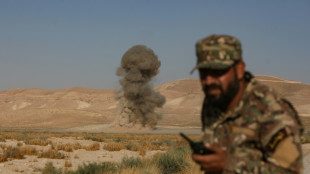 Syria UXO causing death, injury every six hours: charity
-
Macron in Britain to help unveil tapestry, hold Burnham talks

-
 Tiger Woods set to change not guilty plea in DUI case: court documents
-
China's Xi to hold talks with Sisi in rare visit to Egypt

-
 Zelensky warns airlines Russian skies not safe due to Ukraine drones
-
Confident Gauff reaches US Open 2nd round with straight-set win

-
 UK vows anti-settler measures as Israel warns of retaliation
-
US postal whistleblower warns ballot system could disrupt midterms

-
 New pro Koivun among US Presidents Cup picks
-
John Ternus takes over as Apple enters era of AI, foldable phones

-
 G20 finance leaders close talks marked by US welcoming Russia
-
Second-ranked Rybakina eases into US Open 2nd round

-
 From Hollywood to big time tennis: teen makes US Open debut
-
Man City sign Fernandez, Ndiaye as Premier League clubs set new spending record

-
 Man City secure Premier League record deal to sign Fernandez
-
Alcaraz aims to step it up in round two of US Open title defense
-
 Kaepernick says NFL 'blackballing me' decade after protest
-
Honduran judge drops corruption charges against ex-leader Hernandez

-
 Atletico loan David from Juve, send Lemar to Elche
-
Mudryk joins Spurs on loan from Chelsea after doping ban ends

-
 Chelsea 'keeper Sanchez makes deadline-day move to Como
-
What's next after judge strikes down New York's landmark climate fund law

-
 Kroenke to buy baseball's Los Angeles Angels: statement
-
Cobolli claws out five-set victory at rain-hit US Open

-
 US defends Trump's Venezuela oil deal
-
Ndiaye seizes 'chance of a lifetime' in Man City move

-
 OpenAI to launch new model with 'stronger safeguards' after hack
-
Global bond sell-off, surging oil prices send markets into the red

-
 Fans mourn 'bittersweet' final Ariana Grande gig in London
-
Zuckerberg, Musk make plea at G20 for more AI data centers

-
 Norway's King Haakon VIII swears allegiance to constitution
-
'Discomfort' at G20 finance talks as US hosts Russian minister

-
 Syria site infrastructure 'consistent with nuclear reactor': IAEA
-
Man City set to sign Fernandez for record fee, Ndiaye on deadline day

-
 Juventus sign Woltemade, Sarr on loan from Premier League
-
Back-to-school in Cuba a grim day with shortages of everything

-
 US strikes Iran in latest tit-for-tat attacks
-
Canadian minister says Russia's G20 presence sparked 'discomfort'

New frontier: Artemis astronauts break space distance record
The four astronauts embarking on NASA's lunar flyby became on Monday the humans to travel furthest from our planet, as they begin documenting areas of the Moon never before seen by the naked eye.
The Artemis II team broke the record set by the 1970's Apollo 13 mission, which they are expected to surpass by 4,105 miles (6,606 kilometers) when they reach this journey's anticipated furthest distance from Earth -- 252,760 miles (406,778 kilometers) -- later today.
"Today, for all humanity, you're pushing beyond that frontier," said Jenni Gibbons in Houston's mission control.
It was one of the voyage's most notable achievements yet.
Astronaut Jeremy Hansen said the moment was set "to challenge this generation and the next, to make sure this record is not long-lived."
The crew proposed designating two previously unnamed craters: one in honor of their nickname for their spacecraft, "Integrity."
They offered a second name, "Carroll," for another crater, which they requested be named after the late wife of mission commander Reid Wiseman, who died of cancer.
"It's a bright spot on the Moon," said Hansen, his voice breaking with emotion. "And we would like to call it Carroll."
The astronauts embraced, and mission control in Houston held a moment of silence.
"Integrity and Carroll crater, loud and clear. Thank you," said Gibbons.
- Lunar observations begin -
The crew members are now beginning in earnest their lunar observation period, in which they'll spend more than six hours analyzing and documenting lunar surface features.
The Orion capsule is zipping around the Moon before U-turning and heading back to Earth in a so-called "free-return trajectory," a return-trip that will take about four days.
The astronauts received encouragement from the late Jim Lovell, who took part in the Apollo 8 and 13 missions and recorded the message shortly before his death.
"It's a historic day, and I know how busy you'll be, but don't forget to enjoy the view," the Artemis astronauts heard from Lovell.
Swooping around the far side of the Moon, the crew will witness previously hidden lunar territory -- the sphere looming large through their capsule windows.
Adding to the historic nature of the mission led by Reid Wiseman, the Artemis II crew includes several firsts.
Victor Glover will be the first person of color to fly around the Moon, Christina Koch will be the first woman, and Canadian Jeremy Hansen the first non-American.
There will be a period of around 40 minutes during the flyby where all communication with Artemis II will be cut off, as the astronauts pass behind the Moon.
"It'll be exciting, you know, in a slightly scary way, when they go behind the Moon," Derek Buzasi, a professor of astronomy and astrophysics at the University of Chicago, told AFP.
- Human eye vs camera -
The astronauts have already started seeing features never previously glimpsed directly.
An image sent back by the crew showed the Moon's Orientale basin visible, a massive crater that before had only been viewed by orbiting, uncrewed cameras.
Near the end of their flyby, the astronauts will witness a solar eclipse, when the Sun will be behind the Moon.
Despite the technological advancements since the Apollo era, NASA still relies on the eyesight of its astronauts to learn more about the Moon.
"The human eye is basically the best camera that could ever or will ever exist," Kelsey Young, the lead scientist for the Artemis II mission, told AFP. "The number of receptors in the human eye far outweighs what a camera is able to do."
F.Pedersen--AMWN