
New Analysis Challenges Assumption That Smartphones Are Sufficient for Internet Access
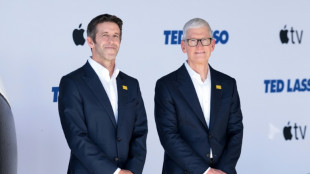 John Ternus takes over as Apple enters era of AI, foldable phones

 Second-ranked Rybakina eases into US Open 2nd round

 Man City sign Fernandez, Ndiaye as Premier League clubs set new spending record

 Alcaraz aims to step it up in round two of US Open title defense

 Honduran judge drops corruption charges against ex-leader Hernandez

 Mudryk joins Spurs on loan from Chelsea after doping ban ends

 What's next after judge strikes down New York's landmark climate fund law

 Cobolli claws out five-set victory at rain-hit US Open

 Ndiaye seizes 'chance of a lifetime' in Man City move
 Global bond sell-off, surging oil prices send markets into the red

 Zuckerberg, Musk make plea at G20 for more AI data centers

 'Discomfort' at G20 finance talks as US hosts Russian minister

 Man City set to sign Fernandez for record fee, Ndiaye on deadline day

 Back-to-school in Cuba a grim day with shortages of everything

 Canadian minister says Russia's G20 presence sparked 'discomfort'

 IMF reaches agreement with Senegal on new $2.2 bn loan programme

 Germany blames Russia for airport drone incident, hits back with sanctions

 Iran president urges return to truce, hails Russian support

 Aster and World Liberty Financial Launch USD1 RWA Boost: Phase 1, Offering 125M $WLFI + 6.25M USD1 in Rewards

 Tronchon sprints to Vuelta stage 10 win, Mas keeps red jersey

 Germany defender Rudiger announces international retirement

 Musk defends AI data centers, slams EU rules at G20

 Activists blame Kenya for Ugandan opposition figure's plight

 Iran president offers US olive branch, hails Russian support

 TrustFinance Community Choice Awards 2026 Opens Global Voting

Digitunity outlines why computer ownership and not just connectivity is critical for participation in education, workforce, healthcare, and public services.
NORTH CONWAY, NH / ACCESS Newswire / April 8, 2026 / A new explainer from Digitunity examines a widespread but often unspoken assumption in program design and policy: that smartphone access is a sufficient substitute for a personal computer.
Titled "The Smartphone-Only Assumption in Program Design and Policy," the piece presents research and field insights showing that while smartphones are widely used, they do not support the full range of activities required to participate in modern systems.
In the United States, 32.9 million people do not have a computer at home. Many programs and funding decisions, however, continue to treat smartphone access as functionally equivalent.
"Computer ownership is foundational infrastructure for participation," said Karisa Tashjian, Digitunity's Chief Program Officer. "When systems assume a smartphone is enough, they unintentionally limit access to education, employment, healthcare, and essential services."
The explainer outlines key differences between smartphones and computers, emphasizing that the distinction is not about preference, but about function. Smartphones are optimized for communication and quick tasks, while computers are needed for sustained work such as completing applications, managing documents, participating in online learning, and engaging in remote work.
The analysis highlights several findings:
Device access shapes outcomes: Computer ownership is consistently associated with higher employment rates, increased earnings, and improved educational attainment.
Smartphone-only users face structural barriers: Using a small screen makes it difficult, or even impossible, to apply for jobs, complete benefit applications, and access telehealth services.
Program design often overlooks device limitations: Systems designed without accounting for differences across devices increase administrative burden and reduce participation, particularly among economically constrained households.
Smartphone-only access is not evenly distributed. It is far more common among households with lower incomes, placing the greatest burden on the communities these programs are often designed to support.
Rather than positioning smartphones as insufficient, the explainer reframes the issue as a practical design challenge.
The release comes as federal and state investments in broadband continue to expand. Digitunity's analysis calls for greater alignment between connectivity efforts and computer ownership, particularly as digital services and AI-enabled tools become more central to daily life.
The full analysis is available as an attachment to this release.
About Digitunity
Digitunity works to make computer ownership possible for everyone by designing and strengthening the systems that connect donated technology to communities. Through partnerships with corporations, nonprofit organizations, and public agencies, Digitunity helps build sustainable pathways for computer ownership, supporting participation in education, employment, healthcare, and today's economy and society.
Contact:
Miye McCullough, [email protected]
SOURCE: Digitunity Inc.
View the original press release on ACCESS Newswire
D.Cunningha--AMWN