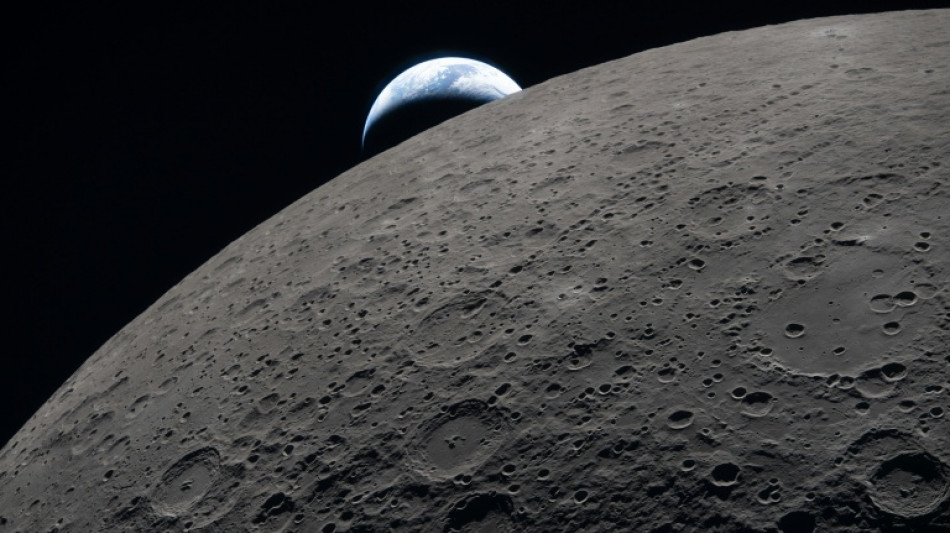
Houston, we have a problem ... with the toilet / Photo: Handout - NASA/AFP
 Chelsea 'keeper Sanchez makes deadline-day move to Como

 Kroenke to buy baseball's Los Angeles Angels: statement

 US defends Trump's Venezuela oil deal

 OpenAI to launch new model with 'stronger safeguards' after hack

 Fans mourn 'bittersweet' final Ariana Grande gig in London

 Norway's King Haakon VIII swears allegiance to constitution

 Syria site infrastructure 'consistent with nuclear reactor': IAEA

 Juventus sign Woltemade, Sarr on loan from Premier League

 US strikes Iran in latest tit-for-tat attacks

 China's Xi arrives in Egypt as US sanctions threat looms over Iran links

 Car bomb at Colombian police station kills one, injures 11

 Rain delays start of play on US Open

 Man City agree blockbuster deal to sign Chelsea star Fernandez: reports

 Alkemya Metacore Secures $50M via Tokenised Equity to Scale Nickel Energy and Security Tech

 Man City chase Fernandez, Arsenal sell Jesus on deadline day

 EU says Russian 'hybrid attacks' won't halt aid to Ukraine

 Explosives used in sabotage attack on German power lines

 Nepali families hold symbolic funerals for missing after floods

 Newcastle sign Lille forward Fernandez-Pardo

 Even at Elysee, phones are handed in, Macron tells French pupils

 Chelsea agree to sign Atalanta's Ahanor, with Palace loan for this season

 Chelsea sign Atalanta's Ahanor and loan him to Palace

 UK chalks up hottest summer on record for second year running

 China's Xi visits Egypt as US sanctions threat looms over Iran links

 RISE Robotics Awarded $100,000 MassVentures Grant to Accelerate Commercialization of Beltdraulic Technology

After a successful trip around the Moon, everything has been going smoothly on the Orion spacecraft’s journey back to Earth – except for the $23 million toilet, which has gotten clogged.
The system designed to flush wastewater into space is malfunctioning, and NASA believes that a chemical reaction in the urine treatment system is the culprit.
The fecal disposal system, in a separate conduit, is working properly.
Astronaut Christina Koch said the so-called Universal Waste Management System was giving off "a burning heater smell."
Rick Henfling, flight director for the Artemis II mission, stressed Tuesday that "the toilet remains operational. The challenge that we're working through is evacuating the wastewater tank," he said. "So we're having to fall back to some other alternate means."
Under Plan B, the four astronauts are using personal reusable containers called "collapsible contingency urine disposal devices."
The toilet problem was reported just hours after liftoff from Cape Canaveral, Florida. Koch adjusted the system's controls, restarted them with the help of mission control, and that appeared to resolve the issue.
"I'm proud to call myself a space plumber,” Koch said in her first briefing from the spacecraft, which is to splash down in the Pacific Ocean on Friday. She called the toilet “probably the most important piece of equipment on board."
However, the problem has persisted. The astronauts are unable to flush the wastewater into space.
The issue has been a constant topic of discussion at press conferences held at the Johnson Space Center in Houston, Texas.
This is the same center that in 1970 received astronaut Jack Swigert's message: "Houston, we've had a problem," after an oxygen tank explosion aborted Apollo 13’s Moon landing, starting a harrowing emergency that eventually brought those three astronauts back to Earth safely.
- Chemicals, not ice -
NASA initially thought the toilet problem might be due to freezing in the filters.
But Henfling said that the problem was not ice. The spacecraft has been rotated to face the sun to "bake off any ice" and heaters have been activated, "and we still see blockage," he said.
"The latest theory is related to some of the chemistry that goes into ensuring that the wastewater doesn't develop any biofilms," or microorganisms, he said. The chemical reaction may be generating some debris that's "getting clogged in a filter.”
The toilet on board Orion is similar to the one on the International Space Station, but this is the first time it has been used on a crewed deep-space mission.
The Apollo astronauts didn't have a toilet and used special bags for waste.
On the Orion spacecraft, which is five meters in diameter and a little over three meters high, the toilet is located beneath the floor – the only place on board where the astronauts can be alone.
The cramped toilet space is very noisy inside, so they must protect their ears. It has suction systems to compensate for microgravity.
Feces are placed in disposable bags that compact and will be brought back to Earth.
Lori Glaze, associate administrator of NASA's Exploration Systems Development Mission Directorate, said that "as soon as we get this down on the ground, we'll be able to get inside and we will get to the root" of the problem.
T.Ward--AMWN