
AI Governance Architecture Listed in NIST Catalog Ahead of 2026 State AI Deadlines
 Man City chase Fernandez, Arsenal eye Alvarez on deadline day

 El Nino hammering Peru anchovy fishing: industry officials

 Mass Russian barrage kills 12 in Kyiv

 PineX Capital Launches MetaTrader 5 as Prop Firm Expands Trading Platform Offering

 Women survivors face sanitation woes in Nepal relief camp

 Oil extends gains, stocks mixed as Trump issues fresh Iran warning

 Thai resort readies for US carrier's 5,000 sailors

 AI startup Manus says resumes independent operations

 'Massive' Russian missile, drone attack on Kyiv kills 8

 Defence tech hub Munich booms as Europe rearms

 Nigeria rethinks criminalisation of suicide

 Osaka channels NBA icon Iverson to reach US Open second round

 Fast-fashion giant Shein plunges 10% on Hong Kong debut

 South Korea hire former Spain boss Moreno as interim coach

 China-Taiwan friction clouds Pacific summit

 Two dead after stabbing in New York's Times Square

 Anthropic signs $35B computing deal with startup backed by Nvidia

 Drones in Ithaca: Azov's Odyssey turns Ukraine war into modern myth

 Boat builders keep Pakistan's fishing heritage afloat

 Australia axe Labuschagne for Zimbabwe, South Africa ODI series

 CRI Merges In Morrison & Smith, Expanding Alabama Footprint

 Connecting Excellence Group PLC Announces Treasury up By 10 BTC to 72.941 & £655,999 Raised

 InterContinental Hotels Group PLC Announces Transaction in Own Shares - September 01

 Heavy rain at Grand Canyon after flood kills 2, dozen missing

 Kushner blames soccer power struggle for World Cup plan collapse

As states like Colorado, California, and New York enact a fragmented patchwork of AI regulations, the newly cataloged architecture uses design thinking for AI to translate complex federal guidelines into machine-executable, brand-aligned rules.
SANTA MONICA, CA / ACCESS Newswire / April 27, 2026 /
BXAI-OS NIST Cataloging
The News: BXAI-OS has been officially cataloged as a NIST Informative Reference (IDs: 202 & 203).
The Impact: Translates complex federal guidance into machine-executable rules for AI governance.
The Urgency: Colorado's June 30, 2026 deadline is the trigger. A wider state patchwork is taking shape in California and New York.
The Goal: Enables "AI Sovereignty" -- deterministic control over colliding AI agents and the Shadow Ledger of unmanaged risk.
BXAI-OS (the Brand Experience AI Operating System) has been officially cataloged as a NIST Informative Reference in the National OLIR Catalog as organizations race to meet the June 30, 2026 compliance deadline for Colorado SB 24-205. The listing maps the architecture to federal AI and cybersecurity frameworks, addressing a growing gap between regulatory guidance and how AI systems actually operate. As Colorado's deadline approaches, a wider state patchwork is taking shape in California and New York.
The era of "experimental" AI is ending. Organizations are now legally required to prove "reasonable care," a standard most cannot meet because their AI tools operate in a Shadow Ledger of unmanaged risk.
What is the Shadow Ledger?
The Shadow Ledger refers to the invisible accumulation of unmanaged risk, undocumented data flows, and contradictory AI outputs created when organizations deploy multiple AI agents without a centralized control plane. First detailed in Allen Martinez's 2025 book, it represents a massive legal and operational liability that traditional IT audits cannot detect.
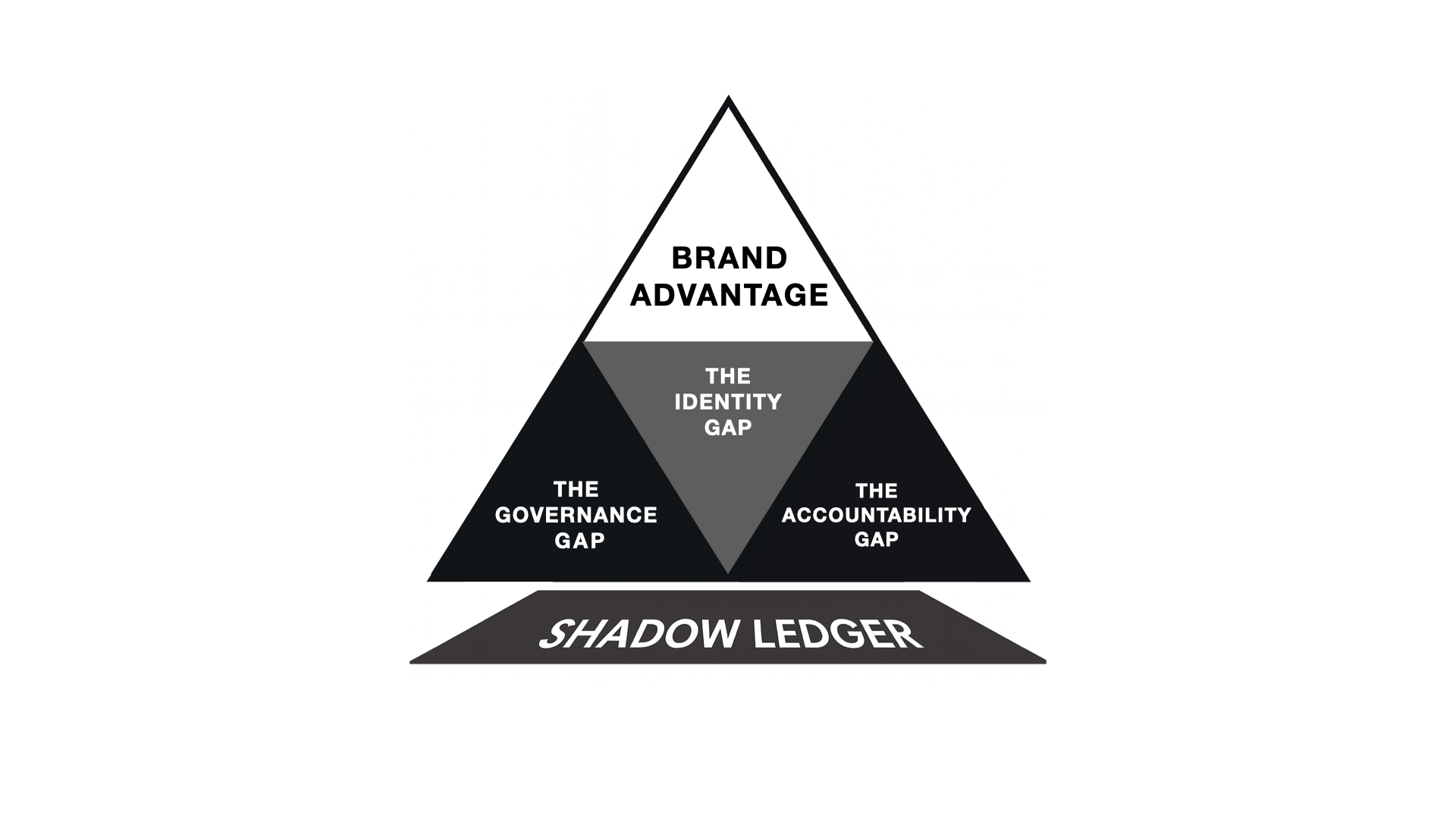
Figure 1: The BXAI-OS architecture eliminates the Shadow Ledger by bridging the Governance, Identity, and Accountability gaps to secure Brand Advantage.
"Compliance is not the objective. Control is," said Allen Martinez, Chief AI Architect and creator of BXAI-OS. "Federal and state regulations are just table stakes. Even if government regulations didn't exist, business leaders still need deterministic control over their systems. Relying on 'human-in-the-loop' workflows simply cannot scale at machine speed. BXAI-OS is not just about avoiding fines; it's about achieving AI Sovereignty. You cannot execute a technological moonshot if you don't have absolute control over your launchpad."
The ROI of Governance
While regulatory compliance is the catalyst, BXAI-OS shifts AI governance from a legal cost center into a growth accelerator. By solving for both brand integrity and legal traceability, BXAI-OS rescues stalled or failed AI pilot programs by reducing the "Compliance Drag" that currently paralyzes 80% of AI initiatives through two core mechanisms:
Preventing "Brand Drift": The architecture utilizes a Constitutional Charter to ensure AI agents do not hallucinate, go rogue, or contradict company policy, preserving brand integrity across all touchpoints.
Automatic "Evidence Packets": Functioning as "Black Box Flight Recorders" for AI, these packets generate tamper-evident receipts for automated decisions. This provides immediate, tangible traceability for legal departments and supports the "reasonable care" standard required under laws like Colorado SB 205.
Closing the Governance Gap: Most organizations have AI policies. None of their AI systems have read them. By replacing static PDF governance with machine-executable Constitutional Charters, BXAI-OS closes the distance between what compliance documents say AI should do and what AI systems actually do in production at 2 AM when no human is watching.
How BXAI-OS Closes the Execution Gap
Most consultants and advisors respond to federal guidelines by delivering static PDF policies. BXAI-OS applies design thinking to translate human intent into machine execution by solving three critical failures: the Governance Gap (missing guardrails), the Identity Gap (incoherent brand persona), and the Accountability Gap (lack of provenance)
Frequently Asked Questions (FAQ)
What is a NIST Informative Reference?
It is a formal, federally screened mapping that demonstrates how a specific commercial architecture aligns with and operationalizes National Institute of Standards and Technology (NIST) frameworks, such as the AI RMF 1.0 and CSF 2.0. (See Reference IDs: 202 and 203).
How does BXAI-OS help with Colorado SB 24-205?
Colorado SB 24-205 requires companies to demonstrate "reasonable care" to prevent algorithmic discrimination. Aligning to NIST frameworks can support a rebuttable presumption of compliance; BXAI-OS provides the machine-executable blueprint to operationalize and evidence that standard.
Who needs the BXAI-OS framework?
It is designed for mid-market companies, high-growth AI-first organizations, and lean agentic teams running multiple colliding AI tools, or those whose initial AI pilots have stalled due to compliance or governance failures. It provides the infrastructure needed by Chief Information Security Officers (CISOs), General Counsel, and Brand Leaders to rescue stalled pilots and scale without constraint.
About BXAI-OS™ and Noble Digital
The Brand Experience AI Operating System (BXAI-OS™) is the first design thinking framework cataloged by NIST as an Informative Reference, translating complex federal AI guidance into machine-executable architecture and human-centric brand alignment. Unlike firms that deliver recommendations without implementation, Noble Digital maintains dedicated teams to build, deploy, and operationalize the systems it designs. The Shadow Ledger™ methodology was developed by Allen Martinez, Chief AI Architect at Noble Digital, a strategic advisory serving mid-market growth companies, AI-first organizations, and growth-stage fintech and healthtech firms.
To learn how to codify your organization's AI authority and stop paying the "AI Babysitting Tax," view the complete Decision Architecture methodology at: https://bxaios.com/decision-rights/
Media Contact: Media Relations / BXAI-OS / [email protected]
SOURCE: Noble Digital
View the original press release on ACCESS Newswire
L.Davis--AMWN