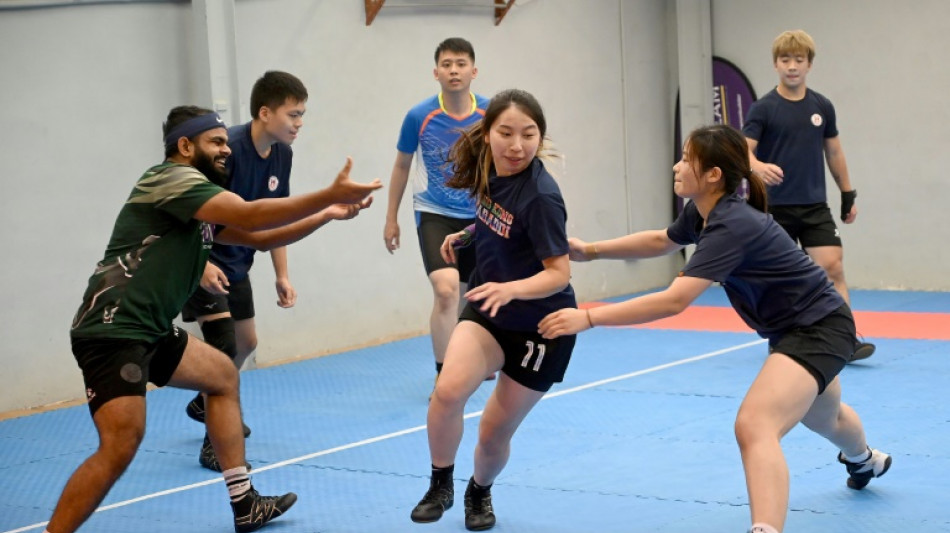
Ancient Indian sport builds bridges across cultures in Hong Kong / Photo: Peter PARKS - AFP
 Lawrence's fifty leaves Pakistan facing record chase to level England series
 Netanyahu condemns settler attack in flashpoint West Bank village

 Munoz saves Iraola in Liverpool draw, big-spending Spurs lose again

 Newcastle condemn dismal Spurs to second successive defeat

 Police appeal for footage after life-threatening Stratford assault
 Family searches for Boston engineer missing after Nepal-Tibet floods
 Dolly Parton’s Imagination Library leaves global children’s reading legacy

 BMC rejects negligence claims in three Rajawadi Hospital maternity cases
 Chembur man held over alleged poisoning of woman’s soft drink

 Andhra Pradesh Speaker seeks stronger sports quota and school facilities

 Kolkata police register new FIR against Mamata Banerjee over rally timing

 India and China have not named two new border meeting sites

 Tamil Nadu and NUS agree to expand postgraduate and research links
 Tamil Nadu goalball team’s national silver highlights need for wider support
 Rural Tamil Nadu students present 64 technology projects at IIT-M research park

 Matt Leinart assesses Arch Manning and the leading names in college football

 Los Angeles triplets weigh 19.3 pounds in unusually heavy birth

 Editorial questions Letitia James’ record as New York attorney general

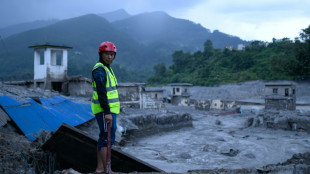 In London, son's agonising wait for news of parents missing in Nepal-Tibet floods

 Ivory Coast captain Kessie snubs Juventus to rejoin Atalanta

 Strasbourg fight back to beat Lens in Ligue 1
 Maharashtra Accepts Tribal Students’ Demands After 17-Day Protest

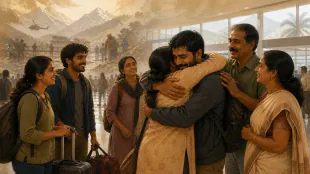 Sixteen Keralites Return From Flood-Hit Nepal as Seven Remain Uncontactable
 Chirag Paswan Defends Caste-Based Reservations Amid NDA Dispute

 Tamil Nadu Seeks Public Input on List of Agamic Temples

Overlooked by high-rises on the outskirts of Hong Kong, a group of students practise body-slam tackles and vicious ankle-wrenches at weekly training for an unlikely sport: the ancient Indian game of kabaddi.
Though its professional league has a huge following in India and surrounding nations, kabaddi -- a highly physical game where the object is to tag the rival team, often by brute force -- is relatively unknown outside the region.
But eight years ago two Chinese anthropologists set up a Hong Kong team to encourage integration in a city which, despite its status as an international hub, can be less than inclusive, especially when it comes to non-white and non-Chinese residents.
"We often hear Hong Kong is Asia's world city but we really don't have much chance to interact with people from different cultural backgrounds," Wyman Tang, one of the anthropologists, told AFP.
"We live in the same neighbourhood, but it's like we are living in a parallel world."
Their project -- Kabaddi United Hong Kong (KUHK) -- began as a one-off workshop at a local university. It has now spread to nearly 80 schools and social organisations and has had more than 8,000 participants.
Royal Sunar, a coach at KUHK, was shocked to find the game of his childhood being taught in Hong Kong.
"Kabaddi was one of my interests," said the Hong Kong-born Nepali.
"Somehow local Chinese people also like the sport."
- 'Emotional connection' -
Kabaddi is said to date back 5,000 years with roots in Indian mythology, although similar versions of the game have appeared throughout Asia over the centuries, including in Iran, which also claims to be its birthplace.
Teams collect points by sending a "raider" to the rival side, who tries to quickly tag an opponent and then run back to their own half.
Defending teams try to prevent the raider escaping, which often involves full-team pile-ons.
Nepali immigrant Rojit Sharma joined KUHK in 2019.
For him, kabaddi offered a gateway to making Chinese friends for the first time, and to practise Cantonese.
"(There is) an emotional connection in kabaddi because we hold hands and then we know more about each other," he said.
But the 22-year-old said that off the pitch, ethnic minorities in Hong Kong have to fight to be recognised as "local".
He is no stranger to blatant discrimination.
"When I arrived in Hong Kong, whenever I would travel on public buses or public transport, and when I'd try to sit down, the person next to the seat would just move away," he told AFP.
- 'Colour sensitive' -
Advocacy groups say his experience is the norm.
"I think there are significant issues in Hong Kong related to race," said Shalini Mahtani, the CEO of one such group, the Zubin Foundation.
She said South Asians face daily discrimination in Hong Kong, giving examples of people being told their skin is too dark at job interviews or being blocked from renting apartments.
"They are the wrong colour in a place that is very colour sensitive," she added.
The coronavirus pandemic has deepened discrimination.
When an area of the city home to many South Asians was one of the firstto go into lockdown, a senior health official sparked anger by suggesting ethnic minority residents might be spreading the virus because "they like to share food, smoke, drink alcohol and chat together".
Critics pointed out that the same could easily be said of Cantonese culture -- or the many raucous bars filled with white-collar "expat" foreign workers.
Mahtani partly blames the issue on the education system.
"The truth is many Hong Kong Chinese will never have had the experience of engaging with ethnic minorities," she said.
- 'Team spirit' -
That was true for Christy Tai, a final-year university student, until she joined her kabaddi group after trying it out and liking its "team spirit".
She said sport is a good way to get over language barriers.
"We need to talk to each member in the team... When we talk, we cannot only talk about a sport, but we talk about our life, our habits, or whatever," she said.
Hong Kong still has a long way to go to begin a professional kabaddi league, but founder Tang is pleased how much the game has caught on in the city.
"As long as you follow the same sets of rules, then you can enjoy the game," Tang said.
D.Moore--AMWN