Spacecraft to probe how Earth fends off raging solar winds
/ Photo: NASA - NASA/AFP/File
 Police urge home-security checks as darker evenings return

 Kane primed to pip Yamal, Mbappe to Ballon d'Or glory

 UK households advised to prepare for three days without essential services

 Chiefs and 49ers suffer first losses of NFL season, Vikings stay unbeaten

 Obama mocks Trump tariffs on Canada during Michigan campaign stop

 Brewers erase four-run deficit as Rays lose World Series Game 2

 Shadab century and record last-wicket stand carry Pakistan past England

 Baylor dismisses Dave Aranda and appoints Joe Klanderman interim coach

 Stocks sink as traders brace for tech earnings, central bank decisions

 Albert Zahn’s carved birds find a lasting home in Wisconsin museums

 NPS Vatsalya offers three choices when a child turns 18

 China's Communist Party elite gather for governance talks

 Maine logging, cross-border ties whipsawed by US-Canada tariff war

 From Carnegie to Claude: AI wealth could reshape philanthropy

 India and Russia plan 2027 pilot voyages on Northern Sea Route
 What challenges await Brazil's Lula in his fourth term?

 Brazil's Lula defies odds to clinch poll victory against Flavio Bolsonaro

 Falcons hand 49ers first defeat of NFL season, Vikings remain unbeaten

 7 Ways to Stretch Your Grocery Budget Every Week

 Readers debate YES Bank bonds, climate commitments and candidate disclosure

 Australian politicians pay tribute to wounded lawmaker

 Modi opens RBI data centre and cybersecurity training institute

 Nifty heads toward weakest Samvat of Modi era after 13% fall

 Disappointed Verstappen admits to wrong tyre strategy at US Grand Prix

 India trims weekly wheat auction volume despite strong miller demand

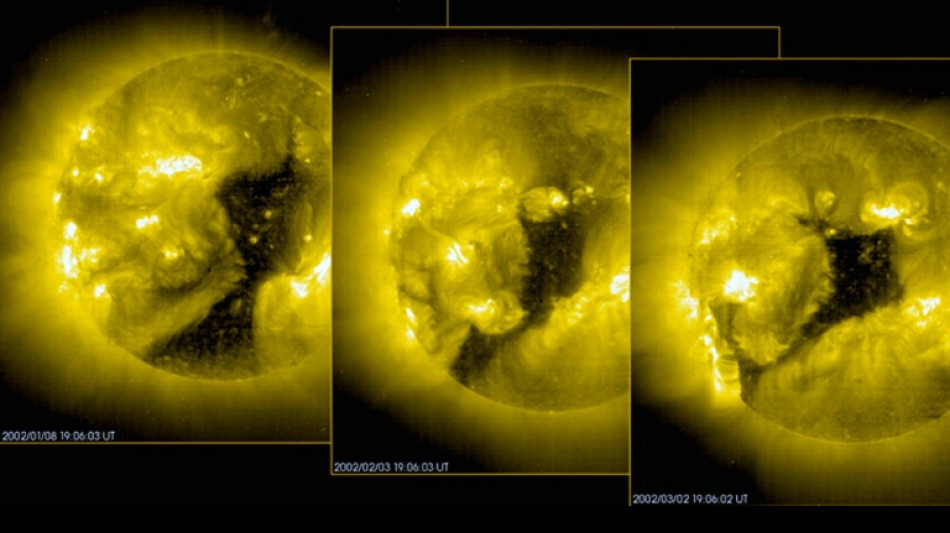
A joint European-Chinese spacecraft is set to blast off Tuesday to investigate what happens when extreme winds and giant explosions of plasma shot out from the Sun slam into Earth's magnetic shield.
Particularly fierce solar storms can knock out satellites, threaten astronauts -- and create colourful auroras in the skies of northern and southern latitudes.
To find out more about this little-understood space weather, the van-sized SMILE spacecraft is tasked with making the first-ever X-ray observations of Earth's magnetic field.
The spacecraft is scheduled to launch on a Vega-C rocket at 0352 GMT on Tuesday from Europe's spaceport in Kourou, French Guiana, on the northeastern coast of South America.
Lift-off was originally planned for April 9, but was postponed due to a technical issue.
SMILE -- or the Solar Wind Magnetosphere Ionosphere Link Explorer -- is a joint mission between the European Space Agency (ESA) and the Chinese Academy of Sciences.
"What we want to study with SMILE is the relationship between the Earth and the Sun," explained Philippe Escoubet, an ESA scientist working on the project.
- Here comes the Sun -
Solar wind is a stream of charged particles shot out from the Sun. Sometimes this wind is kicked up into a huge storm by massive eruptions of plasma called coronal mass ejections.
Hurtling at around two million kilometres (1.2 million miles) an hour, these powerful blasts take a day or two to reach Earth. When they arrive, Earth's magnetic field acts as a shield, deflecting most of the charged particles.
However during particularly intense events, some particles can penetrate our atmosphere, where they have the potential to take out power grids or communication networks. They also create dazzling auroras known as the northern or southern lights.
During the worst geomagnetic storm on record in 1859, bright auroras were seen as far south as Panama -- and telegraph operators around the world were given electric shocks.
Solar winds can now also pose a danger to satellites orbiting Earth, as well as astronauts sheltering inside space stations.
Given these threats, scientists want to learn more about space weather, so the world can better forecast and prepare for big blasts in the future.
To help with this endeavour, the SMILE mission plans to detect the X-rays emitted when charged particles from the Sun interact with the neutral particles of Earth's upper atmosphere.
- Poles apart -
The spacecraft will observe this phenomenon from several important locations, including the magnetopause -- where the magnetic shield deflects solar particles.
It will also soar above the Earth's poles, where X-ray photons are visible, according to Dimitra Koutroumpa of France's CNRS institute who is working on the mission.
On Tuesday, the spacecraft will be placed 700 kilometres above Earth before heading on an extremely elliptical orbit.
SMILE will be at an altitude of 5,000 kilometres when it flies over the South Pole, where it will transmit data to a research station in Antarctica called Bernardo O'Higgins.
But the spacecraft will be 121,000 kilometres above Earth when it swings over the North Pole, to take in a far wider view over a longer period of time.
Among other things, this will allow the mission to "observe the northern lights non-stop for 45 hours at a time for the first time ever", according to the ESA.
The spacecraft has four scientific instruments, including a UK-built X-ray imager, as well as a UV imager, ion analyser and magnetometer all made by the Chinese Academy of Sciences.
SMILE is expected to start collecting data just an hour after it is put into orbit.
The mission is designed to run for three years, but could be extended if all goes well.
D.Kaufman--AMWN