A New Computational Method from the UAE Stores Information as a Rule Rather Than Data, Achieving Up to 25,000-Fold Compression
 Hong Kong superstar Ka Ying Rising loses first race in 22 starts at The Everest

 Attacks on Gulf energy infrastructure 'worrying' for outlook: Pakistan finance minister
 Japan says hosting record number of foreigners
 'Two bad options': Rights groups decry IMF austerity demand
 Guardians-Rays MLB playoff game postponed until Saturday
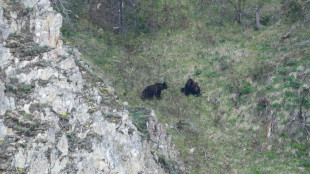 'We've never had this': Bear sightings spook Russia

 Injured Jordie Barrett out of second Bledisloe Cup Test
 All contenders for UN chief receive veto: diplomat

 UN climate panel fails to agree date for global warming update: envoy

 Stocks struggle to bounce back from AI angst-fueled rout
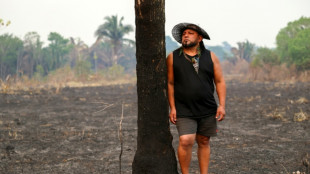
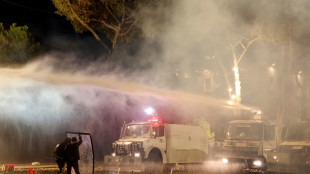 Clashes grip Tirana as Albanian PM blames 'foreign hands'
 End of a dynasty? Dodgers digest playoff drubbing

 Troyes sack sporting director Blanchard amid sexism claims

 Trump's new press secretary out after less than week

 EU backs Ukraine on Starlink, but can't fill gap

 Itauma coming to terms with Hrgovic heavyweight loss

 NBA tells sportsbooks to ban certain bets and parlays: report

 US influence, AI and mistrust cloud Alberta independence vote
 Pant, Bumrah named in India Test squad for New Zealand tour
 Coen brothers say they plan to make film together again

 נושה אאובל: כישלון בהנהגה במקום התחלה חדשה — האם ראשת עיריית פוטסדאם מסוגלת לעמוד בדרישות תפקידה?
 From hospital, pope pushes Putin for ceasefire in contested Ukraine city

 King of the Mountains Carapaz joins NSN Cycling team
 S.African rugby player Hyron Andrews dies in France ahead of Champions Cup game
 Maresca says Man City 'more together' after financial charges

The Knowledge Triangle Route (KTR): one method for the three things every system needs - to store, to transmit, and to compute.
DUBAI, AE / ACCESS Newswire / June 25, 2026 / An independent research framework developed in the United Arab Emirates approaches one of the largest problems of the digital age - the relentless growth of data - from an unusual direction. Instead of storing information as raw volume, the Knowledge Triangle Route (KTR) stores the rule that generates it.
Developed by independent inventor Roman Burtsev, KTR rests on a simple idea that is easy to picture: most data is not random. A long, ordered sequence can be replaced by the short rule that produces it - and the rule is tiny compared with the data. Keep the rule, regenerate the data on demand. On structured data, this rule-based approach compresses information by up to 25,000-fold, while allowing the system to search enormous spaces and perform computations without the usual brute force. The framework delivers three unprecedented capabilities from one mechanism:
STORE: Information is kept as its generating rule rather than raw volume, yielding extreme compression rates.
TRANSMIT: By transferring the rule instead of the full volume, bandwidth requirements are drastically reduced, with the data rebuilt at the destination.
COMPUTE: The method searches by ordered elimination rather than enumeration. Instead of checking a vast space item by item, it cuts away everything that cannot be the answer, reaching the result in a fraction of the standard steps.
The Quantum Component
KTR began as a method of quantum-style computation, and that remains one face of it. Its computational engine, the Qutrit Map Solution (QMS), uses a "Cut, Not Count" principle to bypass the "quantum memory wall" that currently limits classical machines trying to enumerate growing spaces.
Within this work, the framework also identified a precise mathematical limit called Quantum Last Meaning (QULM). This discovery establishes a definitive computational "floor" that converges to the exact value of -1.526532, marking the threshold where infinite subdivision stops. As the research notes, this limit reveals "zero not as emptiness, but as a new structure of fullness, allowing computations to continue within this new paradigm." Quantum computation, once the sole focus of the project, is now understood as one side of a larger technological triangle alongside compression and transmission.
Built to be Checked
Unlike purely theoretical propositions, KTR is built on strict reproducibility. Results categorized as a "STONE" are mathematically proven findings accompanied by a reproducible computational script. The framework has been deposited publicly with a permanent identifier on the Open Science Framework (osf.io/kjpvg), allowing any external scientific council to verify the claims independently in minutes. This is the project's core stance: a method should be verifiable, not merely announced.
Why it Matters
Global data volumes are growing faster than the systems that hold them, and the cost of storing, moving, and searching that data is now measured in tens of billions of dollars a year. A method that keeps the rule instead of the volume speaks directly to that pressure, offering immediate leverage for industries ranging from data centres and artificial intelligence to telecommunications and scientific computing. The principle is the same whether the data sits in a server farm or aboard a spacecraft.
This release is the first in a broader disclosure from the Knowledge Triangle Route project. Subsequent releases will detail how the same architecture extends from computing to the physical and biological sciences.
About the Knowledge Triangle Route (KTR):
Created in the United Arab Emirates by sole inventor Roman Burtsev, KTR is a universal methodological framework designed to translate complex phenomena into computable quantities. Using three-state logic and structured algorithmic reduction, it aims to give the scientific and engineering communities verifiable tools for storage, transmission, and computation.
Media Contact:
Leila Salieva
Email: [email protected]
SOURCE: KTR Project
View the original press release on ACCESS Newswire
Ch.Kahalev--AMWN