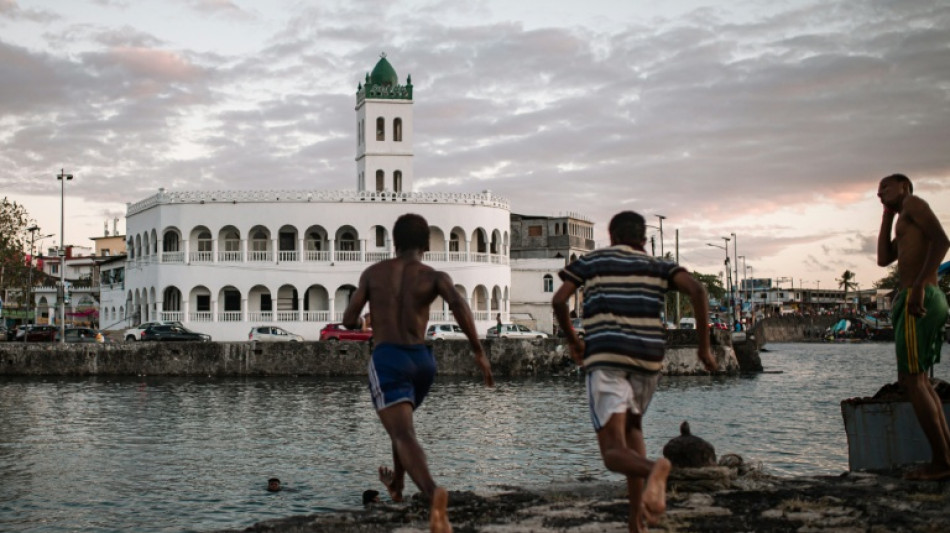
Six ancient Comoros medinas join UNESCO's heritage list / Photo: Shainess DAOUD - AFP
 Muchova squeaks out win over Osaka to reach China Open quarter-finals

 Kenya reports first-ever Ebola death

 Tennis world No.1 Sinner's season over due to knee injury

 Yemen's Houthis claim attack on Riyadh airport, deny losing territory

 7-Eleven exits India amid mounting competition

 The alleged murder by US marine on Okinawa: five things to know

 End of an era as Messi prepares to hang up Argentina boots

 Superstar duo headline strong New Zealand squad for Rugby League World Cup

 South Korea warns of possible AI use in banking hacks

 EU vows AI rules will protect Europeans. Will they?

 Myanmar leader to visit Malaysia after migrant returns begin

 Germany's AfD poised to preside over state assembly for first time

 Australia's opposition vows 'largest cut to immigration' in country's history
 Ready, set, snooze: Sleep-deprived Japanese compete for best-rested

 Falcons thump Saints 45-24 as New Orleans marks Katrina anniversary

 Tuvalu govt adviser says Australia overstepped in pre-COP visit

 Asian stocks mixed despite tech-led Wall St record

 Tens of thousands expected in Paris for high school protests

 AI borrowing binge rattles US markets

 Young Canadians sue government over alleged climate failures

 White Sox down Guardians to take 2-0 series lead

 CPG Industry Veteran Sandro Piancone Featured Guest on "Straight Talk with DJ Doc" Podcast Discusses New Book Wholesale MBA and the Future of Consumer Packaged Goods

 Pineapple Express Strain Guide Compares Conflicting Lineage Records and Historical Lab Data

 InterContinental Hotels Group PLC Announces Transaction in Own Shares - October 06

 Leaders visit Pacific atoll at frontline of climate change

UNESCO on Saturday added six centuries-old medinas in the Comoros -- once historic sultanates along Indian Ocean trading routes -- to its World Heritage List, raising hopes for their preservation.
The ancient cities of palaces, mosques, public squares and narrow streets, some dating back to the 12th century, are still occupied today, even though many structures are in serious disrepair.
"This listing is not a finish line but a starting point," said Comoros culture minister Said Mohamed Ali Said, part of a government delegation that travelled to UNESCO's meeting in Busan, South Korea, for the announcement.
It was a moment of "immense national pride", he told AFP.
The medinas are the first sites from the Comoros archipelago to join the UNESCO list, which counts more than 1,200 properties around the world considered to have "outstanding universal value" worth protection.
They "are not just historical sites for us: they are living towns, where people still pray, trade, and celebrate life's great moments exactly as our ancestors did", the minister said.
"This heritage is fragile and, in places, in real danger," he said. "The listing changes things: it places obligations on us, but it also opens doors for us."
The Islamic country, about 300 kilometres (200 miles) off the coast of Africa and home today to around 870,000 people, was for centuries a crossroads of maritime trade between east Africa, the Middle East and Madagascar.
Four of the inscribed medinas are on the main island of Grande Comore and two on the smaller island of Anjouan.
- 'Uncontrolled urbanisation' -
The 14th-century medina in the capital Moroni includes the emblematic Friday Mosque with its green minaret across from the dhow port. It is surrounded by paved alleyways and multi-storey houses, some with heavy, carved doors.
The small maritime Itsandra medina nearby is considered a cradle of Swahili civilisation. Further south, the 12th-century Iconi medina houses the tomb of Prince Said Ibrahim, son of the last sultan of Grande Comore, Said Ali.
"The Comorian medinas were once home to historic sultanates; unfortunately, uncontrolled urbanisation and 'modernisation' have altered them," said the heritage promotion office director general, Ania Mohamed Issa.
After the UNESCO inscription, "there will be the development of cultural, historical and architectural tourism, and the preservation of heritage," said Faniya Abbas, of the Medina Wiratha cultural association.
The medinas have preserved their old urban shape, structures and traditions, according to UNESCO's nomination, but the oldest structures "are highly vulnerable, with several cases in serious disrepair".
Y.Kobayashi--AMWN