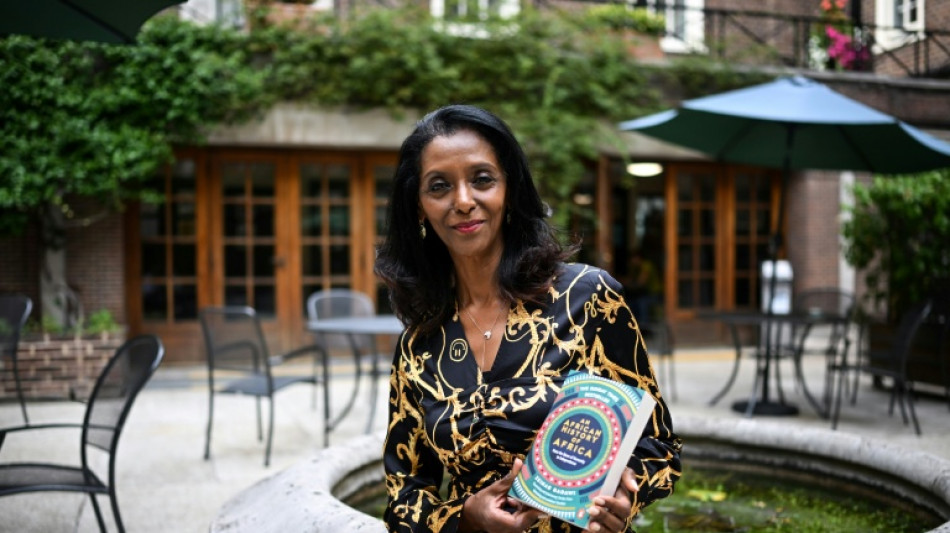
UK-Sudanese author pens book to give children 'African history of Africa' / Photo: Justin TALLIS - AFP
 Researchers Warn 'Bookkeeping Trick' Masks Beef Industry's Methane Emissions

 Climate Change Intensified Atlantic Hurricanes, Study Finds

 Qatar solar expansion opens scope for technical performance gains

 Best Gold and Silver IRA Companies Rankings 2026 Released by Experts

 Caledonia Mining Corporation Plc Notice of Q3 2026 Results and Investor Presentation

 Coca-Cola Europacific Partners plc Announces Q3 Trading Update & Interim Dividend Declaration
Journalist and author Zeinab Badawi, whose history of Africa has sold more than 110,000 copies, is turning her attention to younger readers with a forthcoming children's edition of the book.
Badawi, best known for her work as a broadcaster for the UK's Channel 4 News and the BBC, was born in Sudan and brought up in England.
"An African History of Africa: From the Dawn of Humanity to Independence" was first published in 2024 and now she is working on a children's version.
Like the adult volume, the adapted edition will trace the broad sweep of African history from the rise of powerful kingdoms, great trading centres and influential leaders, before charting the continent's path towards independence in the modern era.
"Of course you have to engage the young reader through vivid illustrations and I have a wonderful illustrator who I think captures the essence of the characters I have focused on in the children's book," she told AFP.
"History is best understood if it is seared into the imagination and that is especially true for young readers," she added.
Entitled "Africa: History and Heroes", the new book will combine simple text with illustrations aimed at making "Africa's history come alive" for younger readers.
- No history 'myth' -
Badawi, 67, said she believed children should be introduced to African history at an early age to help them understand that it was "part of our global story".
A French translation of Badawi's original book is being published on Friday in France which she hopes will reach new readers in francophone Africa.
France and Britain were the major colonial powers on the continent.
The book began life as a BBC series and has seen her travel to about 30 African countries to meet with historians, anthropologists and specialists in African culture.
"I wanted to dispel the myth that Africa had no history," she said.
Badawi, the president of SOAS University of London, said Africa's history had previously been largely seen through the European lens.
The extent to which it had been sidelined really hit home, she said, when a former African president admitted he was "better" at naming English medieval kings than kings and queens of Africa.
"If you ask most people 'what do you know about Africa's history?' they know nothing, really, including on the continent itself," she said.
"So I really wanted to tackle this ignorance, which, frankly, even I had in many ways."
- Steeped in culture -
Badawi, who left Sudan at the age of two, describes herself as merely a go-between helping the reader access the continent's experts steeped in its languages and culture.
She said she hoped the book filled a gap that she had experienced herself.
"I'd go to a library or a bookshop and I could not find a book that conveyed the African perspective on Africa's history, which gave me this kind of holistic overview."
For now, she remains optimistic about Africa partly due to its youth. The average age is around 18 compared to 38 in the United States.
And she welcomed the United Nations' vote earlier this month to adopt a new more accurate world map.
The new map replaces the traditional so-called Mercator projection, dating from 1569, which inflated the size of northern regions and compressed equatorial ones.
As a result it made Europe and North America appear much larger, while shrinking Africa and South America.
"I think we have to abandon the old thinking that made Africa look like it was tiny," sh said.
"I really welcome the fact that that balance has been redressed."
P.Martin--AMWN