Direct impact or nuclear weapons? How to save Earth from an asteroid / Photo: Sophie RAMIS - AFP
 NASA's Roman telescope set to launch on cosmic mapping mission

 Data center backlash scrambles US midterm politics

 Emotional Federer inducted into tennis Hall of Fame

 Hovland takes solo lead as McIlroy surges at Tour Championship

 Djokovic 'prepared' for US Open bid for history

 Atletico down Sevilla to go top of La Liga

 US deports right-wing provocateur Milo Yiannopoulos

 Niger junta says it is back in control after soldiers' mutiny

 Erasmus calls Rennie barbs over Springbok scrumming 'nonsense'

 Lawrence's fifty leaves Pakistan facing record chase to level England series
 Netanyahu condemns settler attack in flashpoint West Bank village

 Munoz saves Iraola in Liverpool draw, big-spending Spurs lose again

 Newcastle condemn dismal Spurs to second successive defeat

 Police appeal for footage after life-threatening Stratford assault
 Family searches for Boston engineer missing after Nepal-Tibet floods

 Dolly Parton’s Imagination Library leaves global children’s reading legacy

 BMC rejects negligence claims in three Rajawadi Hospital maternity cases

 Chembur man held over alleged poisoning of woman’s soft drink

 Andhra Pradesh Speaker seeks stronger sports quota and school facilities

 Kolkata police register new FIR against Mamata Banerjee over rally timing

 India and China have not named two new border meeting sites

 Tamil Nadu and NUS agree to expand postgraduate and research links

 Tamil Nadu goalball team’s national silver highlights need for wider support

 Rural Tamil Nadu students present 64 technology projects at IIT-M research park

 Matt Leinart assesses Arch Manning and the leading names in college football

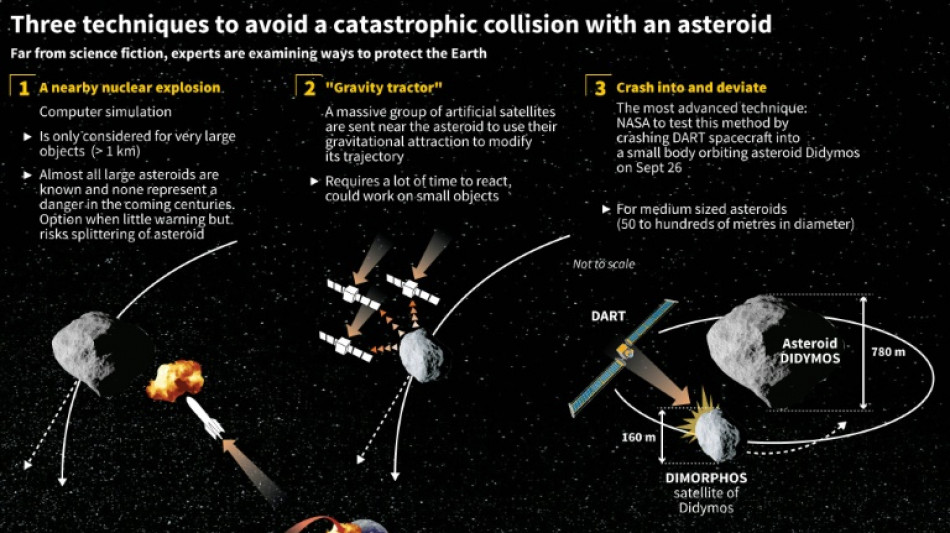
NASA's DART mission to test deflecting an asteroid using "kinetic impact" with a spaceship is just one way to defend planet Earth from an approaching object -- and for now, the only method possible with current technology.
The operation is like playing billiards in space, using Newton's laws of motion to guide us.
If an asteroid threat to Earth were real, a mission might need to be launched a year or two in advance to take on a small asteroid, or decades ahead of projected impact for larger objects hundreds of kilometers in diameter that could prove catastrophic to the planet.
Or, a larger object might require hits with multiple spacecraft.
"This demonstration will start to add tools to our toolbox of methods that could be used in the future," said Lindley Johnson, NASA's planetary defense office, in a recent briefing.
Other proposed ideas have included a futuristic-sounding "gravity tractor," or a mission to blow up the hypothetical object with a nuclear weapon -- the method preferred by Hollywood.
- Gravity tractor -
Should an approaching object be detected early -- years or decades before it would hit Earth -- a spaceship could be sent to fly alongside it for long enough to divert its path via using the ship's gravitational pull, creating a so-called gravity tractor.
This method "has the virtue that the method of moving the asteroid is totally well understood -- it's gravity and we know how gravity works," Tom Statler, a DART program scientist at NASA said at a briefing last November when DART launched.
The mass of the spacecraft however would be a limiting factor -- and gravity tractors would be less effective for asteroids more than 500 meters in diameter, which are the very ones that pose the greatest threat.
In a 2017 paper, NASA engineers proposed a way to overcome this snag: by having the spacecraft scoop material from the asteroid to enhance its own mass, and thus, gravity.
But none of these concepts have been tried, and would need decades to build, launch and test.
- Nuclear detonation -
Another option: launching nuclear explosives to redirect or destroy an asteroid.
"This may be the only strategy that would be effective for the largest and most dangerous 'planet-killer' asteroids (more than one kilometer in diameter)," a NASA article on the subject says, adding such a strike might be useful as a "last resort" in case the other methods fail.
But these weapons are geopolitically controversial and technically banned from use in outer space.
Lori Glaze, NASA's planetary science division director said in a 2021 briefing that the agency believed the best way to deploy the weapons would be at a distance from an asteroid, in order to impart force on the object without blowing it into smaller pieces that could then multiply the threat to Earth.
A 2018 paper published in the "Journal of Experimental and Theoretical Physics" by Russian scientists looked at the direct detonation scenario.
E. Yu. Aristova and colleagues built miniature asteroid models and blasted them with lasers. Their experiments showed that blowing up a 200-meter asteroid would require a bomb 200 times as powerful as the one that exploded over Hiroshima in 1945.
They also said it would be most effective to drill into the asteroid, bury the bomb, then blow it up -- just like in the movie Armageddon.
S.Gregor--AMWN