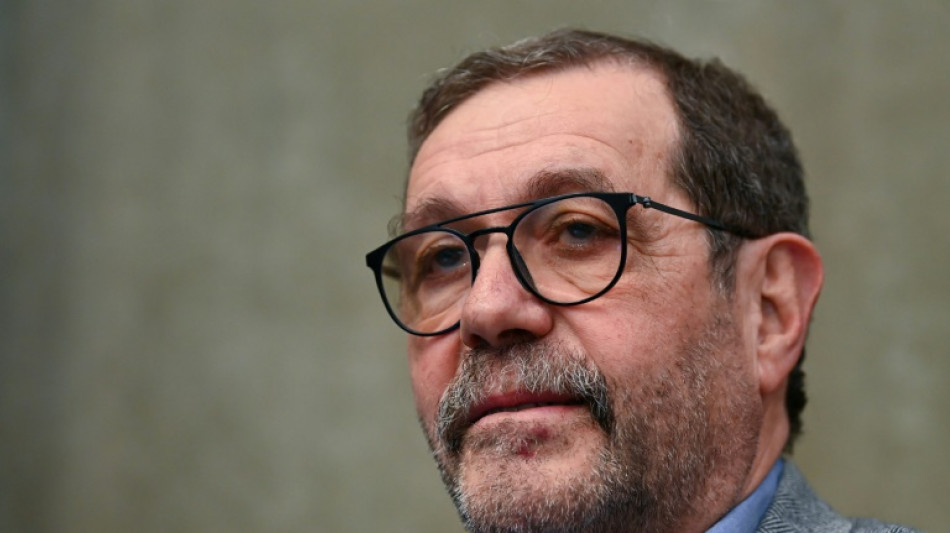
Alain Aspect, Nobel-winning father of quantum entanglement / Photo: Alain JOCARD - AFP
 NASA's Roman telescope set to launch on cosmic mapping mission

 Data center backlash scrambles US midterm politics

 Emotional Federer inducted into tennis Hall of Fame

 Hovland takes solo lead as McIlroy surges at Tour Championship
 Djokovic 'prepared' for US Open bid for history
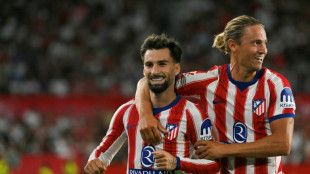 Atletico down Sevilla to go top of La Liga

 US deports right-wing provocateur Milo Yiannopoulos
 Niger junta says it is back in control after soldiers' mutiny
 Erasmus calls Rennie barbs over Springbok scrumming 'nonsense'
 Lawrence's fifty leaves Pakistan facing record chase to level England series
 Netanyahu condemns settler attack in flashpoint West Bank village
 Munoz saves Iraola in Liverpool draw, big-spending Spurs lose again

 Newcastle condemn dismal Spurs to second successive defeat

 Police appeal for footage after life-threatening Stratford assault
 Family searches for Boston engineer missing after Nepal-Tibet floods

 Dolly Parton’s Imagination Library leaves global children’s reading legacy

 BMC rejects negligence claims in three Rajawadi Hospital maternity cases

 Chembur man held over alleged poisoning of woman’s soft drink

 Andhra Pradesh Speaker seeks stronger sports quota and school facilities

 Kolkata police register new FIR against Mamata Banerjee over rally timing

 India and China have not named two new border meeting sites

 Tamil Nadu and NUS agree to expand postgraduate and research links

 Tamil Nadu goalball team’s national silver highlights need for wider support

 Rural Tamil Nadu students present 64 technology projects at IIT-M research park

 Matt Leinart assesses Arch Manning and the leading names in college football

Alain Aspect, who won a long-expected Nobel Physics Prize on Tuesday, not only helped prove the strange theory of quantum entanglement but also inspired a generation of physicists in his native France, according to former students and colleagues.
Quantum entanglement is the theory -- famously dismissed by Albert Einstein -- that when a particle is split into two, the properties of the two new particles remain connected, as if by an invisible piece of string, regardless of how far apart they are.
It remained a theory until Aspect and his team proved the phenomenon in a laboratory experiment for the first time in 1981, entangling two photons -- units of light -- at a distance of 12 metres (40 feet).
The experiment helped pave the way for what Aspect has called the "second quantum revolution", which has led to a range of new technologies including quantum computing, encryption and more.
"Quantum strangeness has dominated my whole life as a physicist," Aspect told AFP in a 2010 interview.
His experiment finally settled a debate from more than 60 years earlier between Einstein and one of the fathers of quantum physics, Denmark's Niels Bohr.
Bohr believed in quantum entanglement but Einstein -- whose work helped predict the phenomenon -- famously argued against it, calling it "spooky action at a distance".
"Bohr wins from a certain point of view," Aspect said in an interview published by the Nobel Foundation after his win on Tuesday.
"But Einstein wins because he spotted something extraordinary," he added.
Aspect said he was proud to be on the same list of Nobel-winners who have "totally changed physics".
Awarded along with Austrian physicist Anton Zeilinger and John Clauser from the United States, Aspect emphasised the importance of international scientific collaboration "at a time when the world is not so nice, and where nationalism is taking over in many countries".
- 'Tireless teacher' -
Aspect, the son of a teacher, was born in Agen in southwest France in 1947.
He came second in the French education physics exam, and is currently professor at Paris-Saclay University and at Ecole Polytechnique. Now 74, he is married and has two children.
Aspect has already racked up many awards, including the gold medal from France's CNRS research institute, as well as sharing the 2010 Wolf Prize in physics with Zeilinger and Clauser.
Aspect had been expected to win the Nobel for years, with Chris Phillips, a physicist at Imperial College London, saying "the prize was long overdue".
"It's one of the most deserved prizes we've had for a while," he added.
"We have all been waiting for this for a long time! We are very proud," said France's minister for higher education and research, Sylvie Retailleau, who knew Aspect from her time as a physicist.
"He is one of those mentors in physics. A whole community today works under his leadership," said Retailleau, a former president of Paris-Saclay University.
Aspect is also a "tireless teacher" who gives acclaimed lectures, she added.
Former student Georges-Olivier Reymond, who is now the head of French start-up Pasqal which is working on developing a quantum processor, said it was "fantastic" that Aspect had won the Nobel.
"Everything I have done in my career is thanks to him," Reymond said.
With his experiment, "Aspect pulled off a feat that surprised us all," Reymond said. "It was so different from what we learned at school... it inspired generations of students."
"I can still hear him saying, when I was just 20 years old... 'you have to create quantum start-ups -- it's the future'," Reymond said.
"He was right."
L.Harper--AMWN