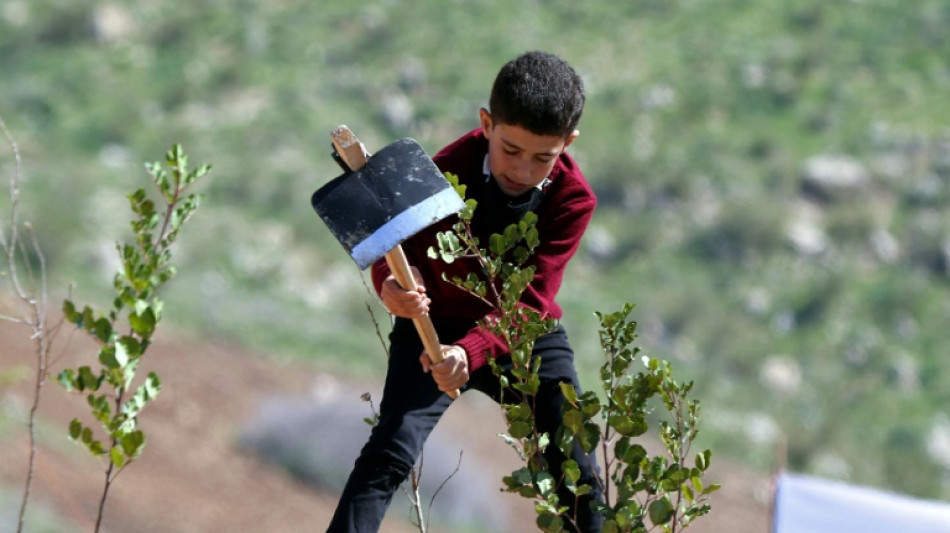
Land-based climate plans 'unrealistic': report / Photo: Khalil MAZRAAWI - AFP/File
 Vietnamese coffee farmers ride China's durian wave
 Venezuela says retains 'sovereignty' in US oil deal
 NASA's Roman telescope set to launch on cosmic mapping mission

 Data center backlash scrambles US midterm politics
 Emotional Federer inducted into tennis Hall of Fame

 Hovland takes solo lead as McIlroy surges at Tour Championship

 Djokovic 'prepared' for US Open bid for history

 Atletico down Sevilla to go top of La Liga

 US deports right-wing provocateur Milo Yiannopoulos

 Niger junta says it is back in control after soldiers' mutiny

 Erasmus calls Rennie barbs over Springbok scrumming 'nonsense'

 Lawrence's fifty leaves Pakistan facing record chase to level England series
 Netanyahu condemns settler attack in flashpoint West Bank village
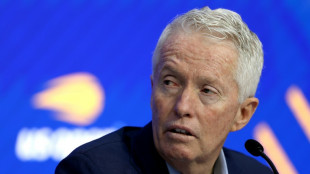
 Munoz saves Iraola in Liverpool draw, big-spending Spurs lose again

 Newcastle condemn dismal Spurs to second successive defeat

 Police appeal for footage after life-threatening Stratford assault

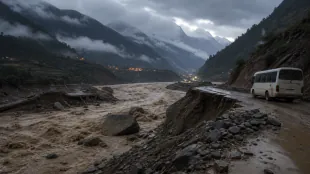
 Family searches for Boston engineer missing after Nepal-Tibet floods

 Dolly Parton’s Imagination Library leaves global children’s reading legacy

 BMC rejects negligence claims in three Rajawadi Hospital maternity cases

 Chembur man held over alleged poisoning of woman’s soft drink

 Andhra Pradesh Speaker seeks stronger sports quota and school facilities
 Kolkata police register new FIR against Mamata Banerjee over rally timing

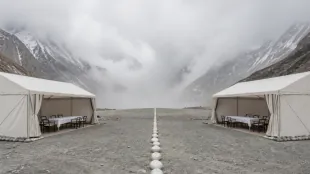 India and China have not named two new border meeting sites

 Tamil Nadu and NUS agree to expand postgraduate and research links

 Tamil Nadu goalball team’s national silver highlights need for wider support

The world needs to set aside an area bigger than the United States for tree planting and other measures to meet climate pledges, according to research published Tuesday that warned against "unrealistic" carbon-cutting plans.
Almost 200 nations will begin high-stakes UN climate talks in Egypt from November 6, as increasing damage from floods, heat waves and droughts are being felt across the world.
Recent UN assessments conclude that current policies and plans are not nearly enough to limit global warming and avoid catastrophic climate impacts.
They may also be unattainable, new research showed Tuesday on the planned use of land-based schemes such as tree planting to offset fossil fuel pollution.
An assessment of plans from 166 countries and the European Union, released by the University of Melbourne, estimated that the total area implied was almost 1.2 billion hectares (2.9 billion acres) -- bigger than the United States, or four times the size of India.
"Servicing all of the land-based carbon removal pledges is unrealistic because it would require a land mass half the size of current global cropland, putting potential pressure on ecosystems, food security and indigenous peoples' rights," the report said.
The research looked at countries' targets, particularly longer-term commitments, and if the land needed was not explicitly stated, they calculated using information about the types of activity as well as carbon removal data from UN climate experts.
They found that while over 550 hectares were earmarked for restoring degraded land and protecting primary forests, some 630 million hectares were estimated for carbon capture schemes, like tree planting.
"Land-based carbon removals have to be considered together with deep cuts in fossil fuel emissions, not as a replacement," said Anne Larson, of the Center for International Forestry Research and World Agroforestry, who was a co-author of the report.
Larson said governments might see tree planting as "easy, compared to other options", but cautioned that these projects can cause their own problems.
If there is no long-term management plan or if the species are not native, the trees can simply wither.
Tree plantations imposed on communities risk being "neglected, burned, cut down", she said.
A.Rodriguezv--AMWN