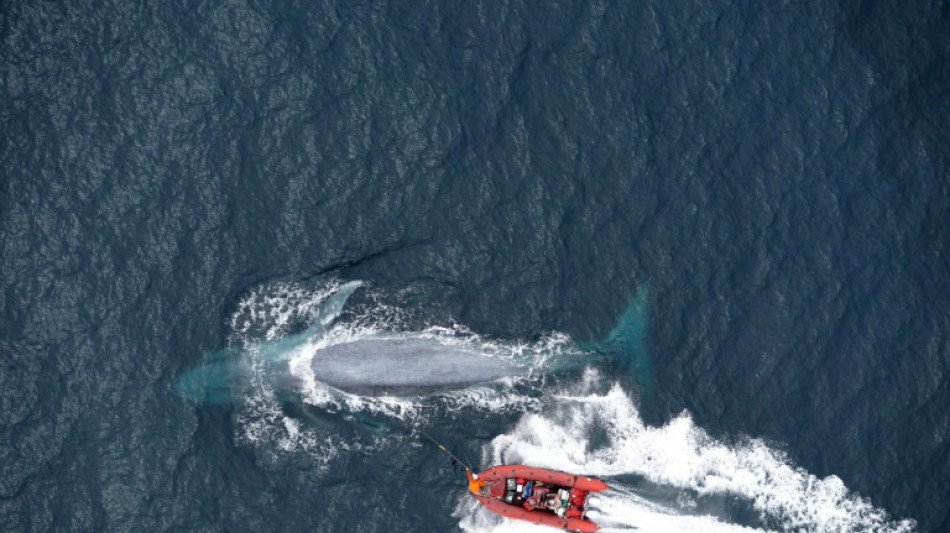
Blue whales eat 10 million pieces of microplastic a day: study / Photo: - - Goldbogen Laboratory/AFP/File
 Vietnamese coffee farmers ride China's durian wave

 Venezuela says retains 'sovereignty' in US oil deal

 NASA's Roman telescope set to launch on cosmic mapping mission

 Data center backlash scrambles US midterm politics

 Emotional Federer inducted into tennis Hall of Fame

 Hovland takes solo lead as McIlroy surges at Tour Championship

 Djokovic 'prepared' for US Open bid for history

 Atletico down Sevilla to go top of La Liga

 US deports right-wing provocateur Milo Yiannopoulos

 Niger junta says it is back in control after soldiers' mutiny

 Erasmus calls Rennie barbs over Springbok scrumming 'nonsense'

 Lawrence's fifty leaves Pakistan facing record chase to level England series
 Netanyahu condemns settler attack in flashpoint West Bank village

 Munoz saves Iraola in Liverpool draw, big-spending Spurs lose again

 Newcastle condemn dismal Spurs to second successive defeat

 Police appeal for footage after life-threatening Stratford assault

 Family searches for Boston engineer missing after Nepal-Tibet floods

 Dolly Parton’s Imagination Library leaves global children’s reading legacy

 BMC rejects negligence claims in three Rajawadi Hospital maternity cases

 Chembur man held over alleged poisoning of woman’s soft drink

 Andhra Pradesh Speaker seeks stronger sports quota and school facilities

 Kolkata police register new FIR against Mamata Banerjee over rally timing

 India and China have not named two new border meeting sites

 Tamil Nadu and NUS agree to expand postgraduate and research links

 Tamil Nadu goalball team’s national silver highlights need for wider support

Blue whales consume up to 10 million pieces of microplastic every day, research estimated Tuesday, suggesting that the omnipresent pollution poses a bigger danger to the world's largest animal than previously thought.
The tiny fragments of plastic have been found everywhere from the deepest oceans to the highest mountains, and even inside human organs and blood.
Now a modelling study published in the journal Nature Communications has estimated how much is being ingested by whales.
A US-led research team put tags on 191 blue, fin and humpback whales that live off the coast of California to observe their movements.
"It's basically like an Apple Watch, just on the back of a whale," said Shirel Kahane-Rapport, a researcher at California State University, Fullerton and the study's first author.
The whales mostly fed at depths of between 50 to 250 metres (165-820 feet), which is home to the "greatest concentration of microplastics in the water column," Kahane-Rapport told AFP.
The researchers then estimated the size and number of mouthfuls the whales had daily and what was filtered out, modelling three different scenarios.
Under the most likely scenario, the blue whales ate up to 10 million microplastic pieces a day.
Over the 90-120 day annual feeding season, that represents more than a billion pieces a year.
The largest animal ever to live on Earth is also likely the biggest microplastic consumer, eating up to 43.6 kilogrammes a day, the study said.
"Imagine carrying around an extra 45 kilogrammes -- yes, you're a very big whale, but that will take up space," Kahane-Rapport said.
Humpback whales were estimated to eat around four million pieces a day.
While it is easy to imagine whales sucking in vast amounts of microplastics as they gulp their way through the ocean, the researchers found that was not the case.
Instead, 99 percent of the microplastics entered the whales because they were already inside their prey.
"That's concerning for us," Kahane-Rapport said, because humans eat that prey.
"We also eat anchovies and sardines," she said, adding that "krill is the basis of the food web".
Previous research has shown that if krill are in a tank with microplastic, "they will eat it," Kahane-Rapport said.
Now that the researchers know how much microplastic is being consumed by whales, next they aim to determine how much harm it could be doing.
"The dose defines the poison," Kahane-Rapport said.
D.Sawyer--AMWN