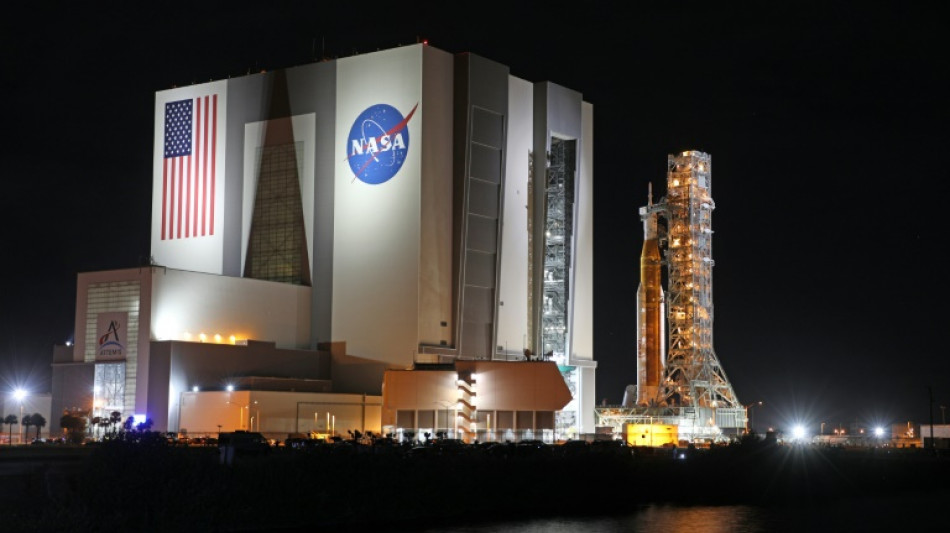
NASA rolls Moon rocket out to Kennedy Space Center launch pad / Photo: Gregg Newton - AFP
 Vietnamese coffee farmers ride China's durian wave

 Venezuela says retains 'sovereignty' in US oil deal

 NASA's Roman telescope set to launch on cosmic mapping mission

 Data center backlash scrambles US midterm politics
 Emotional Federer inducted into tennis Hall of Fame

 Hovland takes solo lead as McIlroy surges at Tour Championship
 Djokovic 'prepared' for US Open bid for history
 Atletico down Sevilla to go top of La Liga

 US deports right-wing provocateur Milo Yiannopoulos

 Niger junta says it is back in control after soldiers' mutiny

 Erasmus calls Rennie barbs over Springbok scrumming 'nonsense'

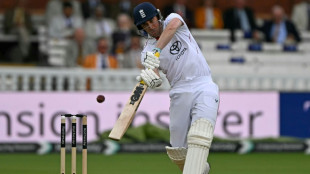 Lawrence's fifty leaves Pakistan facing record chase to level England series
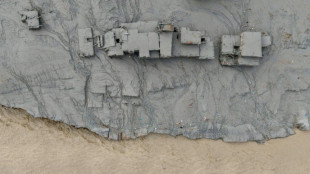
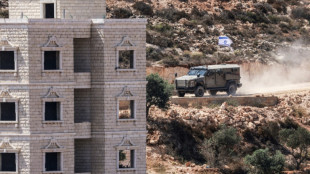 Netanyahu condemns settler attack in flashpoint West Bank village
 Munoz saves Iraola in Liverpool draw, big-spending Spurs lose again

 Newcastle condemn dismal Spurs to second successive defeat

 Police appeal for footage after life-threatening Stratford assault
 Family searches for Boston engineer missing after Nepal-Tibet floods

 Dolly Parton’s Imagination Library leaves global children’s reading legacy

 BMC rejects negligence claims in three Rajawadi Hospital maternity cases

 Chembur man held over alleged poisoning of woman’s soft drink

 Andhra Pradesh Speaker seeks stronger sports quota and school facilities

 Kolkata police register new FIR against Mamata Banerjee over rally timing

 India and China have not named two new border meeting sites

 Tamil Nadu and NUS agree to expand postgraduate and research links

 Tamil Nadu goalball team’s national silver highlights need for wider support
NASA rolled out its largest-ever rocket to a launch pad in Florida on Friday and will try again 10 days from now to blast off on a much-delayed uncrewed mission to the Moon.
After two launch attempts were scrubbed this summer because of technical problems, the rocket returned to the Vehicle Assembly Building to protect it from Hurricane Ian.
The US space agency used the time to carry out minor repairs and to recharge the batteries that power systems on the Space Launch System (SLS) rocket.
The SLS rocket's four-mile (six-kilometer) journey from the Vehicle Assembly Building to the Kennedy Space Center's Launch Pad 39B took nearly nine hours, NASA said.
The 322-foot (98-meter) rocket was rolled out slowly on a giant platform known as the crawler-transporter designed to minimize vibrations.
The next launch attempt is scheduled for 12:07 am Eastern Time (0407 GMT) on November 14 with backup dates on November 16 at 1:04 am and November 19 at 1:45 am.
"We're comfortable launching at night," NASA associate administrator Jim Free said at a briefing on Thursday.
Free said radar and infrared camera imaging will provide the necessary data to track the rocket's performance.
If the rocket blasts off on November 16, the mission would last a little more than 25 days with the crew capsule splashing down in the Pacific Ocean on December 9.
The highly anticipated uncrewed mission, dubbed Artemis 1, will bring the United States a step closer to returning astronauts to the Moon five decades after humans last walked on the lunar surface.
The goal of Artemis 1, named after the twin sister of Apollo, is to test the SLS rocket and Orion crew capsule that sits on top.
Mannequins equipped with sensors are standing in for astronauts on the mission and will record acceleration, vibration and radiation levels.
The Orion capsule is to orbit the Moon to see if the vessel is safe for people in the near future. At some point, Artemis aims to put a woman and a person of color on the Moon for the first time.
And since humans have already visited the Moon, Artemis has its sights set on another lofty goal: a crewed mission to Mars.
During the trip, Orion will follow an elliptical course around the Moon, coming within 60 miles (100 kilometers) at its closest approach and 40,000 miles at its farthest -- the deepest into space ever by a craft designed to carry humans.
Y.Kobayashi--AMWN