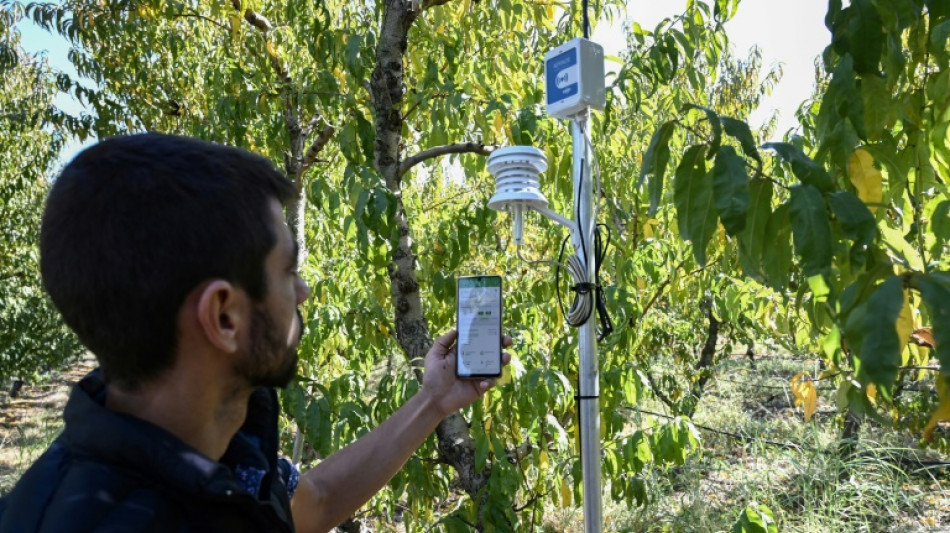
Smart farming tech offers sprout of hope in Greece / Photo: Sakis MITROLIDIS - AFP
 Vietnamese coffee farmers ride China's durian wave
 Venezuela says retains 'sovereignty' in US oil deal

 NASA's Roman telescope set to launch on cosmic mapping mission

 Data center backlash scrambles US midterm politics

 Emotional Federer inducted into tennis Hall of Fame

 Hovland takes solo lead as McIlroy surges at Tour Championship
 Djokovic 'prepared' for US Open bid for history

 Atletico down Sevilla to go top of La Liga

 US deports right-wing provocateur Milo Yiannopoulos

 Niger junta says it is back in control after soldiers' mutiny

 Erasmus calls Rennie barbs over Springbok scrumming 'nonsense'

 Lawrence's fifty leaves Pakistan facing record chase to level England series
 Netanyahu condemns settler attack in flashpoint West Bank village

 Munoz saves Iraola in Liverpool draw, big-spending Spurs lose again

 Newcastle condemn dismal Spurs to second successive defeat

 Police appeal for footage after life-threatening Stratford assault
 Family searches for Boston engineer missing after Nepal-Tibet floods

 Dolly Parton’s Imagination Library leaves global children’s reading legacy

 BMC rejects negligence claims in three Rajawadi Hospital maternity cases

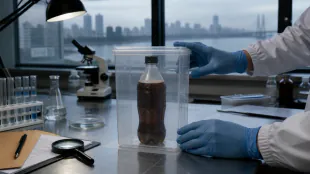 Chembur man held over alleged poisoning of woman’s soft drink
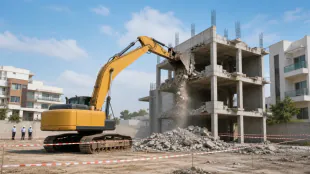
 Andhra Pradesh Speaker seeks stronger sports quota and school facilities

 Kolkata police register new FIR against Mamata Banerjee over rally timing

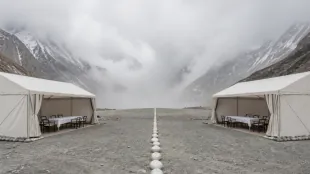 India and China have not named two new border meeting sites

 Tamil Nadu and NUS agree to expand postgraduate and research links

 Tamil Nadu goalball team’s national silver highlights need for wider support

Eyes glued to his mobile phone, farmer Sotiris Mournos pores over the latest microclimate and humidity data about his fields on the plain of Imathia in northern Greece.
The high-tech farming techniques he uses are making slow progress in Greece's tradition-bound and struggling agricultural sector, but growers like him see them as key to their future.
Mournos, 25, employs a Greek smart-farming app to boost production of his family's cotton fields and fruit trees.
Using real-time data recorded by a weather station, he can analyse and correlate the impact of weather conditions on his 10-hectare (nearly 25-acre) cotton plantation.
"We've managed to reduce the use of fertiliser and irrigation... (and thereby to) increase the financial return" of the farm, said Mournos, who gave up studying computer science at university to devote himself to the family holding in the town of Platy.
Measuring the humidity or the nitrogen level in the soil helps to curb the excessive use of fertilisers and saves water, he notes.
As in many other southern European countries, Greece's agricultural sector is chronically short of water and smart farming could help deal with that problem.
- Boosting yields -
The sector has also lost a major share of its available labour in recent decades, as young people snub farm work for better-paid jobs in services such as tourism.
Agriculture now represents just five percent of Greece's GDP, half what it was 20 years ago.
The government has budgeted 230 million euros ($231 million) over the next three years to revive the country's farming industry.
Most of that derives from the European Union's Common Agricultural Policy innovation fund.
"Most young people in my village prefer other jobs and have given up working in the fields," Mournos told AFP.
But he is making a go at farming, aiming to work smart by using the farming app for several years now.
It means he uses 40 percent less fertiliser on his cotton field and can avoid using two pesticide sprays -- altogether saving 9,000 euros (about $9,000) -- without affecting production rates.
Analysts say the farming app is not widely used in Greece although interest is gradually picking up.
But persuading farmers who may be less technologically minded than Mournos to embrace it faces myriad challenges.
A key hurdle is the small size of Greek farms -- less than 10 hectares on average -- and the country's largely mountainous terrain.
Greek farms are often family businesses or involve rented fields, making investment in tools and practices less appealing.
- Convincing farmers -
Meanwhile, an "endemic" lack of cooperation among farmers prevents them sharing costs, says Aikaterini Kasimati, an agricultural engineer at the University of Agronomy in Athens.
As a result, Greece lags far behind other European states in the use of smart farming, says Vassilis Protonotarios, marketing manager of Neuropublic, a company specialising in digital agriculture.
He said farmers could benefit from new technology without having to invest in expensive equipment or have "specialised digital skills".
Then, there is the difficulty of convincing farmers to try something new.
Organic farmer Thodoris Arvanitis says his colleagues are not interested in new technologies because they don't know enough about them and prefer long-used conventional methods.
"Farmers won't go after technology when they don't have enough money for fuel," he added, at his farm in the small town of Kiourka, some 30 kilometres (nearly 20 miles) north of Athens.
Attitudes may change in time as climate change puts additional pressure on farm costs, says Machi Symeonidou, an agronomist and creator of the agricultural IT startup Agroapps.
The war in Ukraine and its impact on global food supplies also shows that it is increasingly necessary to produce food at a local level, said agricultural engineer Kasimati.
"We see a constant degradation of fields and a fall in yield," she said, adding that water was also becoming expensive.
"But as the technology becomes simpler and cheaper, these tools will see more use," she added.
P.Silva--AMWN