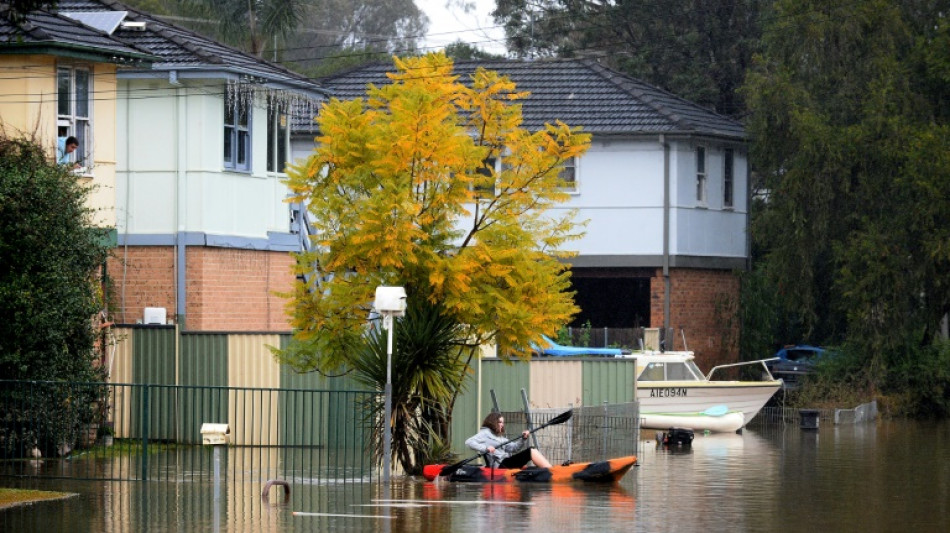
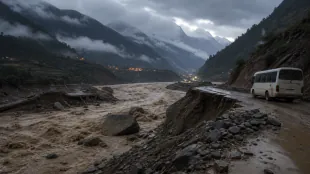
Report lays bare Australia's 'sobering' climate challenge / Photo: Muhammad FAROOQ - AFP
 'No' camp seen winning Iceland's EU referendum

 Nepal flood survivors return to ruins to salvage memories

 Killing of Palestinian children and teens by Israel surges in West Bank

 Educators keep 9/11 memory alive for next generation, 25 years on

 Venezuelans view US oil deal with doubt, hope

 Gobena and Jepchirchir power to Sydney Marathon victories

 Iceland in suspense after close EU vote

 Wallabies hold on for victory in Argentina

 Juve notch second straight win, Fiorentina's centenary party falls flat

 Rybakina eases injury fears ahead of US Open
 Djokovic kicks off latest Grand Slam quest under US Open lights

 'Sorry' De Zerbi won't panic after Spurs shambles

 UN, Nepal warn of climate threat after deadly floods

 USTA boss says structure of new player council not yet set

 Tiny Elversberg stun Leverkusen on Bundesliga debut, Dortmund beat Hamburg

 James Cleverly leaves shadow cabinet to seek London mayoralty

 Baladi Map app turns Lebanon’s local problems into a public record

 Thirty-seven Mumbai pilgrims return after Nepal flood disruption

 Ankle ligament tear ends Neeraj Chopra’s 2026 season

 Chinchpoklicha Chintamani begins 2026 arrival procession in Parel

 Cyberabad civic body demolishes 19 unauthorised structures

 About 50 Karnataka travellers return from Nepal as 24 remain missing

 French campaign sharpens as far right accuses left over civil disobedience calls

 Court orders JIPMER assessment of Durai Dayanidhi before money-laundering trial

 Chennai councillors unite across parties to demand ward development funds

Rising temperatures are fuelling widespread environmental degradation across Australia and supercharging natural disasters, according to a government report released Wednesday in the wake of flash floods on the country's east coast.
The State of the Climate report found global warming was also slowly melting Australia's fragile alpine regions while contributing to ocean acidification and rising sea levels.
Climate researcher Ian Lowe said the report was a "frightening" wake-up call for Australia, which relies heavily on coal and gas exports for economic growth.
"The scale of changes demonstrates that cleaning up our energy use is an urgent priority," Lowe said.
"We also need to reduce our exports of coal and gas."
The report, a joint effort between the government's weather bureau and national science agency, found Australia's climate had warmed by an average of 1.47 degrees Celsius since records began in 1910.
Environment Minister Tanya Plibersek said it was "sobering" reading.
"For our environment, for our communities, this report reinforces the urgent need for climate action," she said.
- 'Record-breaking extremes' -
Australia has in recent years experienced a series of extreme weather events linked to rising global temperatures.
Flash floods swept through parts of inland New South Wales earlier this month, tearing entire homes from their foundations in some country towns.
Tens of thousands of Sydney residents were ordered to evacuate in July when floods swamped the city's fringe.
An east coast flooding disaster in March -- caused by heavy storms in Queensland and New South Wales -- claimed more than 20 lives.
Catastrophic bushfires swept through huge chunks of New South Wales in the "Black Summer" of 2019 and 2020, while the Great Barrier Reef has suffered four separate mass coral bleaching events since 2016.
"These changes are happening at an increased pace," the State of the Climate report found.
"The past decade has seen record-breaking extremes leading to natural disasters that are exacerbated by anthropogenic (human-caused) climate change."
Prime Minister Anthony Albanese last week unveiled a bid to host the 2026 COP summit, seeking to repair Australia's international reputation as a climate change laggard.
Albanese's centre-left government introduced a 2050 net zero emissions target following its election earlier this year but has faced calls domestically to do more.
University of Melbourne climate scientist Andrew King said Australia needed to rapidly cut its carbon emissions.
"The consequences of our continued use of fossil fuels are clear in Australia like elsewhere," he said.
"We must act quickly to decarbonise our economy to limit further damages from worsening extreme events."
Ailie Gallant from the Australia Centre of Excellence for Climate Extremes said the deterioration in the country's climate would "continue without deep and aggressive cuts to carbon emissions".
P.Santos--AMWN