Michael Parkinson: Britain's chatshow king / Photo: JUSTIN TALLIS - AFP
 Dow boosted as markets rotate from tech shares
 Zelensky hails resumption of US advance warning of strikes on Ukraine
 Carrick says only wins can ease doubts over Man Utd future
 Top NBA Draft pick Dybantsa to miss opener with ankle sprain
 Italy sends troops, toughens security laws after Milan clashes
 Alberta separatists vow to fight on, risking turmoil for Canada
 Two men re-arrested for suspected spying for Iran in airbase scare: UK police
 Guatemalan man gets 30 years for truck smuggling deaths of 53 migrants
 'Clayface' gets under the skin of the superhero genre

 Zelensky, US envoys hold Oslo talks as Ukraine claims US missile holdup
 All-rounder Minhas stars as Pakistan crush England in tri-series
 Bavuma hits 179, Rabada strikes as South Africa dominate
 Allrounder Minhas stars as Pakistan crush England in tri-series
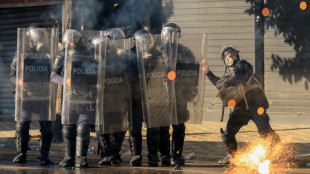 Albania PM blames 'hybrid war' for week of unrest
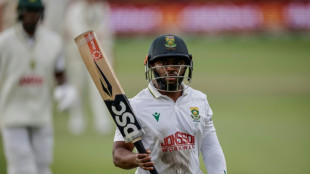 Bavuma hits 179 to lead South African fightback
 Solid GM results overshadowed by latest jump in commodity costs
 Houthi attacks undermine Saudi Arabia's economic ambitions

 French PM vows 'massive' police deployment for new demonstrations
 Power outage hits Google Cloud services, disrupting UK banks
 AI challenges maths by solving the unsolvable
 Turkey troops to stay in Syria, Iraq 'until border security ensured', defence minister tells AFP
 Kulusevski a 'different man' after emotional Spurs return
 Nawaz and Minhas lift Pakistan to 302-9 in England ODI
 Mourinho warns no 'untouchable' stars at Real Madrid
 Indonesian anger builds over wildfires, toxic haze

Michael Parkinson was a regular first port of call for reporters looking for a tribute on the passing of the rich and famous, so much so that he often picked up the phone and asked: "Who's died now?"
But it was a reflection of how many stars -- from Hollywood A-listers to sporting and actual royalty -- had appeared on his eponymous Saturday night chatshow, which first ran from 1971 to 1982.
When he finally bowed out in December 2007 after his show was revived for a second stint, "Parky", as he was often called, reckoned he had interviewed some 2,000 celebrities.
"Sinatra was the one that got away," he recalled. The great Australian cricketer Don Bradman was another.
"Otherwise, I've met everyone I have ever wanted to meet," he added.
Parkinson, whose death aged 88 was announced Thursday, won fans for his laid-back interviewing style that encouraged guests to talk, in stark contrast to some modern chatshow hosts who are often billed as the main attraction.
But it was also the calibre of people he attracted, in an age when big-name celebrities were rarely seen on prime-time television.
His assessment of his abilities was typically modest.
"I'm not bad at what I do," he told The Guardian in 2000, adding that he knew his limitations and the trick was getting the chemistry right between guests.
- Ali and Billy -
Parkinson, the son of a miner, was the quintessential plain-speaking, flat-vowelled, cricket-loving Yorkshireman.
He once opened the batting for his local club side Barnsley with the future Test umpire Dickie Bird, and tried out for Yorkshire with Geoff Boycott, later an England opener and commentator.
From school he became a newspaper journalist, moving into television in the 1960s after stints on the Manchester Guardian and Daily Express.
Highlights on his chatshow included Marlon Brando, David Niven, Richard Burton, and Orson Welles, Alec Guinness, Fred Astaire and even Princess Anne.
He also appeared on the cover of Paul McCartney and Wing's 1973 album "Band on the Run".
But he will be best remembered for his encounters with the heavyweight boxer Muhammad Ali, whom he called "the most remarkable human being I ever encountered".
"I interviewed him four times and lost on points on just about every occasion," he told the Daily Telegraph in 2016.
Parkinson once recalled that only two guests could add millions to the viewing figures -- Ali and the Scottish comedian Billy Connolly, whose early career he championed.
He sometimes secured scoops, such as in March 2006 when prime minister Tony Blair told him that he believed he would be judged by God for the divisive Iraq War.
There were lows, too, notably with the actress Helen Mirren in 1975, whom he introduced as the "sex queen" of the Royal Shakespeare Company and pursued a prurient line of questioning.
Mirren dismissed him later as a "sexist old fart" but Parkinson was largely unrepentant, assessing it was "over the top" and "of its time" yet still "good television".
- Big band and sport -
After TV, Parkinson moved to radio, briefly presenting the BBC's "Desert Island Discs", on which celebrities and others reminisce about their lives before being cast away to an imaginary desert island.
The widow of the man he replaced, however, decided he was "a rough country boy with a terrible accent", he said, and he left.
Other stints followed ranging from sport to music, particularly jazz and big band.
He also kept up his sports writing, and was president of the Sports Journalists Association.
Parkinson, who married his wife Mary in 1959 after meeting her on the top deck of a bus, earned a knighthood in 2008, becoming "Sir Michael" for his services to broadcasting.
But he admitted he was a print journalist at heart.
"I've never had that fear about what would happen if TV didn't come calling," he told The Guardian in 2000.
"That's terribly important. If they said tomorrow 'we never want to see your face on television again', it wouldn't matter a damn.
"I could still make a living and I'd probably write a book about how crazy they all were on TV, all my secrets."
A.Malone--AMWN