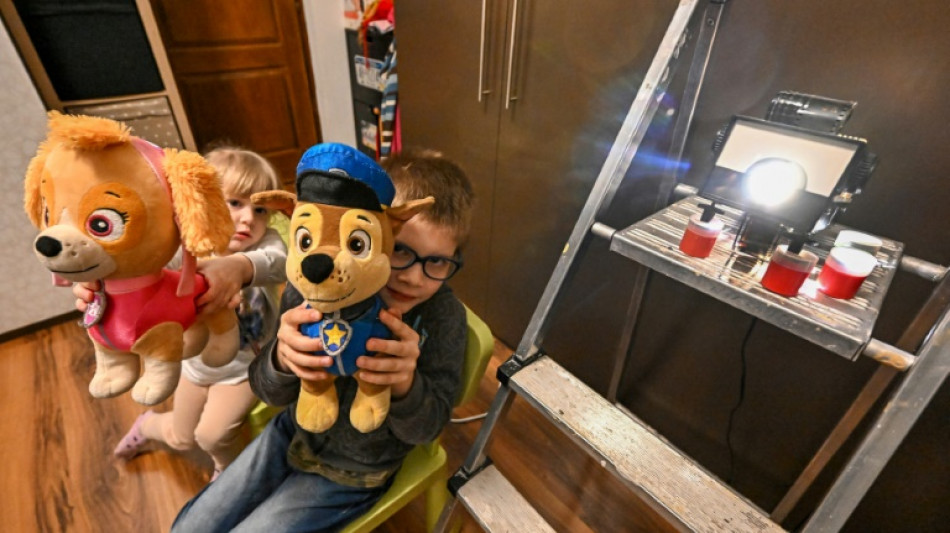
Filmstrip, Hungary's old-school projectors children love / Photo: ATTILA KISBENEDEK - AFP
 Carrefour shares plunge after profit warning on French protests

 North Korea says 'new firepower units' in place after border threat

 Australia lawmaker loses both legs after 'targeted' attack

 Director Nick Paley channels childhood fears in new thriller 'Phony'

 'Daily struggle': Cubans dig wells in search of water
 Prized wild pepper at risk in Madagascar's shrinking forests

 World falling 'dangerously short' on climate action: UN chief

 LeBron, Sixers spoil Knicks party, Thunder top Spurs as NBA season tips off

 Sooryavanshi told to be patient by captain Iyer ahead of NZ series

 Man in court over alleged 'targeted' attack on Australia lawmaker

 As actors get more physical, Bollywood embraces intimacy coordinators

 Brazil's presidential candidates seek to disqualify each other

 French PM to meet unions as government prepares for more protests

 'To the shelter, quickly!' Air raids reshape Kyiv school life

 'Leave us alone!' DC golfers fear worst over Trump's course remodel

 NFL players union wants probe into Hurts' medical care

 Press Release QNX Research Finds Automotive Developers Spend More than a Third of Their Time on Software "Plumbing" Slowing SDV Innovation
 Guardian Metal Resources PLC Announces Strengthening of Senior Management Team

 Man allegedly behind 'targeted' attack on Australian lawmaker due in court

 Netflix shares drop on slowing engagement, revenue growth

 Rodri needed a rest for Barcelona ahead of Clasico, says Flick

 Musk says backs SpaceX-Tesla merger as rocket firm turns profit

 US regulators certify Boeing 737 MAX 10 after delays

 PSG strike late to get better of Yamal and Barcelona in Champions League

 Foden hat-trick fuels Man City rout of AEK Athens

Tablets and mobile phones may have to be prised from the fingers of children elsewhere, but in Hungary storytime can be all about a 100-year-old piece of tech -- filmstrip.
Generations of kids there have been enthralled with stories told with the help of a projector.
Alexandra Csosz-Horvath turns off the lights and reads "Sleeping Beauty" from a series of still captioned images projected onto the bedroom wall -- her three- and seven-year-old clearly under her spell.
"We're together, it's cozier than the cinema yet it's better than a book," said the 44-year-old lawyer.
Filmstrip -- a century-old storytelling medium that was killed off in the West by the video cassette in the 1980s -- is not just hanging on in Hungary, it is thriving with a new wave of enthusiasts charmed by its slower-paced entertainment.
Printed on rolls of film, the still images were never meant to move.
- Long tradition -
"Between the 1940s and the 1980s filmstrips were used worldwide as a cost-effective visualisation tool in education and other fields," Levente Borsos, of Seoul's Hankuk University of Foreign Studies, told AFP.
But while it was surpassed by more advanced technologies in the West, it became a popular form of home entertainment in the Soviet bloc where TVs and videos were harder to come by.
When communism collapsed, filmstrip began to disappear -- except in Hungary, where the since privatised Diafilmgyarto company survives as the country's sole producer.
"Continuous filmstrip publishing and slide shows at home can be considered a Hungarian peculiarity, a special part of the country's cultural heritage," Borsos said.
- Revival -
Producer Diafilmgyarto has seen sales rebound from 60,000 in the 1990s to 230,000 rolls last year.
Each film -- produced solely for the domestic market -- costs around five euros ($5.50), less than a cinema ticket. Most are adaptations of classic fairy tales or children's books.
One bestseller, Hungarian classic "The Old Lady and the Fawn" about a woman taking care of a young deer, has been in the top 10 since its release in 1957, according to Diafilmgyarto's managing director Gabriella Lendvai.
The company also commissions artists, including some famous Hungarians, to create exclusive content for its filmstrips.
It's "an irreplaceable tradition in Hungarian culture", said Beata Hajdu-Toth, who attended a recent filmstrip screening in a Budapest cinema along with her son to celebrate Diafilmgyarto's 70th anniversary.
"I am very happy it's part of our life and hopefully I will be able to narrate to my grandchildren as well," the 37-year-old added.
At her home in the Budapest suburbs, Csosz-Horvath also hails the tradition, preferring it to fast-paced cartoons, which she said drive the children "wild".
"They just can't understand that what happens in three seconds on the screen happens in three hours in real life," she said.
With filmstrips "they don't believe that everything happens in the blink of an eye."
S.Gregor--AMWN