Frozen in time: Colombian town's unexplained mummies
/ Photo: Raul ARBOLEDA - AFP
 Carrefour shares plunge after profit warning on French protests
 North Korea says 'new firepower units' in place after border threat

 Australia lawmaker loses both legs after 'targeted' attack

 Director Nick Paley channels childhood fears in new thriller 'Phony'

 'Daily struggle': Cubans dig wells in search of water
 Prized wild pepper at risk in Madagascar's shrinking forests

 World falling 'dangerously short' on climate action: UN chief

 LeBron, Sixers spoil Knicks party, Thunder top Spurs as NBA season tips off
 Sooryavanshi told to be patient by captain Iyer ahead of NZ series

 Man in court over alleged 'targeted' attack on Australia lawmaker

 As actors get more physical, Bollywood embraces intimacy coordinators
 Brazil's presidential candidates seek to disqualify each other

 French PM to meet unions as government prepares for more protests

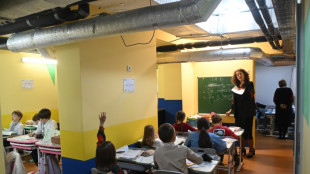 'To the shelter, quickly!' Air raids reshape Kyiv school life
 'Leave us alone!' DC golfers fear worst over Trump's course remodel

 NFL players union wants probe into Hurts' medical care

 Press Release QNX Research Finds Automotive Developers Spend More than a Third of Their Time on Software "Plumbing" Slowing SDV Innovation

 Guardian Metal Resources PLC Announces Strengthening of Senior Management Team

 Man allegedly behind 'targeted' attack on Australian lawmaker due in court

 Netflix shares drop on slowing engagement, revenue growth

 Rodri needed a rest for Barcelona ahead of Clasico, says Flick

 Musk says backs SpaceX-Tesla merger as rocket firm turns profit

 US regulators certify Boeing 737 MAX 10 after delays

 PSG strike late to get better of Yamal and Barcelona in Champions League

 Foden hat-trick fuels Man City rout of AEK Athens

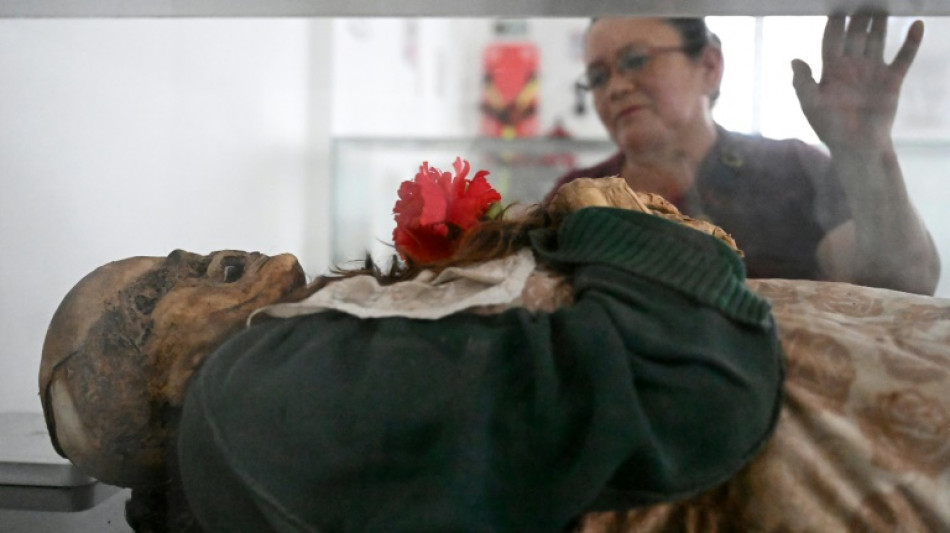
In a small town high in the Colombian Andes, Clovisnerys Bejarano kneels before a glass box holding the petrified corpse of her mother, who died 30 years ago, but looks as if she might just be asleep.
Saturnina Torres de Bejarano is dressed in the same rose-print dress and green woolen jersey she was interred in, clasping a fake red carnation in her eerily well-preserved hands.
"She still has her little brown face, round, her braids, her hair," Bejarano, 63, told AFP at her mother's final resting place in a museum displaying her body and those of 13 others from the town of San Bernardo who became spontaneously, and mysteriously, mummified after death.
"If God wanted to preserve her... it must be for a reason," said Bejarano, a resident of the town some 100 kilometers (62 miles) south of Bogota.
Torres was interred in a vault in the San Bernardo municipal cemetery in 1993.
Exhumed in 2001 -- as is customary to make space for new bodies -- her relatives found her still with hair, nails and much of her tissue unspoilt.
It came as no major surprise. Dozens of mummified bodies have come out of the vaults since the first one in 1963.
"When all this began, people were a little incredulous about what was happening; they thought these were going to be isolated events," said museum guide Rocio Vergara.
"As time went on, it became more and more frequent to find bodies in this condition," she told AFP.
Some even still had their eyes, usually quick to decompose.
In the late 1980s, some 50 mummies were found in the mausoleum every year, but the rate has declined to a handful per year, said Vergara.
- Reward after death? -
Despite numberous attempts by experts to explain the phenomenon -- which has also been observed in countries such as Mexico and Italy -- the reason for the spontaneous mummification in San Bernardo has never been pinned down, said Vergara.
Some locals "believe "that the process (mummification) is due to the fact that the person was too good, and it is a reward after death," said Vergara.
"There are others who consider that... it is a punishment."
Most are convinced it is because of the healthy diet of the residents of temperate San Bernardo, and an active, farming lifestyle.
But this is not always borne out by the evidence: one of the mummies belongs to Jorge Armando Cruz, who spent most of his life in the big city of Bogota, where he died before being brought back to his birthplace for burial.
There is no clear pattern to the mummifications: those who are involved are of all different ages when they died, and no particular gender or body type predominates.
Vergara said there is no particular sector of the cemetery that yields more mummies than others.
- 'Like an oven' -
Many believe the answer must lie in the burial vaults.
The first mummies were found in San Bernardo only after the cemetery, which has no underground graves, was inaugurated.
Prior to the 1960s, the town had two burial grounds with not a single known case of mummification, said Vergara.
The climate in the area is humid, which would ordinarily aid decomposition, not hinder it, she added.
Anthropologist Daniela Betancourt of the National University of Colombia said the phenomenon could be due to the cemetery's placement on a steep mountain slope.
"The wind is constantly blowing as it is hot. It is possible to assume that the vaults work like an oven... they dehydrate you."
This hypothesis still needs to be tested, Betancourt told AFP.
"There has been a lack (of) studies about what is happening and what specific conditions are the ones that cause people to mummify," she said.
Relatives of the mummified corpses must authorize their display in the museum.
Most opt to have the remains cremated instead, but the Bejarano family did not wish that fate for Torres.
"God wanted to leave her to us, and here we have her... Seeing her like that, how could one let her be cremated," asked Bejarano, who regularly brings Torres's great-grandchildren to visit her tomb.
/lv/das/mar/mlr/mdl
H.E.Young--AMWN