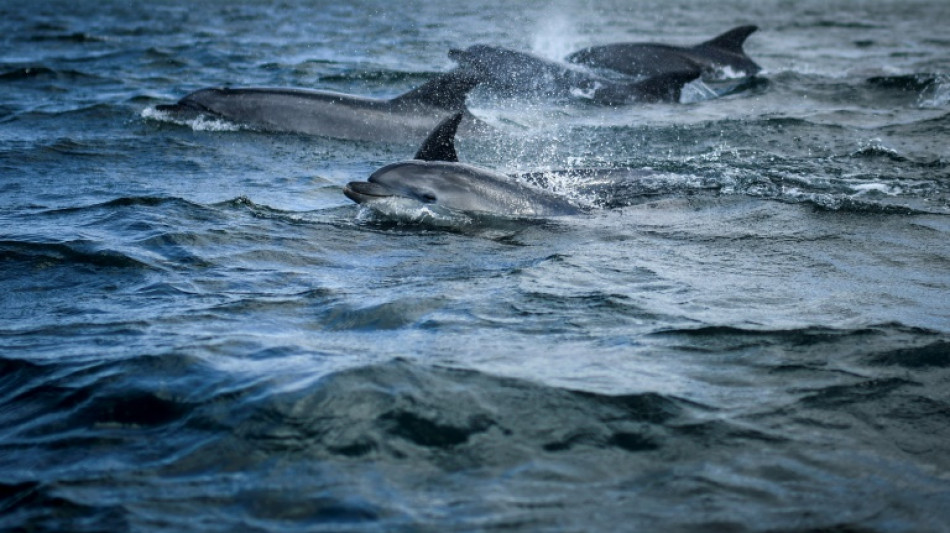
Study predicts mass marine life extinction if warming continues / Photo: PATRICIA DE MELO MOREIRA - AFP/File
 Australia's new Ghost Shark submarines grow some 'teeth'

 'I call it a bribe': Pennsylvania residents spurn $10,000 data center checks

 In a former US steel city, ordinary people struggle to get by

 'Liar,' 'clown': Lula and Bolsonaro spar in Brazil poll debate

 Record El Nino? Depends who's counting

 On the front line of ocean conservation off Portugal's Madeira

 Wembanyama targets title breakthrough as NBA season tips off

 With LeBron on board it's title or bust for Philly fans

 One year after Louvre heist, where are the missing jewels?

 Knicks face tall task in NBA championship repeat bid

 Warriors' Curry 'fine' after limping out of practice - Kerr

 InterContinental Hotels Group PLC Announces Transaction in Own Shares - October 19

 Hemogenyx Pharmaceuticals PLC Announces Feasibility Study Agreement

 Zelensky speaks to US envoys as Trump lashes out

 'Surprise package' Lazio crush Juve to keep pace with Serie A leaders Inter

 China growth expected to miss official target in third quarter

 Lazio crush Juventus to move level with Serie A leaders Inter

 Leeds draw feels like 'fresh start' for Man Utd's Carrick

 Macron denounces 'unbridled' violence as France hit by new clashes

 Hurzeler lauds 'hard worker' Gomez after Brighton goal from halfway line

 Toulouse hold off Exeter, Northampton save English Champions Cup blushes

 Arsenal snatch late win to keep pressure on Man City as Man Utd held

 Arsenal strike late to keep pressure on Man City as Man Utd held

 Four soldiers dead, dozens injured in fire at Canada military base

 Ton-up Agha helps Pakistan down Sri Lanka in tri-series opener

By the year 2300, life in the oceans faces a mass die-off rivaling the great extinctions of Earth's deep past if humanity fails to curb greenhouse gas emissions, a study said Thursday.
But limiting planetary warming to two degrees Celsius above pre-industrial levels will stave off such a catastrophe, said the paper's authors, Justin Penn and Curtis Deutsch, both affiliated with the University of Washington and Princeton University.
The authors used ecophysiological modeling to weigh species' physical limits with projected marine temperatures and depletion of oxygen levels -- a task that was particularly challenging given a lack of previous work in the area.
The results were alarming: under "business as usual" warming, marine ecosystems planetwide could experience a mass extinction comparable to that of the end-Permian extinction, known as the "Great Dying."
This occurred 250 million years ago and led to the demise of more than two-thirds of marine animals, because of warming and oxygen depletion, similar conditions that are occurring today.
While the tropical oceans would lose the most species, many from these areas would migrate to higher latitudes in order to survive.
On the other hand, polar species would disappear en masse, since their types of habitat would disappear from the planet entirely.
Limiting warming to 2C, the upper limit of goal set by the Paris agreement, "would cut the severity of extinctions by >70%, avoiding a marine mass extinction," the paper said.
The preferred goal, of limiting warming to 1.5C, is impossible to achieve with current international commitments, according to UN climate experts.
"Because marine extinctions have not progressed as far as those on land, society has time to turn the tide in favor of ocean life," wrote scientists Malin Pinsky and Alexa Fredston in an accompanying commentary.
"Exactly where the future falls between the best-case and worst-case scenarios will be determined by the choices that society makes not only about climate change, but also about habitat destruction, overfishing, and coastal pollution."
L.Durand--AMWN