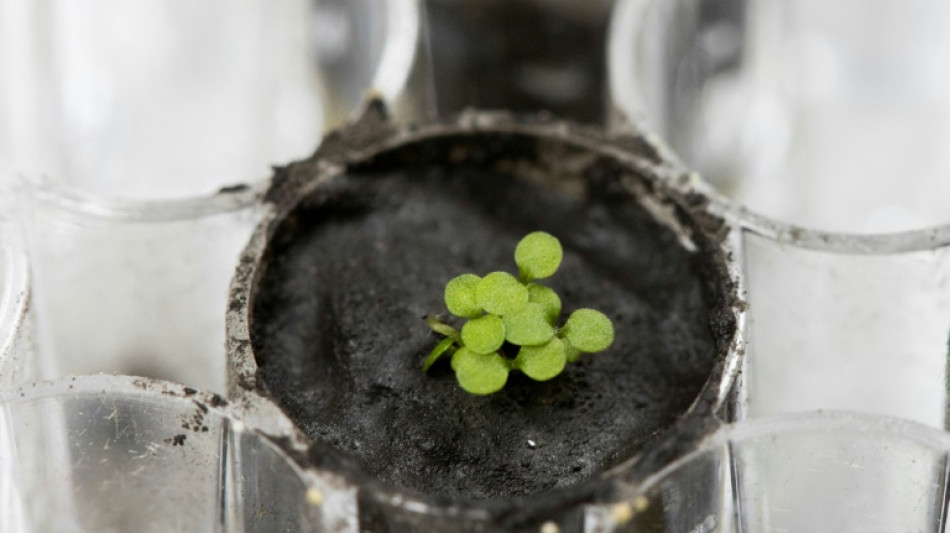
Scientists successfully grow plants in soil from the Moon / Photo: Tyler JONES - UF/IFAS Communications/AFP
 Australia's new Ghost Shark submarines grow some 'teeth'

 'I call it a bribe': Pennsylvania residents spurn $10,000 data center checks

 In a former US steel city, ordinary people struggle to get by

 'Liar,' 'clown': Lula and Bolsonaro spar in Brazil poll debate

 Record El Nino? Depends who's counting

 On the front line of ocean conservation off Portugal's Madeira
 Wembanyama targets title breakthrough as NBA season tips off

 With LeBron on board it's title or bust for Philly fans

 One year after Louvre heist, where are the missing jewels?

 Knicks face tall task in NBA championship repeat bid

 Warriors' Curry 'fine' after limping out of practice - Kerr

 InterContinental Hotels Group PLC Announces Transaction in Own Shares - October 19

 Hemogenyx Pharmaceuticals PLC Announces Feasibility Study Agreement

 Zelensky speaks to US envoys as Trump lashes out

 'Surprise package' Lazio crush Juve to keep pace with Serie A leaders Inter

 China growth expected to miss official target in third quarter

 Lazio crush Juventus to move level with Serie A leaders Inter

 Leeds draw feels like 'fresh start' for Man Utd's Carrick

 Macron denounces 'unbridled' violence as France hit by new clashes

 Hurzeler lauds 'hard worker' Gomez after Brighton goal from halfway line

 Toulouse hold off Exeter, Northampton save English Champions Cup blushes

 Arsenal snatch late win to keep pressure on Man City as Man Utd held

 Arsenal strike late to keep pressure on Man City as Man Utd held

 Four soldiers dead, dozens injured in fire at Canada military base

 Ton-up Agha helps Pakistan down Sri Lanka in tri-series opener

That's one small pot of soil, one giant leap for man's knowledge of space agriculture: scientists have for the first time grown plants in lunar soil brought back by astronauts in the Apollo program.
The ground-breaking experiment, detailed in the journal Communications Biology on Thursday, has given researchers hope that it may be possible to one day grow plants directly on the Moon.
That would save future space missions much hassle and expense, facilitating longer and farther trips.
However, according to the study's University of Florida authors, much remains to be studied on the topic, and they intend to leave no stone unturned.
"This research is critical to NASA's long-term human exploration goals," said Bill Nelson, the head of the US space agency. "We'll need to use resources found on the Moon and Mars to develop food sources for future astronauts living and operating in deep space."
For their experiment, the researchers used just 12 grams (a few teaspoons) of lunar soil collected from various spots on the Moon during the Apollo 11, 12, and 17 missions.
In tiny thimble-sized pots, they placed about a gram of soil (called "regolith") and added water, then the seeds. They also fed the plants a nutrient solution every day.
The researchers chose to plant arabidopsis thaliana, a relative of mustard greens, because it grows easily and, most importantly, has been studied extensively. Its genetic code and responses to hostile environments -- even in space -- are well known.
As a control group, seeds were also planted in soil from Earth as well as samples imitating lunar and Martian soil.
The result: after two days, everything sprouted, including the lunar samples.
"Every plant -- whether in a lunar sample or in a control -- looked the same up until about day six," Anna-Lisa Paul, lead author of the paper, said in a statement.
But after that, differences started to appear: the plants in the lunar samples grew more slowly and had stunted roots.
After 20 days, the scientists harvested all the plants, and ran studies on their DNA.
Their analysis showed that the lunar plants had reacted similarly to those grown in hostile environments, such as soil with too much salt, or heavy metals.
In the future, scientists want to understand how this environment could be made more hospitable.
NASA is preparing to return to the Moon as part of the Artemis program, with a long-term goal of establishing a lasting human presence on its surface.
D.Sawyer--AMWN