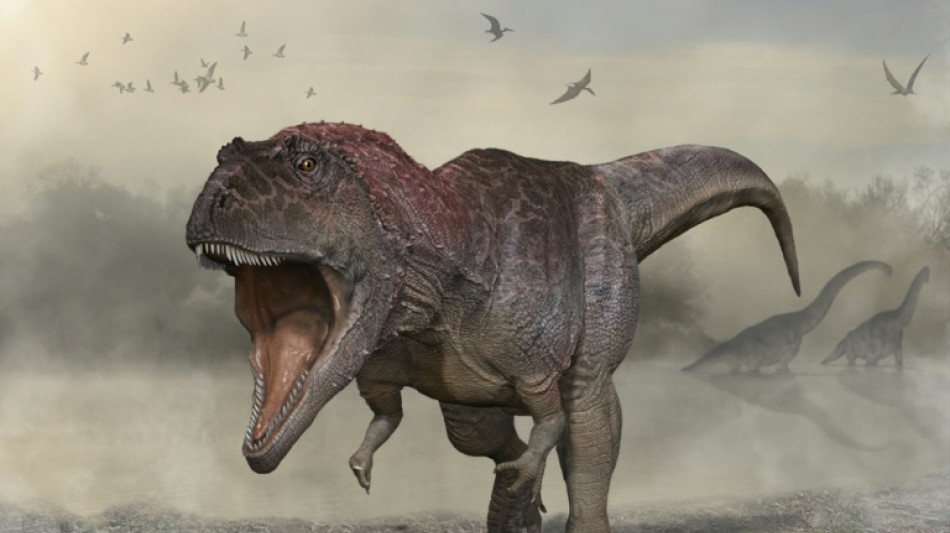
New giant dinosaur predator discovered with tiny arms, like T. rex / Photo: Carlos Papolio - University of Minnesota/AFP
 European stocks retreat as France violence spreads

 North Korea warns 'grave situation' prevailing along border

 Raya proud of Arsenal's 'incredible' reaction after third straight win

 Indonesia fires have burned nearly two million hectares: monitor

 Australian lawmaker 'critically' hurt in attack, officials say

 Indonesia fires burned over 1.9 mn hectares through September: monitor

 Asian tech stocks mixed after Wall St losses, eyes on earnings

 China's third-quarter growth narrowly beats forecasts

 Asian stocks start week on back foot, tracking tech-led Wall St losses

 China growth narrowly beats forecasts

 Faith and fury: Texas Senate rivals offer contrasting visions
 Women await justice for police killings in Brazil
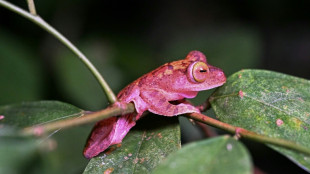 The painstaking task of cataloguing the world's species

 Nations seek reset at UN talks as nature goals off track

 Rubio seeks to strengthen US foothold in Central Asia

 LeBron joins 76ers to chase one more NBA title at age 41

 Rays one win from World Series return after downing Guardians

 Stillwater Critical Minerals Files NI 43-101 Technical Report for the Updated Stillwater West Mineral Resource Estimate in Montana, USA

 HyProMag USA Deploys Mobile Inserma System, Extending Hard Disk Drive Processing to Customer Sites Across the United States

 INEO Announces Preliminary Q1 Fiscal 2027 Revenue of More Than $1.3 Million and Adjusted EBITDA Near Break-Even

 Zedge's DataSeeds.AI and Bria Complete First AI Model Evaluation Engagement

 DEA Denies Federal Marijuana Manufacturing License: Are State Operators Next?

 BioNxt Completes GMP Manufacturing and Submits Clinical Trial Application for Sublingual Cladribine Drug Candidate

 Caledonia Mining Corporation Plc: Notification of Relevant Change To Significant Shareholder

 Kings' Ben Simmons tears Achilles in training

Paleontologists said Thursday they had discovered a new giant carnivorous dinosaur species that had a massive head and tiny arms, just like Tyrannosaurus rex.
The researchers' findings, published in the journal Current Biology, suggest that small forelimbs were no evolutionary accident, but rather gave apex predators of the time certain survival advantages.
Meraxes gigas -- named after a fictional dragon in the Game of Thrones book series -- was dug up over the course of four years during field expeditions in the northern Patagonia region of Argentina, starting with the skull which was found in 2012.
"We won the lottery and found it literally on the first morning," senior author Peter Makovicky from the University of Minnesota told AFP.
The fossilized remains were remarkably well preserved. The skull is just over four feet long (127 centimeters), while the entire animal would have been some 36 feet long, and weighed four metric tons.
Its arms were two feet long, "so it's literally half the length of the skull and the animal would not have been able to reach its mouth," said Makovicky.
T. rex didn't get its tiny arms from M. gigas. The latter went extinct 20 million years before the former arose, and the two species were far apart on the evolutionary tree.
Instead, the authors believe the fact that tyrannosaurids, carcharodontosaurids -- the group Meraxes belonged to -- and a third giant predator species called abelisaurids all evolved tiny arms points to certain benefits.
Makovicky believes that as their heads grew larger, it became the dominant tool of their predatory arsenal, taking on the function that forelimbs would have had in smaller species.
His co-author Juan Canale, the project lead at Ernesto Bachmann Paleontological Museum in Neuquen, Argentina, went further in suggesting other advantages.
- Mating and movement support -
"I'm convinced that those proportionally tiny arms had some sort of function. The skeleton shows large muscle insertions and fully developed pectoral girdles, so the arm had strong muscles," he said in a statement.
"They may have used the arms for reproductive behavior such as holding the female during mating or support themselves to stand back up after a break or a fall."
Meraxes roamed the Earth between 90 to 100 million years ago during the Cretaceous, at a time when the region was wetter, more forested, and much closer to the sea, said Makovicky.
They would have preyed on a menagerie of contemporary sauropods -- some of whom were discovered at the same site.
The individual lived to around 40 years -- a ripe old age for dinosaurs -- and its skull was replete with crests, furrows, bumps and small hornlets.
"It certainly would have looked very imposing and gargoyle like," said Makovicky.
"Those are the kinds of features that in living animals are often under sexual selection," speculating the species used their massive skulls as "billboards" for advertising to would-be mates.
P.Santos--AMWN